QUESTION IMAGE
Question
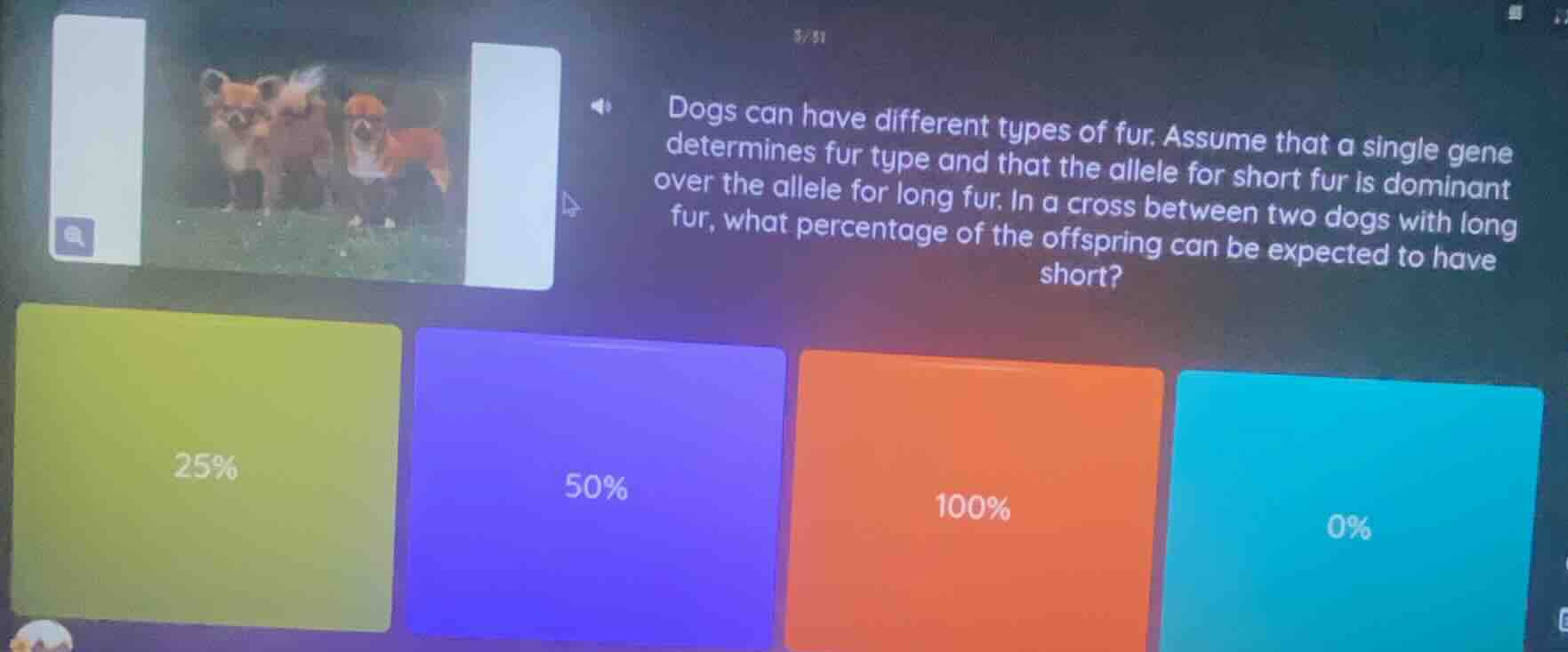
dogs can have different types of fur. assume that a single gene determines fur type and that the allele for short fur is dominant over the allele for long fur. in a cross between two dogs with long fur, what percentage of the offspring can be expected to have short?
Step1: Determine Genotypes of Parents
Long fur is recessive, so dogs with long fur must have the homozygous recessive genotype (let's use \( ff \), where \( f \) is the allele for long fur and \( F \) for short fur). Both parents are long - furred, so their genotypes are \( ff \) and \( ff \).
Step2: Analyze Gamete Production
Each \( ff \) parent can only produce gametes with the \( f \) allele. So, all gametes from both parents are \( f \).
Step3: Determine Offspring Genotypes
When we cross the two parents (\( ff\times ff \)), using a Punnett square (or simple combination of gametes), all offspring will have the genotype \( ff \) (since we are combining \( f \) from the first parent and \( f \) from the second parent).
Step4: Determine Phenotype of Offspring
Since the allele for short fur (\( F \)) is dominant and the offspring have the genotype \( ff \) (homozygous recessive), all offspring will have long fur. So the percentage of offspring with short fur is \( 0\% \).

Snap & solve any problem in the app
Get step-by-step solutions on Sovi AI
Photo-based solutions with guided steps
Explore more problems and detailed explanations
0% (The option corresponding to 0% among the given choices, for example, if the blue - colored option is 0%, then the answer is the option with 0%)