QUESTION IMAGE
Question
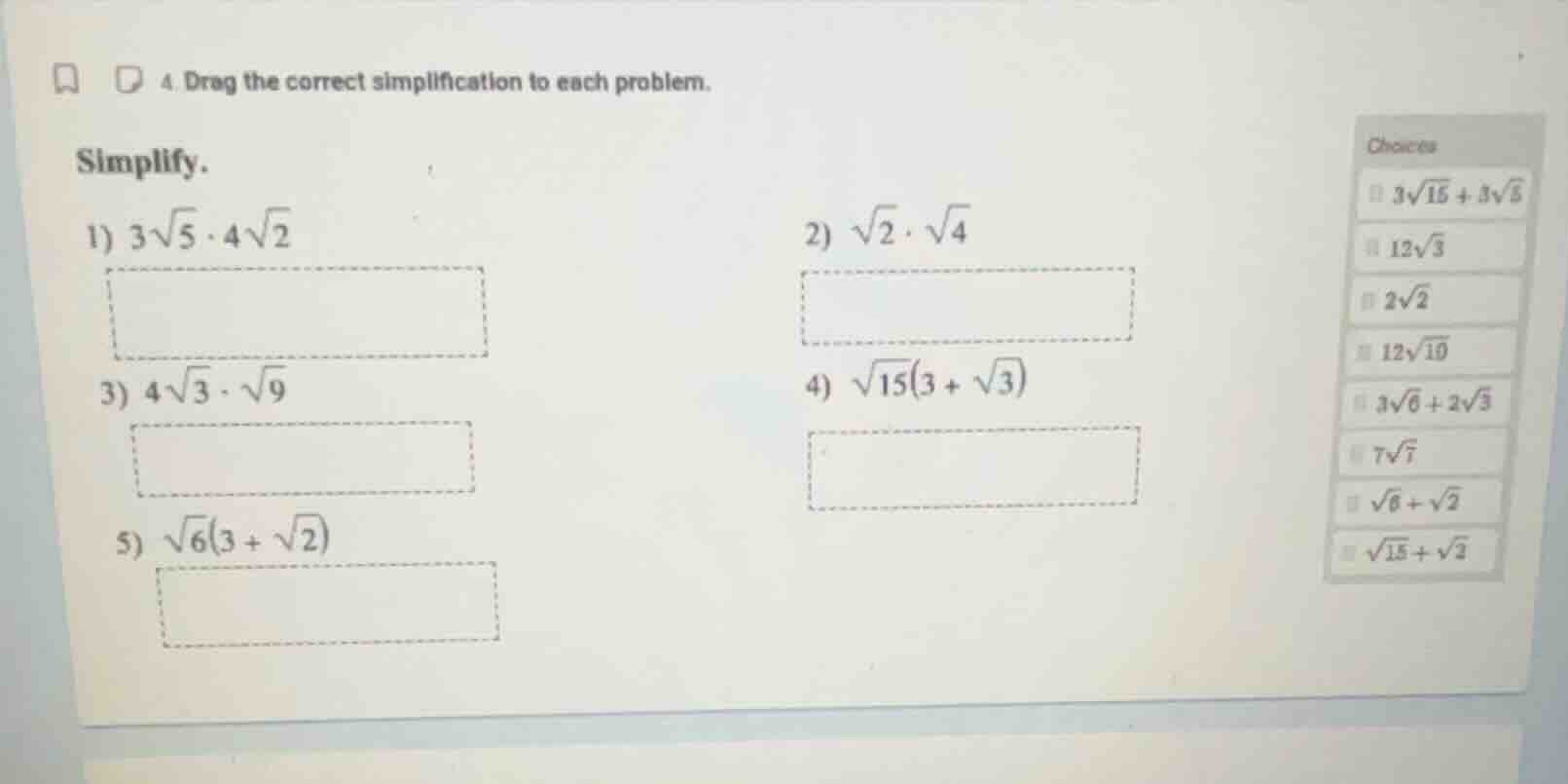
- drag the correct simplification to each problem.
simplify.
- $3\sqrt{5} \cdot 4\sqrt{2}$
- $\sqrt{2} \cdot \sqrt{4}$
- $4\sqrt{3} \cdot \sqrt{9}$
- $\sqrt{15}(3 + \sqrt{3})$
- $\sqrt{6}(3 + \sqrt{2})$
choices
$3\sqrt{15} + 3\sqrt{5}$
$12\sqrt{3}$
$2\sqrt{2}$
$12\sqrt{10}$
$3\sqrt{6} + 2\sqrt{3}$
$7\sqrt{7}$
$\sqrt{6} + \sqrt{2}$
$\sqrt{15} + \sqrt{2}$
Response
Problem 1: \( 3\sqrt{5} \cdot 4\sqrt{2} \)
Step 1: Multiply the coefficients and the radicals separately.
The coefficient part: \( 3 \times 4 = 12 \)
The radical part: \( \sqrt{5} \times \sqrt{2}=\sqrt{5\times2}=\sqrt{10} \)
Step 2: Combine the results.
So \( 3\sqrt{5} \cdot 4\sqrt{2}=12\sqrt{10} \)
Step 1: Simplify \( \sqrt{4} \)
We know that \( \sqrt{4} = 2 \)
Step 2: Multiply with \( \sqrt{2} \)
\( \sqrt{2} \times 2 = 2\sqrt{2} \)
Step 1: Simplify \( \sqrt{9} \)
\( \sqrt{9}=3 \)
Step 2: Multiply the coefficients and the radical.
The coefficient part: \( 4\times3 = 12 \)
The radical part remains \( \sqrt{3} \)
So \( 4\sqrt{3} \cdot \sqrt{9}=12\sqrt{3} \)

Snap & solve any problem in the app
Get step-by-step solutions on Sovi AI
Photo-based solutions with guided steps
Explore more problems and detailed explanations
\( 12\sqrt{10} \)