QUESTION IMAGE
Question
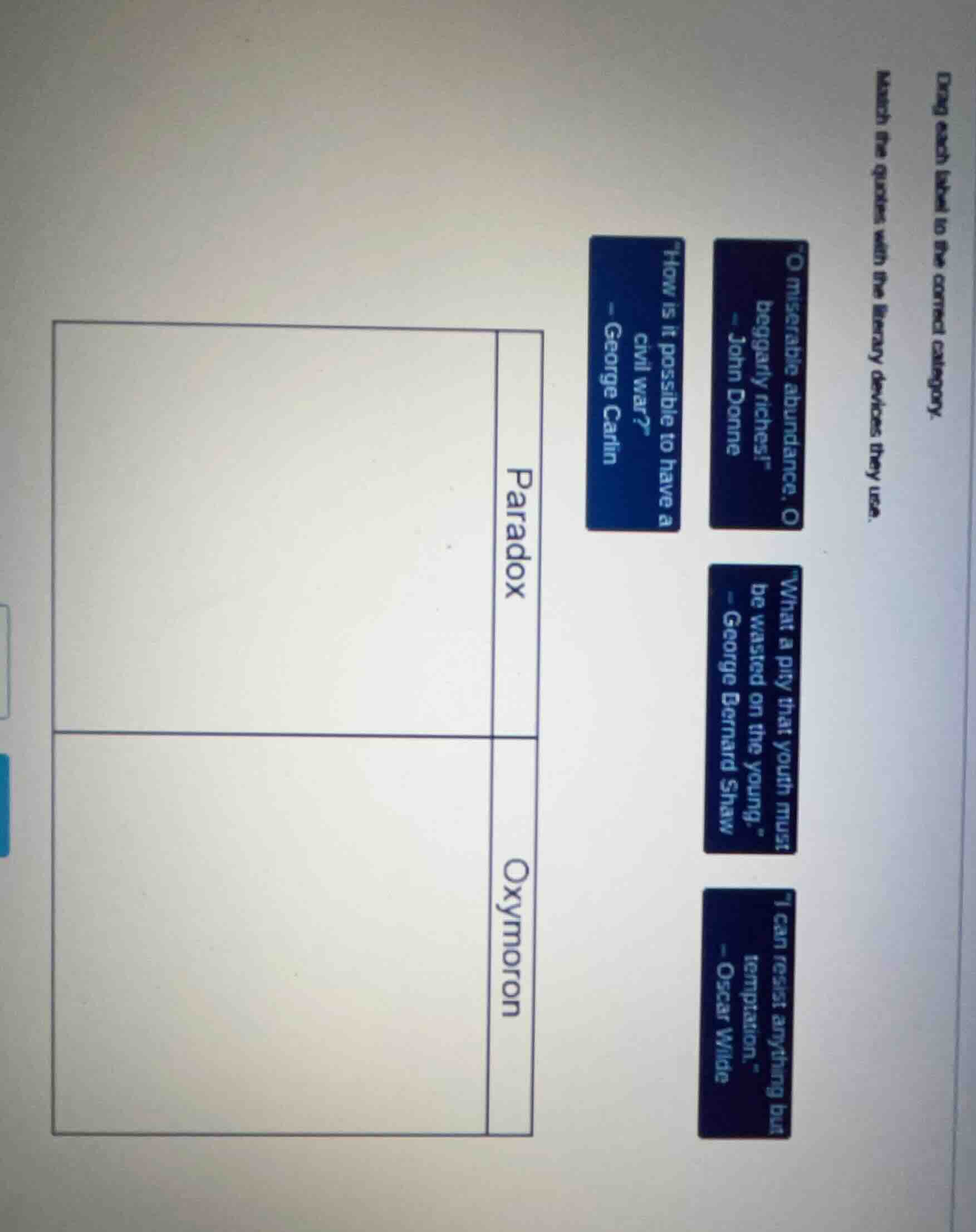
drag each label to the correct category.
match the quotes with the literary devices they use.
paradox
oxymoron
\o miserable abundance, o beggarly riches!\
— john donne
\how is it possible to have a civil war?\
— george carlin
\what a pity that youth must be wasted on the young.\
— george bernard shaw
\i can resist anything but temptation.\
— oscar wilde
To solve this, we first recall the definitions of Paradox (a statement that seems contradictory but has a deeper truth) and Oxymoron (a figure of speech with contradictory terms in a phrase).
Step 1: Analyze each quote
- “O miserable abundance, O beggarly riches!” – John Donne
Contains contradictory terms (miserable + abundance, beggarly + riches) in a phrase → Oxymoron.
- “How is it possible to have a civil war?” – George Carlin
A civil war is inherently contradictory (war implies conflict, “civil” implies unity) → Paradox (asks about the contradiction of a “civil” war).
- “What a pity that youth must be wasted on the young.” – George Bernard Shaw
Contradicts expectations (youth is associated with vitality, but here it’s “wasted” on the young) → Paradox (a seemingly contradictory observation).
- “I can resist anything but temptation.” – Oscar Wilde
Contradicts itself (claiming to resist “anything” but admitting to failing at “temptation”) → Paradox (a self-contradictory statement).
Step 2: Categorize
- Paradox: Quotes that present contradictory ideas/truths:
- “How is it possible to have a civil war?” – George Carlin
- “What a pity that youth must be wasted on the young.” – George Bernard Shaw
- “I can resist anything but temptation.” – Oscar Wilde
- Oxymoron: Quote with contradictory terms in a phrase:
- “O miserable abundance, O beggarly riches!” – John Donne
Final Categorization Table
| Category | Quotes |
|---|---|
| “What a pity that youth must be wasted on the young.” – G.B. Shaw | |
| “I can resist anything but temptation.” – Oscar Wilde | |
| Oxymoron | “O miserable abundance, O beggarly riches!” – John Donne |
(If you need to “drag and drop” the quotes, place the three paradoxical quotes under “Paradox” and the oxymoron quote under “Oxymoron.”)

Snap & solve any problem in the app
Get step-by-step solutions on Sovi AI
Photo-based solutions with guided steps
Explore more problems and detailed explanations
To solve this, we first recall the definitions of Paradox (a statement that seems contradictory but has a deeper truth) and Oxymoron (a figure of speech with contradictory terms in a phrase).
Step 1: Analyze each quote
- “O miserable abundance, O beggarly riches!” – John Donne
Contains contradictory terms (miserable + abundance, beggarly + riches) in a phrase → Oxymoron.
- “How is it possible to have a civil war?” – George Carlin
A civil war is inherently contradictory (war implies conflict, “civil” implies unity) → Paradox (asks about the contradiction of a “civil” war).
- “What a pity that youth must be wasted on the young.” – George Bernard Shaw
Contradicts expectations (youth is associated with vitality, but here it’s “wasted” on the young) → Paradox (a seemingly contradictory observation).
- “I can resist anything but temptation.” – Oscar Wilde
Contradicts itself (claiming to resist “anything” but admitting to failing at “temptation”) → Paradox (a self-contradictory statement).
Step 2: Categorize
- Paradox: Quotes that present contradictory ideas/truths:
- “How is it possible to have a civil war?” – George Carlin
- “What a pity that youth must be wasted on the young.” – George Bernard Shaw
- “I can resist anything but temptation.” – Oscar Wilde
- Oxymoron: Quote with contradictory terms in a phrase:
- “O miserable abundance, O beggarly riches!” – John Donne
Final Categorization Table
| Category | Quotes |
|---|---|
| “What a pity that youth must be wasted on the young.” – G.B. Shaw | |
| “I can resist anything but temptation.” – Oscar Wilde | |
| Oxymoron | “O miserable abundance, O beggarly riches!” – John Donne |
(If you need to “drag and drop” the quotes, place the three paradoxical quotes under “Paradox” and the oxymoron quote under “Oxymoron.”)