QUESTION IMAGE
Question
4
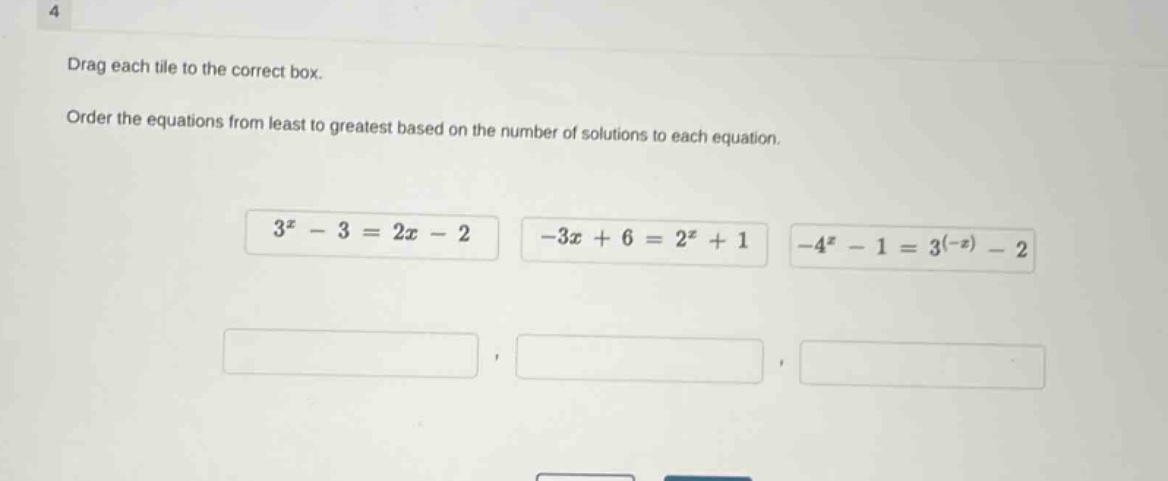
drag each tile to the correct box.
order the equations from least to greatest based on the number of solutions to each equation.
$3^x - 3 = 2x - 2$ $-3x + 6 = 2^x + 1$ $-4^x - 1 = 3^{(-x)} - 2$
Step1: Analyze \( 3^x - 3 = 2x - 2 \)
Rewrite as \( 3^x=2x + 1 \). Let \( f(x)=3^x \) (exponential, increasing) and \( g(x)=2x + 1 \) (linear, slope 2). At \( x = 0 \), \( f(0)=1 \), \( g(0)=1 \) (intersection). At \( x = 1 \), \( f(1)=3 \), \( g(1)=3 \) (another intersection). So two solutions.
Step2: Analyze \( -3x + 6 = 2^x + 1 \)
Rewrite as \( 2^x=-3x + 5 \). Let \( f(x)=2^x \) (exponential, increasing) and \( g(x)=-3x + 5 \) (linear, slope - 3). At \( x = 1 \), \( f(1)=2 \), \( g(1)=2 \) (intersection). At \( x = 2 \), \( f(2)=4 \), \( g(2)=-1 \) (no intersection here). At \( x = 0 \), \( f(0)=1 \), \( g(0)=5 \) (no intersection). So one solution.
Step3: Analyze \( -4^x - 1 = 3^{-x}-2 \)
Rewrite as \( 3^{-x}+4^x = 1 \). Let \( f(x)=4^x+3^{-x} \). \( 4^x>0 \), \( 3^{-x}=\frac{1}{3^x}>0 \), so \( f(x)>0 \). At \( x = 0 \), \( f(0)=1 + 1=2>1 \). As \( x\to+\infty \), \( 4^x\to+\infty \), \( f(x)\to+\infty \). As \( x\to-\infty \), \( 3^{-x}\to+\infty \), \( f(x)\to+\infty \). The function \( f(x) \) is decreasing then increasing? Wait, take derivative (or test values). At \( x = 0 \), \( f(0)=2 \); at \( x = 1 \), \( f(1)=4+\frac{1}{3}\approx4.33>1 \); at \( x=-1 \), \( f(-1)=\frac{1}{4}+3 = 3.25>1 \). Wait, maybe no solution? Wait, no, wait: \( 4^x+3^{-x}=1 \). But \( 4^x\geq0 \), \( 3^{-x}\geq0 \), and \( 4^x = 0 \) only as \( x\to-\infty \), \( 3^{-x}=0 \) as \( x\to+\infty \). But at any real \( x \), \( 4^x+3^{-x}>0 \), and at \( x = 0 \), it's 2. So no solution? Wait, no, maybe I made a mistake. Wait, rewrite the original equation: \( -4^x - 1=3^{-x}-2 \implies 4^x+3^{-x}=1 \). Let \( y = 4^x \), then \( 3^{-x}=\frac{1}{3^x}=\frac{1}{(3^{\log_4 y})}=\frac{1}{y^{\log_4 3}} \) (using \( a^{\log_b c}=c^{\log_b a} \)). But maybe better to test \( x = 0 \): 1 + 1 = 2 ≠ 1. \( x = 1 \): 4 + 1/3 ≈ 4.33 ≠ 1. \( x=-1 \): 1/4 + 3 = 3.25 ≠ 1. So no solution? Wait, but that can't be. Wait, maybe I messed up. Wait, the equation is \( -4^x -1=3^{-x}-2 \implies 3^{-x}+4^x=1 \). Since \( 4^x>0 \) and \( 3^{-x}>0 \), the minimum value of \( 4^x + 3^{-x} \): by AM - GM, \( 4^x+3^{-x}\geq2\sqrt{4^x\cdot3^{-x}}=2\sqrt{(4/3)^x} \). At \( x = 0 \), it's 2, which is greater than 1. So \( 4^x + 3^{-x}>1 \) for all real \( x \), so no solution. Wait, but that would mean zero solutions. Wait, but maybe I made a mistake in step 1. Wait, for \( 3^x=2x + 1 \): at \( x = 0 \), 1 = 1; \( x = 1 \), 3 = 3; \( x = 2 \), 9 vs 5, so two solutions. For \( 2^x=-3x + 5 \): at \( x = 1 \), 2 = 2; \( x = 0 \), 1 vs 5 (no); \( x = 2 \), 4 vs -1 (no), so one solution. For \( 4^x+3^{-x}=1 \): as above, no solution (zero solutions). Wait, but the problem says "number of solutions". So order from least (zero) to greatest (two). Wait, but maybe I made a mistake in the third equation. Let's re - check:
Original equation: \( -4^x - 1=3^{-x}-2 \)
Add 2 to both sides: \( -4^x + 1=3^{-x} \)
Add \( 4^x \) to both sides: \( 1 = 4^x+3^{-x} \)
Yes, \( 4^x>0 \), \( 3^{-x}>0 \), and \( 4^x + 3^{-x}\geq2\sqrt{4^x\cdot3^{-x}} \) by AM - GM. \( 4^x\cdot3^{-x}=(4/3)^x \). At \( x = 0 \), \( 4^x\cdot3^{-x}=1 \), so \( 2\sqrt{1}=2 \). So \( 4^x + 3^{-x}\geq2>1 \) for all real \( x \). So no solutions (0 solutions).
So the number of solutions:
- \( -3x + 6 = 2^x + 1 \): 1 solution
- \( 3^x - 3 = 2x - 2 \): 2 solutions
- \( -4^x - 1 = 3^{(-x)} - 2 \): 0 solutions
Wait, no, wait: when we analyze \( 3^x=2x + 1 \), at \( x = 0 \), 1 = 1; \( x = 1 \), 3 = 3; what about \( x=-1 \): \( 3^{-1}=\frac{1}{3} \), \( 2(-1)+1=-1 \), \( \frac{1}{3}>-1 \). So the function \( f(x)=3^x \)…

Snap & solve any problem in the app
Get step-by-step solutions on Sovi AI
Photo-based solutions with guided steps
Explore more problems and detailed explanations
\( -4^x - 1 = 3^{(-x)} - 2 \), \( -3x + 6 = 2^x + 1 \), \( 3^x - 3 = 2x - 2 \)