QUESTION IMAGE
Question
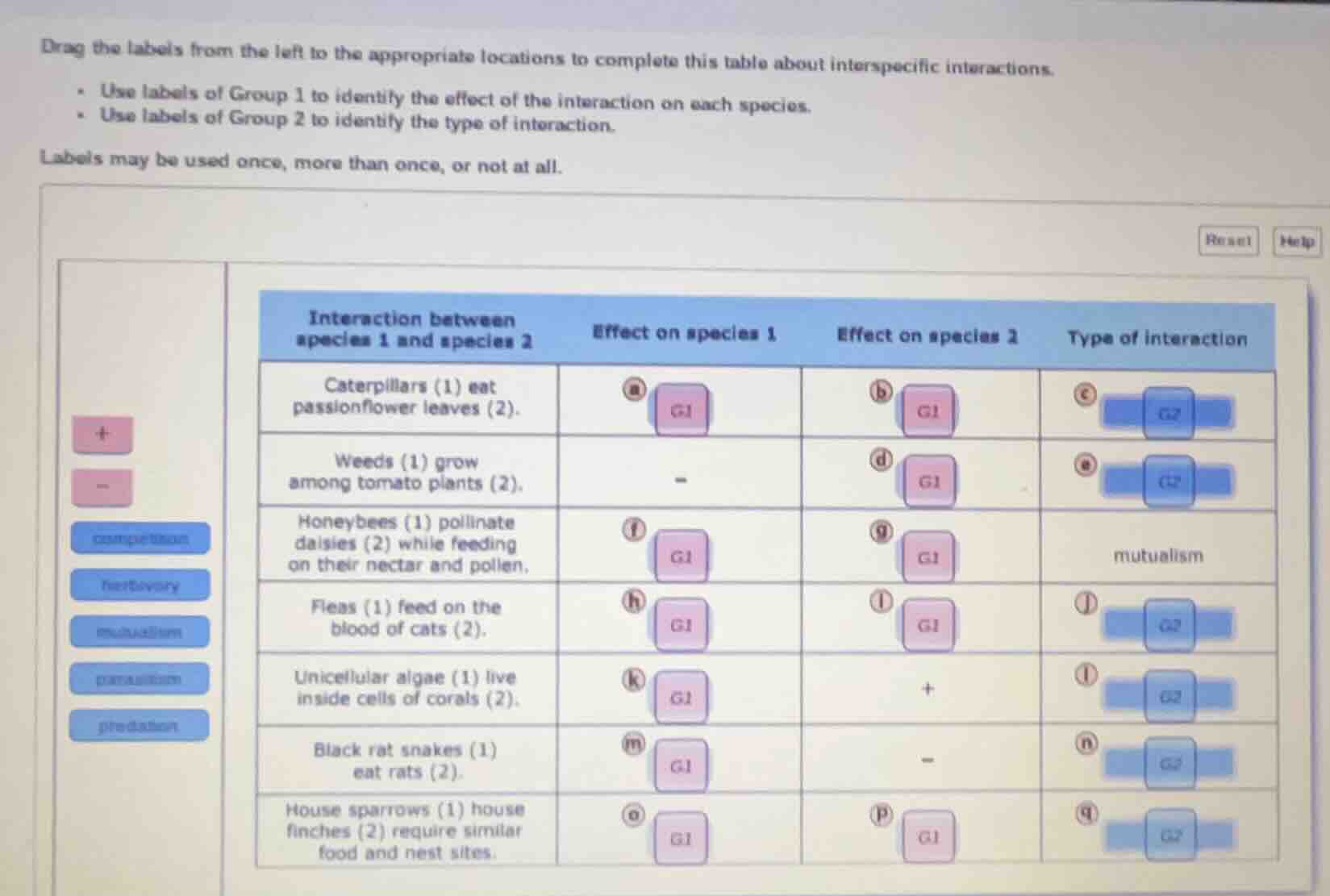
drag the labels from the left to the appropriate locations to complete this table about interspecific interactions.
- use labels of group 1 to identify the effect of the interaction on each species.
- use labels of group 2 to identify the type of interaction.
labels may be used once, more than once, or not at all.
(table content:
interaction between species 1 and species 2 | effect on species 1 | effect on species 2 | type of interaction
caterpillars (1) eat passionflower leaves (2). | a (g1) | b (g1) | c (g2)
weeds (1) grow among tomato plants (2). | - | d (g1) | e (g2)
honeybees (1) pollinate daisies (2) while feeding on their nectar and pollen. | f (g1) | g (g1) | mutualism
fleas (1) feed on the blood of cats (2). | h (g1) | i (g1) | j (g2)
unicellular algae (1) live inside cells of corals (2). | k (g1) | + | l (g2)
black rat snakes (1) eat rats (2). | m (g1) | - | n (g2)
house sparrows (1) house finches (2) require similar food and nest sites. | o (g1) | p (g1) | q (g2)
left labels: +, -, competition, herbivory, mutualism, parasitism, predation)
Step1: Define interaction effects/types
Group 1: $+$ = positive effect, $-$ = negative effect
Group 2: herbivory, competition, mutualism, parasitism, predation
Step2: Analyze caterpillar-plant interaction
Caterpillars gain food (+), plant loses tissue (-); interaction is herbivory.
Effect on 1: $+$, Effect on 2: $-$, Type: herbivory
Step3: Analyze weed-tomato interaction
Weeds compete for resources (+), tomato is outcompeted (-); interaction is competition.
Effect on 2: $-$, Type: competition
Step4: Analyze honeybee-daisy interaction
Mutualism means both benefit.
Effect on 1: $+$, Effect on 2: $+$
Step5: Analyze flea-cat interaction
Fleas gain nutrients (+), cat loses blood/harmed (-); interaction is parasitism.
Effect on 1: $+$, Effect on 2: $-$, Type: parasitism
Step6: Analyze algae-coral interaction
Coral benefits (+), so algae also benefits (+); interaction is mutualism.
Effect on 1: $+$, Type: mutualism
Step7: Analyze snake-rat interaction
Snake gains food (+), rat is killed (-); interaction is predation.
Effect on 1: $+$, Type: predation
Step8: Analyze sparrow-finch interaction
Both compete for shared resources, so both are harmed (-); interaction is competition.
Effect on 1: $-$, Effect on 2: $-$, Type: competition

Snap & solve any problem in the app
Get step-by-step solutions on Sovi AI
Photo-based solutions with guided steps
Explore more problems and detailed explanations
| Interaction between species 1 and species 2 | Effect on species 1 | Effect on species 2 | Type of interaction |
|---|---|---|---|
| Weeds (1) grow among tomato plants (2). | $-$ | $-$ | competition |
| Honeybees (1) pollinate daisies (2) while feeding on their nectar and pollen. | $+$ | $+$ | mutualism |
| Fleas (1) feed on the blood of cats (2). | $+$ | $-$ | parasitism |
| Unicellular algae (1) live inside cells of corals (2). | $+$ | $+$ | mutualism |
| Black rat snakes (1) eat rats (2). | $+$ | $-$ | predation |
| House sparrows (1) house finches (2) require similar food and nest sites. | $-$ | $-$ | competition |