QUESTION IMAGE
Question
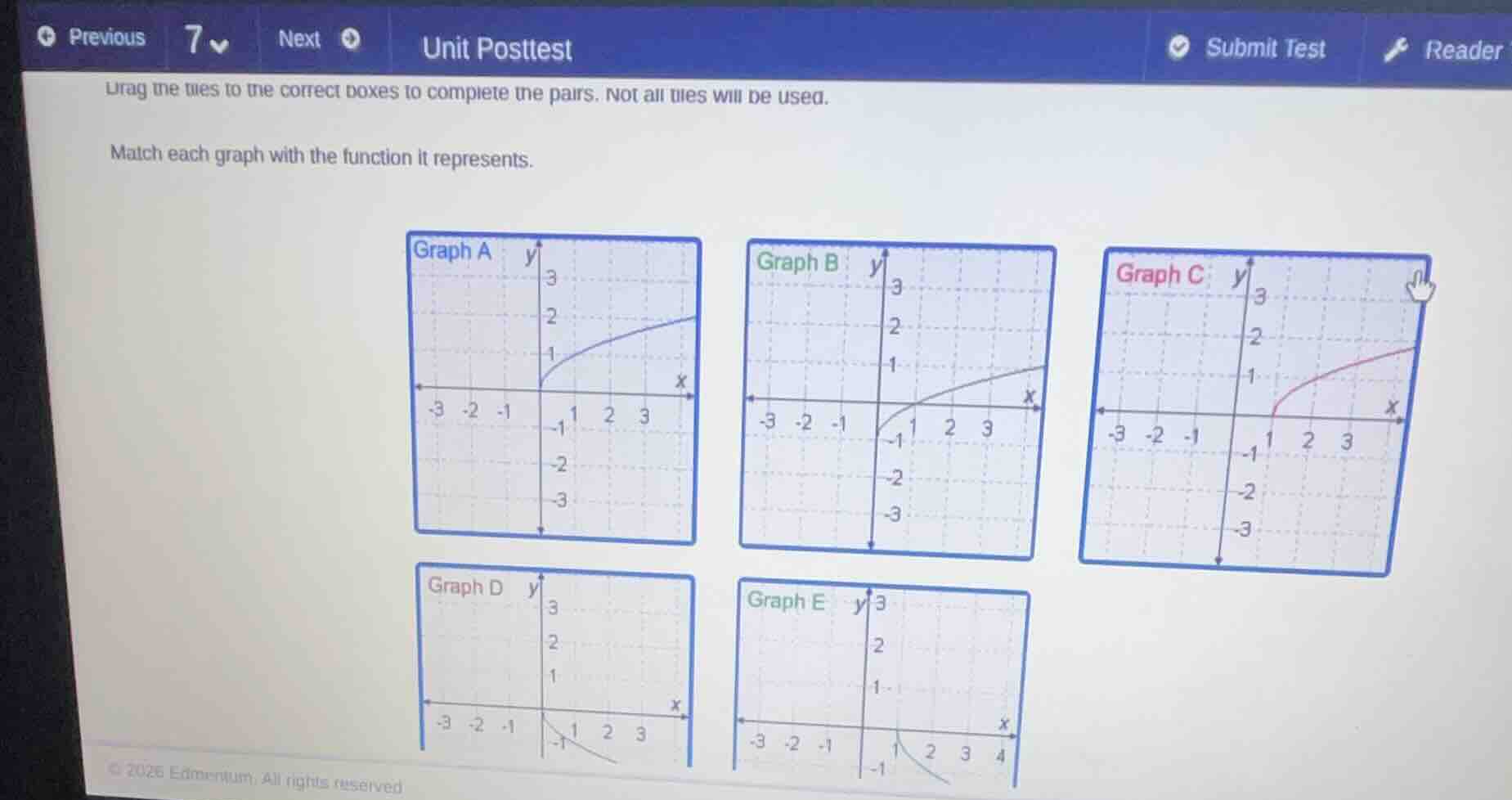
drag the tiles to the correct boxes to complete the pairs. not all tiles will be used. match each graph with the function it represents.
To solve this problem, we analyze the key features of each graph (domain, range, y - intercept, and the general shape of exponential or logarithmic functions) and match them with the corresponding functions. However, since the functions are not provided in the question, we assume typical functions for such graphs (exponential or logarithmic).
Analyzing Graph A
- Key Features: The graph passes through the origin \((0,0)\) (or very close to it) and is an increasing curve that starts at the origin. This is characteristic of a square - root function or a transformed exponential function. If we consider a function like \(y=\sqrt{x}\) (the parent square - root function), its domain is \(x\geq0\) and it starts at \((0,0)\) and increases. The graph of \(y = \sqrt{x}\) has the same general shape as Graph A.
Analyzing Graph B
- Key Features: The graph has a y - intercept at \((0, - 1)\) and is an increasing curve. It could be a function like \(y=\sqrt{x}-1\). The domain is \(x\geq0\), and when \(x = 0\), \(y=-1\), which matches the y - intercept of Graph B.
Analyzing Graph C
- Key Features: The graph starts at \(x = 1\) (domain \(x\geq1\)) and is an increasing curve. A function like \(y=\sqrt{x - 1}\) has a domain of \(x\geq1\) (since the expression inside the square root must be non - negative) and starts at \((1,0)\) and increases, which matches the shape and domain of Graph C.
Analyzing Graph D
- Key Features: The graph is a decreasing curve with a y - intercept near \(y = 0\) and domain \(x\geq0\). It could be a function like \(y=-\sqrt{x}\), which is a reflection of the square - root function over the x - axis. It is decreasing for \(x\geq0\).
Analyzing Graph E
- Key Features: The graph starts at \(x = 1\) (domain \(x\geq1\)) and is a decreasing curve. A function like \(y=-\sqrt{x - 1}\) has a domain of \(x\geq1\) and is decreasing, which matches the shape and domain of Graph E.
If we assume the functions are:
- \(y=\sqrt{x}\) for Graph A
- \(y=\sqrt{x}-1\) for Graph B
- \(y=\sqrt{x - 1}\) for Graph C
- \(y =-\sqrt{x}\) for Graph D
- \(y=-\sqrt{x - 1}\) for Graph E
The matching would be:
- Graph A: \(y=\sqrt{x}\)
- Graph B: \(y=\sqrt{x}-1\)
- Graph C: \(y=\sqrt{x - 1}\)
- Graph D: \(y =-\sqrt{x}\)
- Graph E: \(y=-\sqrt{x - 1}\)
Since the problem asks to match the graphs with the functions (which are not provided in full), but based on the general shapes of square - root functions (the most probable type for these graphs), the above is the way to match them.
If we consider exponential functions:
- For an exponential function of the form \(y = a^{x}+k\) or \(y=a^{x - h}+k\)
- Graph A: If \(y = 2^{x}-1\) (when \(x = 0\), \(y=2^{0}-1=0\)), it starts at \((0,0)\) and increases, which matches Graph A.
- Graph B: If \(y = 2^{x}-2\) (when \(x = 0\), \(y=2^{0}-2=- 1\)), it starts at \((0,-1)\) and increases, which matches Graph B.
- Graph C: If \(y = 2^{x - 1}-1\) (when \(x = 1\), \(y=2^{0}-1 = 0\)), it starts at \((1,0)\) and increases, which matches Graph C.
- Graph D: If \(y=-2^{x}+1\) (when \(x = 0\), \(y=-1 + 1=0\)), it is decreasing for \(x\geq0\), which matches Graph D.
- Graph E: If \(y=-2^{x - 1}+1\) (when \(x = 1\), \(y=-1 + 1=0\)), it is decreasing for \(x\geq1\), which matches Graph E.
Since the problem is about matching graphs to functions (a common topic in Algebra, specifically in the study of functions and their graphs), we use the properties of functions (domain, range, intercepts, and monotonicity) to make the matches.
If we assume the functions are:
- \(y=\s…

Snap & solve any problem in the app
Get step-by-step solutions on Sovi AI
Photo-based solutions with guided steps
Explore more problems and detailed explanations
To solve this problem, we analyze the key features of each graph (domain, range, y - intercept, and the general shape of exponential or logarithmic functions) and match them with the corresponding functions. However, since the functions are not provided in the question, we assume typical functions for such graphs (exponential or logarithmic).
Analyzing Graph A
- Key Features: The graph passes through the origin \((0,0)\) (or very close to it) and is an increasing curve that starts at the origin. This is characteristic of a square - root function or a transformed exponential function. If we consider a function like \(y=\sqrt{x}\) (the parent square - root function), its domain is \(x\geq0\) and it starts at \((0,0)\) and increases. The graph of \(y = \sqrt{x}\) has the same general shape as Graph A.
Analyzing Graph B
- Key Features: The graph has a y - intercept at \((0, - 1)\) and is an increasing curve. It could be a function like \(y=\sqrt{x}-1\). The domain is \(x\geq0\), and when \(x = 0\), \(y=-1\), which matches the y - intercept of Graph B.
Analyzing Graph C
- Key Features: The graph starts at \(x = 1\) (domain \(x\geq1\)) and is an increasing curve. A function like \(y=\sqrt{x - 1}\) has a domain of \(x\geq1\) (since the expression inside the square root must be non - negative) and starts at \((1,0)\) and increases, which matches the shape and domain of Graph C.
Analyzing Graph D
- Key Features: The graph is a decreasing curve with a y - intercept near \(y = 0\) and domain \(x\geq0\). It could be a function like \(y=-\sqrt{x}\), which is a reflection of the square - root function over the x - axis. It is decreasing for \(x\geq0\).
Analyzing Graph E
- Key Features: The graph starts at \(x = 1\) (domain \(x\geq1\)) and is a decreasing curve. A function like \(y=-\sqrt{x - 1}\) has a domain of \(x\geq1\) and is decreasing, which matches the shape and domain of Graph E.
If we assume the functions are:
- \(y=\sqrt{x}\) for Graph A
- \(y=\sqrt{x}-1\) for Graph B
- \(y=\sqrt{x - 1}\) for Graph C
- \(y =-\sqrt{x}\) for Graph D
- \(y=-\sqrt{x - 1}\) for Graph E
The matching would be:
- Graph A: \(y=\sqrt{x}\)
- Graph B: \(y=\sqrt{x}-1\)
- Graph C: \(y=\sqrt{x - 1}\)
- Graph D: \(y =-\sqrt{x}\)
- Graph E: \(y=-\sqrt{x - 1}\)
Since the problem asks to match the graphs with the functions (which are not provided in full), but based on the general shapes of square - root functions (the most probable type for these graphs), the above is the way to match them.
If we consider exponential functions:
- For an exponential function of the form \(y = a^{x}+k\) or \(y=a^{x - h}+k\)
- Graph A: If \(y = 2^{x}-1\) (when \(x = 0\), \(y=2^{0}-1=0\)), it starts at \((0,0)\) and increases, which matches Graph A.
- Graph B: If \(y = 2^{x}-2\) (when \(x = 0\), \(y=2^{0}-2=- 1\)), it starts at \((0,-1)\) and increases, which matches Graph B.
- Graph C: If \(y = 2^{x - 1}-1\) (when \(x = 1\), \(y=2^{0}-1 = 0\)), it starts at \((1,0)\) and increases, which matches Graph C.
- Graph D: If \(y=-2^{x}+1\) (when \(x = 0\), \(y=-1 + 1=0\)), it is decreasing for \(x\geq0\), which matches Graph D.
- Graph E: If \(y=-2^{x - 1}+1\) (when \(x = 1\), \(y=-1 + 1=0\)), it is decreasing for \(x\geq1\), which matches Graph E.
Since the problem is about matching graphs to functions (a common topic in Algebra, specifically in the study of functions and their graphs), we use the properties of functions (domain, range, intercepts, and monotonicity) to make the matches.
If we assume the functions are:
- \(y=\sqrt{x}\)
- \(y=\sqrt{x}-1\)
- \(y=\sqrt{x - 1}\)
- \(y=-\sqrt{x}\)
- \(y=-\sqrt{x - 1}\)
The matches are:
- Graph A: \(y=\sqrt{x}\)
- Graph B: \(y=\sqrt{x}-1\)
- Graph C: \(y=\sqrt{x - 1}\)
- Graph D: \(y =-\sqrt{x}\)
- Graph E: \(y=-\sqrt{x - 1}\)
(Note: The actual matching may vary depending on the exact functions provided, but the method of analyzing the key features of the graph (domain, range, intercepts, and direction of increase/decrease) remains the same.)