QUESTION IMAGE
Question
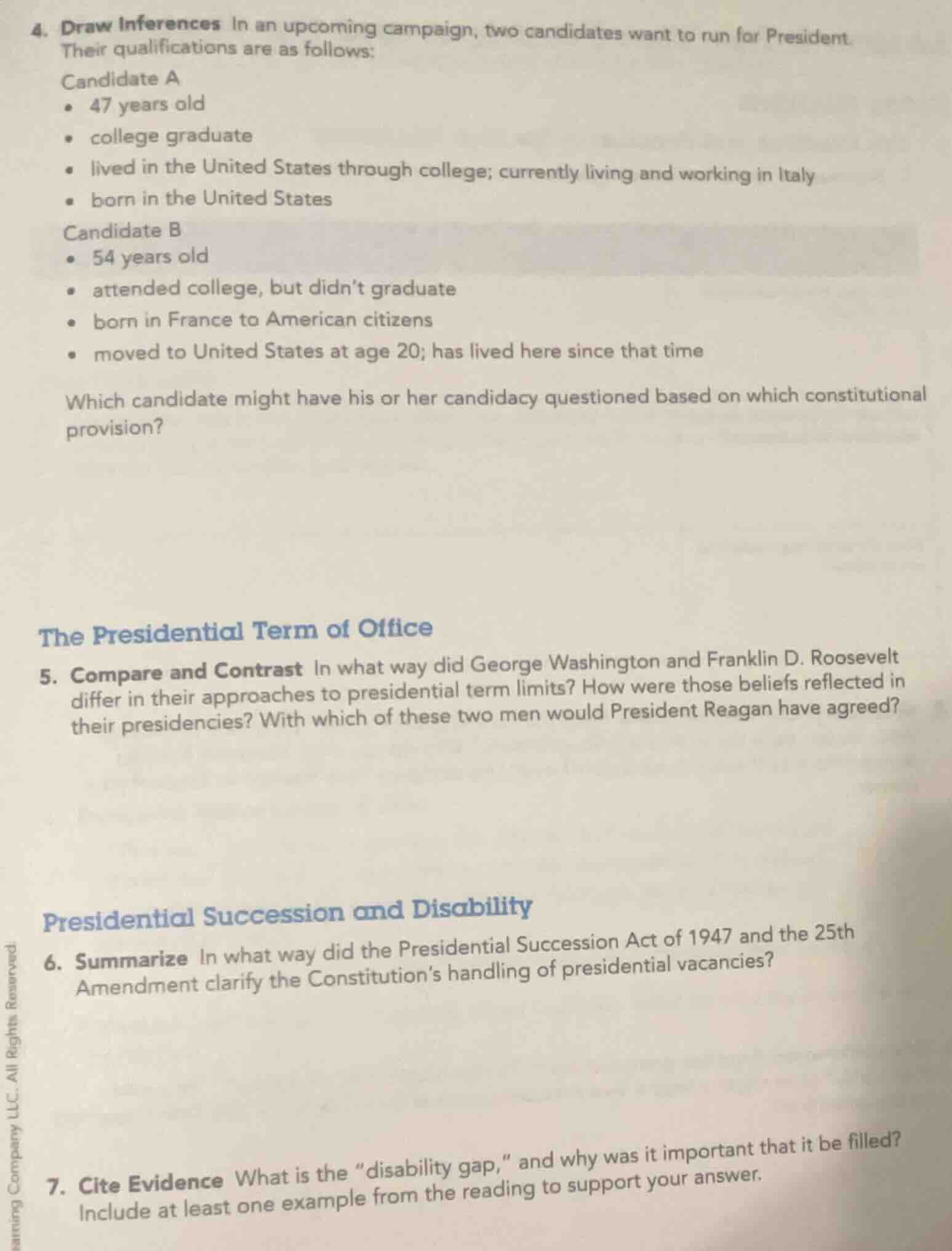
- draw inferences in an upcoming campaign, two candidates want to run for president. their qualifications are as follows:candidate a• 47 years old• college graduate• lived in the united states through college; currently living and working in italy• born in the united statescandidate b• 54 years old• attended college, but didnt graduate• born in france to american citizens• moved to united states at age 20; has lived here since that timewhich candidate might have his or her candidacy questioned based on which constitutional provision?the presidential term of office5. compare and contrast in what way did george washington and franklin d. roosevelt differ in their approaches to presidential term limits? how were those beliefs reflected in their presidencies? with which of these two men would president reagan have agreed?presidential succession and disability6. summarize in what way did the presidential succession act of 1947 and the 25th amendment clarify the constitutions handling of presidential vacancies?7. cite evidence what is the \disability gap,\ and why was it important that it be filled? include at least one example from the reading to support your answer.
For Question 4:
U.S. presidential eligibility requires being a natural-born citizen, at least 35 years old, and a U.S. resident for 14 years. Candidate A currently lives in Italy, so their recent residency may not meet the 14-year continuous (or cumulative) U.S. residency requirement in the Constitution (Article II, Section 1). Candidate B is a natural-born citizen (born to American citizens abroad, per legal precedent) and has lived in the U.S. for 34 years, meeting residency rules.
For Question 5:
George Washington voluntarily stepped down after 2 terms, establishing an informal 2-term limit precedent. Franklin D. Roosevelt broke this, serving 4 terms (1933-1945) due to the Great Depression and WWII. This led to the 22nd Amendment (1951) formalizing the 2-term limit. President Reagan supported the 22nd Amendment, so he would agree with Washington's stance on term limits.
For Question 6:
The Presidential Succession Act of 1947 clarified the line of succession to the presidency after the Vice President, listing the Speaker of the House, President pro tempore of the Senate, and then Cabinet members in order. The 25th Amendment formalized procedures for filling a Vice Presidential vacancy (via presidential nomination and congressional confirmation) and for handling presidential disability (temporary transfer of power to the Vice President, and procedures for the President to resume duties).
For Question 7:
The "disability gap" was the lack of clear constitutional rules for when a President was unable to carry out their duties (e.g., illness, injury) but did not resign. For example, when President Dwight D. Eisenhower had a heart attack in 1955, there was no formal process to transfer power temporarily. Filling this gap was critical to ensure continuity of government, prevent a power vacuum, and clarify who acts as President during a disability, which the 25th Amendment addressed.

Snap & solve any problem in the app
Get step-by-step solutions on Sovi AI
Photo-based solutions with guided steps
Explore more problems and detailed explanations
- Question 4: Candidate A's candidacy might be questioned based on the U.S. Constitution's Article II, Section 1 requirement that a presidential candidate must have been a resident of the United States for at least 14 years, as they currently live and work in Italy.
- Question 5: Washington established an informal 2-term limit by retiring after two terms; Roosevelt served four terms, leading to the 22nd Amendment formalizing the 2-term limit. Reagan would have agreed with Washington, as he supported the 22nd Amendment.
- Question 6: The 1947 Presidential Succession Act defined the line of succession after the Vice President. The 25th Amendment clarified filling Vice Presidential vacancies and formalized procedures for presidential disability and temporary power transfer.
- Question 7: The "disability gap" was the lack of clear rules for handling presidential inability to serve. It was critical to fill to avoid power vacuums; e.g., Eisenhower's 1955 heart attack exposed this gap, which the 25th Amendment fixed.