QUESTION IMAGE
Question
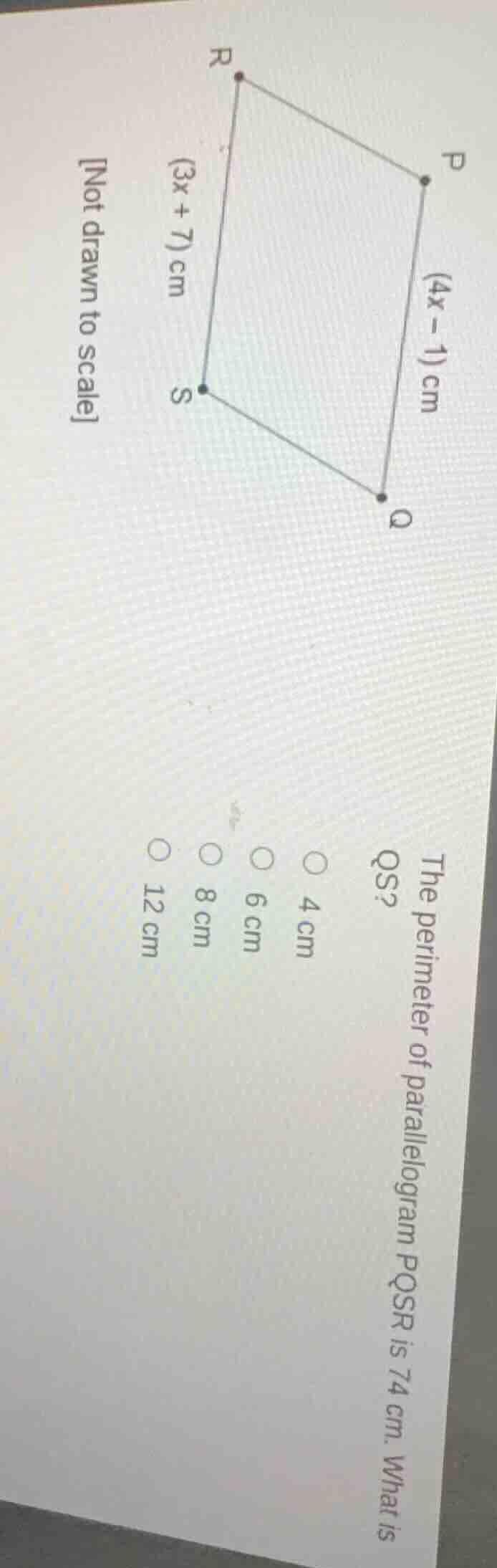
not drawn to scale the perimeter of parallelogram pqsr is 74 cm. what is qs? 4 cm 6 cm 8 cm 12 cm
Step1: Recall parallelogram side property
In a parallelogram, opposite sides are equal. So \( PQ = RS \) and \( QR = PS \) (wait, actually in \( PQSR \), \( PQ = RS \) and \( PS = QR \)? Wait, the sides given: \( PQ = (4x - 1) \) cm, \( RS = (3x + 7) \) cm. So set them equal: \( 4x - 1 = 3x + 7 \).
\[ 4x - 1 = 3x + 7 \]
Step2: Solve for x
Subtract \( 3x \) from both sides: \( x - 1 = 7 \). Then add 1 to both sides: \( x = 8 \).
Step3: Find length of PQ
Substitute \( x = 8 \) into \( PQ = 4x - 1 \): \( 4(8) - 1 = 32 - 1 = 31 \)? Wait, no, wait the perimeter is 74. Wait, maybe I misread the sides. Wait, the parallelogram has sides \( PQ = (4x - 1) \), \( RS = (3x + 7) \), and the other pair of sides? Wait, maybe the sides are \( PQ \) and \( PS \)? Wait, no, the diagram: PQ is \( (4x - 1) \), RS is \( (3x + 7) \), and the other sides: let's see, in a parallelogram, perimeter is \( 2(a + b) \), where \( a \) and \( b \) are adjacent sides. Wait, maybe the two adjacent sides are \( (4x - 1) \) and \( (3x + 7) \)? Wait, no, because in a parallelogram, opposite sides are equal, so \( PQ = RS \) and \( QR = PS \). Wait, maybe the problem is that \( PQ \) and \( RS \) are opposite, so \( 4x - 1 = 3x + 7 \), so \( x = 8 \), then \( PQ = 4*8 - 1 = 31 \), \( RS = 3*8 + 7 = 31 \). Then perimeter is \( 2(PQ + QR) = 74 \), so \( PQ + QR = 37 \), so \( QR = 37 - 31 = 6 \)? Wait, no, the question is "What is QS?" Wait, maybe QS is a diagonal? Wait, no, the options are 4,6,8,12. Wait, maybe I misread the diagram. Wait, maybe the sides are PQ = (4x -1), PS = (3x +7), and PQSR is a parallelogram, so PQ = SR and PS = QR. Wait, perimeter is 2(PQ + PS) = 74, so PQ + PS = 37. So \( (4x -1) + (3x +7) = 37 \). Let's try that.
\[ (4x - 1) + (3x + 7) = 37 \]
Step4: Solve for x with perimeter
Combine like terms: \( 7x + 6 = 37 \), so \( 7x = 31 \)? No, that doesn't make sense. Wait, earlier when I set PQ = RS (opposite sides), \( 4x -1 = 3x +7 \), x=8, then PQ=31, RS=31, then the other sides: let's say PS and QR are equal. Perimeter is 2(PQ + PS) =74, so PQ + PS=37, so PS=37-31=6. Then QS: maybe QS is equal to PS? Wait, no, maybe it's a rhombus? No, the options are 6, which is one of the options. Wait, maybe the adjacent sides are (4x -1) and (3x +7), and perimeter is 2[(4x -1) + (3x +7)] =74. Let's compute that:
\[ 2[(4x - 1) + (3x + 7)] = 74 \]
Divide both sides by 2: \( (4x -1) + (3x +7) = 37 \)
Combine like terms: \( 7x + 6 = 37 \)
Subtract 6: \( 7x = 31 \), which is not integer. So that's wrong. So back to opposite sides: \( 4x -1 = 3x +7 \), x=8, then PQ=31, RS=31, then perimeter is 2(PQ + QR)=74, so PQ + QR=37, so QR=6. Then QS: maybe QS is equal to QR? Wait, the options include 6. So maybe QS is 6 cm.

Snap & solve any problem in the app
Get step-by-step solutions on Sovi AI
Photo-based solutions with guided steps
Explore more problems and detailed explanations
6 cm (Option: 6 cm)