QUESTION IMAGE
Question
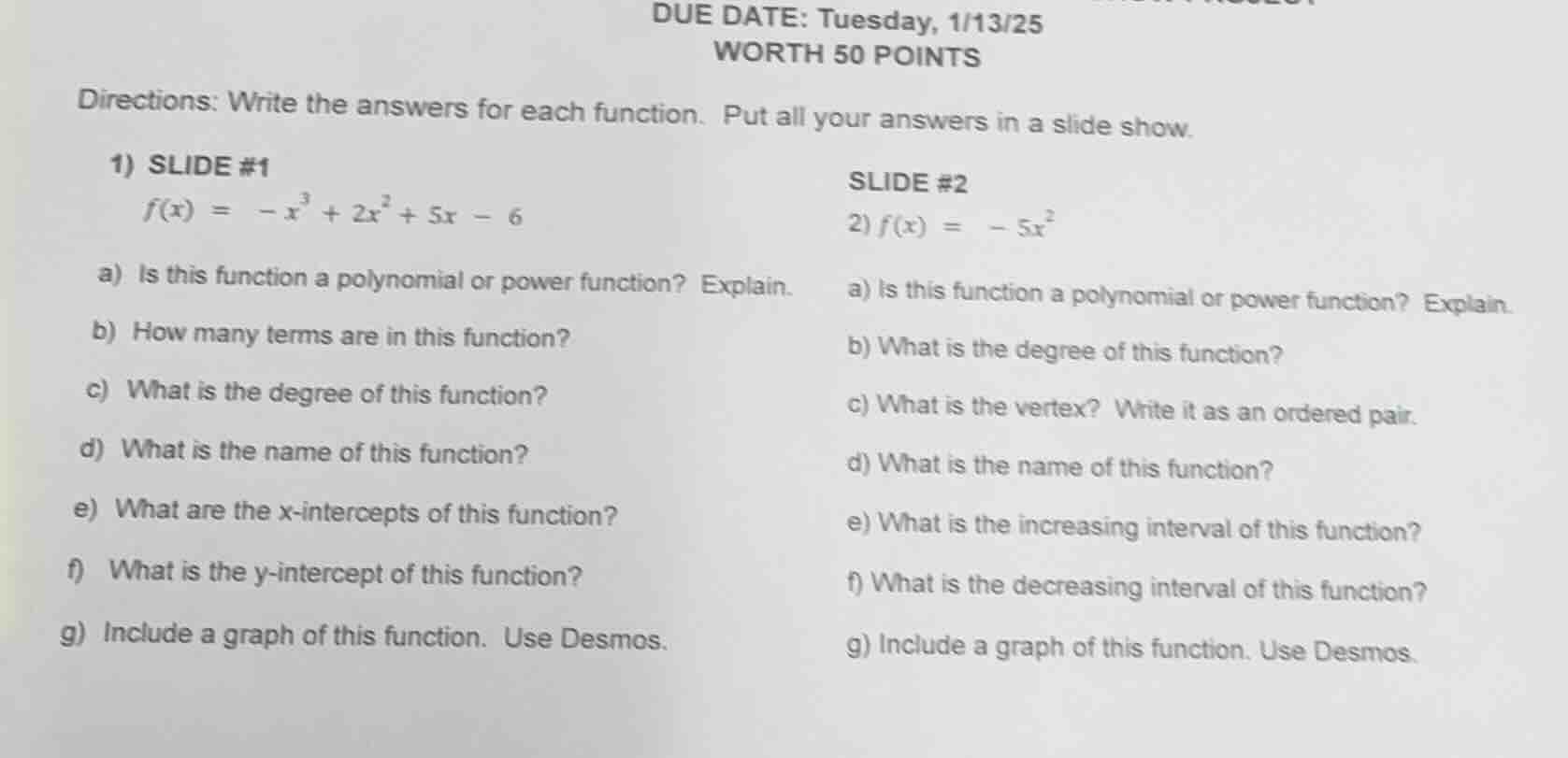
due date: tuesday, 1/13/25
worth 50 points
directions: write the answers for each function. put all your answers in a slide show.
- slide #1
$f(x) = -x^3 + 2x^2 + 5x - 6$
a) is this function a polynomial or power function? explain.
b) how many terms are in this function?
c) what is the degree of this function?
d) what is the name of this function?
e) what are the x-intercepts of this function?
f) what is the y-intercept of this function?
g) include a graph of this function. use desmos.
slide #2
- $f(x) = -5x^2$
a) is this function a polynomial or power function? explain.
b) what is the degree of this function?
c) what is the vertex? write it as an ordered pair.
d) what is the name of this function?
e) what is the increasing interval of this function?
f) what is the decreasing interval of this function?
g) include a graph of this function. use desmos.
---
Slide #1: $f(x) = -x^3 + 2x^2 + 5x - 6$
Step1: Classify the function
A polynomial function is a sum of terms with non-negative integer exponents on the variable. A power function has the form $f(x)=kx^n$ (single term). This function has multiple terms, so it is a polynomial.
Step2: Count the terms
Each separated term by $+$ or $-$ is a term: $-x^3$, $2x^2$, $5x$, $-6$. Total terms: 4.
Step3: Find the degree
The degree is the highest exponent of $x$. The highest exponent is 3.
Step4: Name the function
A 3rd-degree polynomial is a cubic function.
Step5: Find x-intercepts
Set $f(x)=0$: $-x^3 + 2x^2 + 5x - 6=0$ → $x^3 - 2x^2 -5x +6=0$. Test rational roots: $x=1$ is a root. Factor as $(x-1)(x^2 -x -6)=0$ → $(x-1)(x-3)(x+2)=0$. Roots: $x=1, 3, -2$.
Step6: Find y-intercept
Set $x=0$: $f(0)= -0^3 + 2(0)^2 +5(0)-6 = -6$.
---
Slide #2: $f(x) = -5x^2$
Step1: Classify the function
This function fits both the form of a power function ($f(x)=kx^n$ with $k=-5, n=2$) and a polynomial (single-term polynomial). It is both, but is a power function by strict single-term definition.
Step2: Find the degree
The highest exponent of $x$ is 2.
Step3: Find the vertex
For $f(x)=ax^2+bx+c$, vertex $x=-\frac{b}{2a}$. Here $b=0$, so $x=0$. $f(0)=0$. Vertex: $(0,0)$.
Step4: Name the function
A 2nd-degree polynomial is a quadratic function.
Step5: Find increasing interval
The parabola opens downward ($a=-5<0$), so it increases on $(-\infty, 0)$.
Step6: Find decreasing interval
The parabola opens downward, so it decreases on $(0, \infty)$.
---

Snap & solve any problem in the app
Get step-by-step solutions on Sovi AI
Photo-based solutions with guided steps
Explore more problems and detailed explanations
Slide #1 Answers:
a) It is a polynomial function. It is a sum of multiple terms with non-negative integer exponents on $x$, while a power function has only one term of the form $kx^n$.
b) 4 terms
c) 3
d) Cubic function
e) $x=-2$, $x=1$, $x=3$ (or ordered pairs $(-2,0)$, $(1,0)$, $(3,0)$)
f) $(0, -6)$
g) (Graph generated via Desmos: a cubic curve crossing the x-axis at -2, 1, 3 and y-axis at -6, with a local maximum and minimum)
Slide #2 Answers:
a) It is both a polynomial function (single-term polynomial) and a power function. It fits the strict power function form $f(x)=kx^n$ where $k=-5$ and $n=2$.
b) 2
c) $(0, 0)$
d) Quadratic function
e) $(-\infty, 0)$
f) $(0, \infty)$
g) (Graph generated via Desmos: a downward-opening parabola with vertex at the origin, symmetric across the y-axis)