QUESTION IMAGE
Question
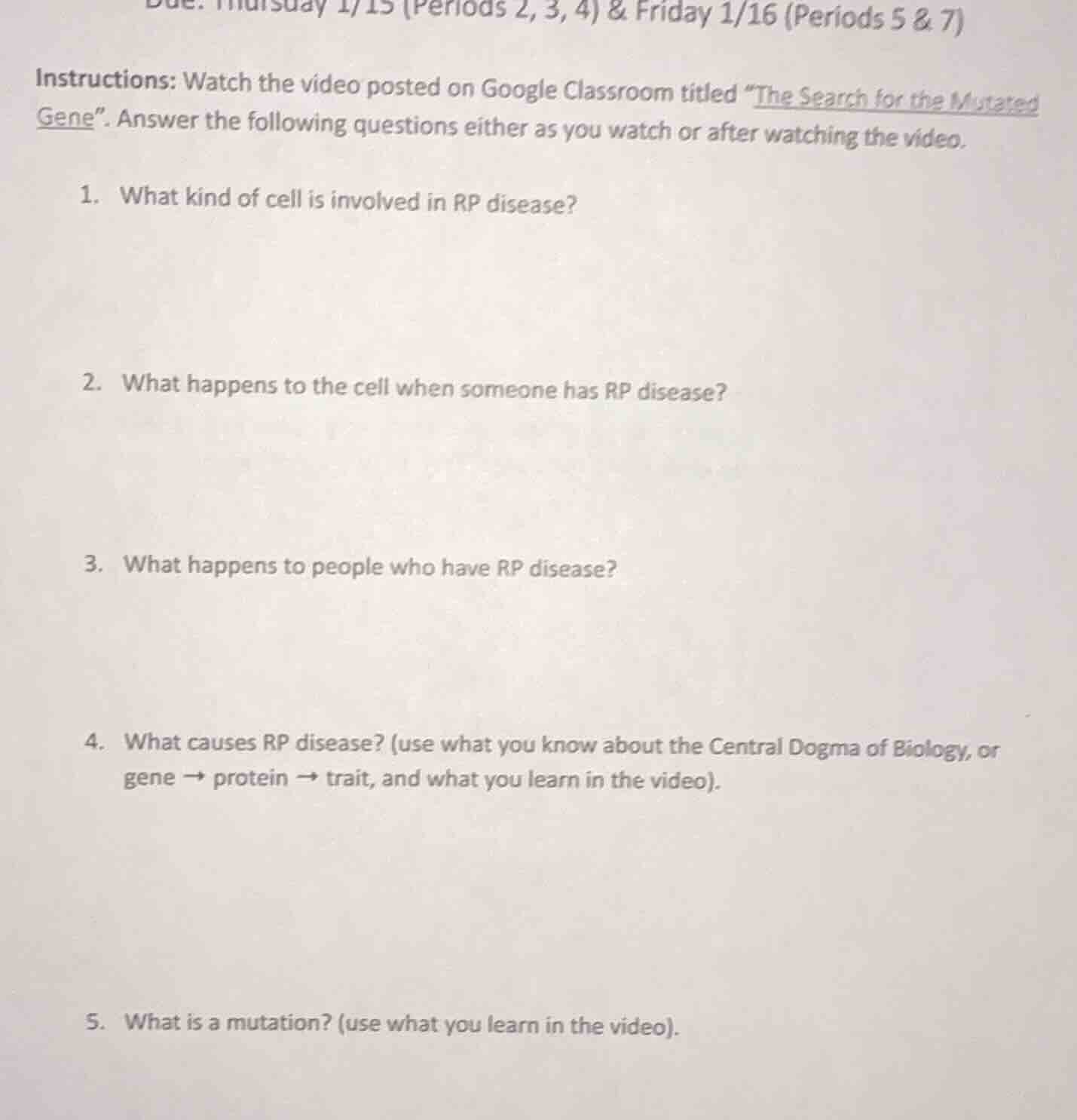
due: thursday 1/15 (periods 2, 3, 4) & friday 1/16 (periods 5 & 7)
instructions: watch the video posted on google classroom titled “the search for the mutated gene”. answer the following questions either as you watch or after watching the video.
- what kind of cell is involved in rp disease?
- what happens to the cell when someone has rp disease?
- what happens to people who have rp disease?
- what causes rp disease? (use what you know about the central dogma of biology, or gene → protein → trait, and what you learn in the video).
- what is a mutation? (use what you learn in the video).
To answer these questions, you need to watch the video "The Search for the Mutated Gene" as the answers are based on the content of that video. Here's a general guide on what to look for (though the exact answers depend on the video):
Question 1: What kind of cell is involved in RP disease?
RP (Retinitis Pigmentosa) is a retinal disease, so the cells involved are likely photoreceptor cells (rods and/or cones) in the retina, or retinal cells more broadly.
Question 2: What happens to the cell when someone has RP disease?
In RP, photoreceptor cells (or retinal cells) typically degenerate/die over time. The video may explain that the mutated gene disrupts normal cell function, leading to cell damage, malfunction, or apoptosis (cell death).
Question 3: What happens to people who have RP disease?
People with RP usually experience progressive vision loss (starting with night blindness, then peripheral vision loss, and potentially total blindness over time). The video may detail symptoms like difficulty seeing in low light, tunnel vision, or eventual central vision impairment.
Question 4: What causes RP disease? (use the Central Dogma: gene → protein → trait)
RP is caused by a gene mutation (in one of many RP-associated genes). Per the Central Dogma, a mutated gene produces an abnormal (or non-functional) protein. This abnormal protein disrupts the normal trait (vision) by impairing photoreceptor function, leading to cell death and vision loss. The video likely explains how a mutated gene (e.g., in retinal cells) fails to produce the correct protein needed for healthy vision.
Question 5: What is a mutation? (from the video)
A mutation is a change in the DNA sequence of a gene. The video may define it as a mistake or alteration in the genetic code, which can affect how a gene functions (e.g., by changing the protein it produces). Mutations can be inherited or spontaneous and may lead to abnormal traits (like RP) when they disrupt normal gene/protein function.
To get precise answers, watch the video and extract details directly from its content!

Snap & solve any problem in the app
Get step-by-step solutions on Sovi AI
Photo-based solutions with guided steps
Explore more problems and detailed explanations
To answer these questions, you need to watch the video "The Search for the Mutated Gene" as the answers are based on the content of that video. Here's a general guide on what to look for (though the exact answers depend on the video):
Question 1: What kind of cell is involved in RP disease?
RP (Retinitis Pigmentosa) is a retinal disease, so the cells involved are likely photoreceptor cells (rods and/or cones) in the retina, or retinal cells more broadly.
Question 2: What happens to the cell when someone has RP disease?
In RP, photoreceptor cells (or retinal cells) typically degenerate/die over time. The video may explain that the mutated gene disrupts normal cell function, leading to cell damage, malfunction, or apoptosis (cell death).
Question 3: What happens to people who have RP disease?
People with RP usually experience progressive vision loss (starting with night blindness, then peripheral vision loss, and potentially total blindness over time). The video may detail symptoms like difficulty seeing in low light, tunnel vision, or eventual central vision impairment.
Question 4: What causes RP disease? (use the Central Dogma: gene → protein → trait)
RP is caused by a gene mutation (in one of many RP-associated genes). Per the Central Dogma, a mutated gene produces an abnormal (or non-functional) protein. This abnormal protein disrupts the normal trait (vision) by impairing photoreceptor function, leading to cell death and vision loss. The video likely explains how a mutated gene (e.g., in retinal cells) fails to produce the correct protein needed for healthy vision.
Question 5: What is a mutation? (from the video)
A mutation is a change in the DNA sequence of a gene. The video may define it as a mistake or alteration in the genetic code, which can affect how a gene functions (e.g., by changing the protein it produces). Mutations can be inherited or spontaneous and may lead to abnormal traits (like RP) when they disrupt normal gene/protein function.
To get precise answers, watch the video and extract details directly from its content!