QUESTION IMAGE
Question
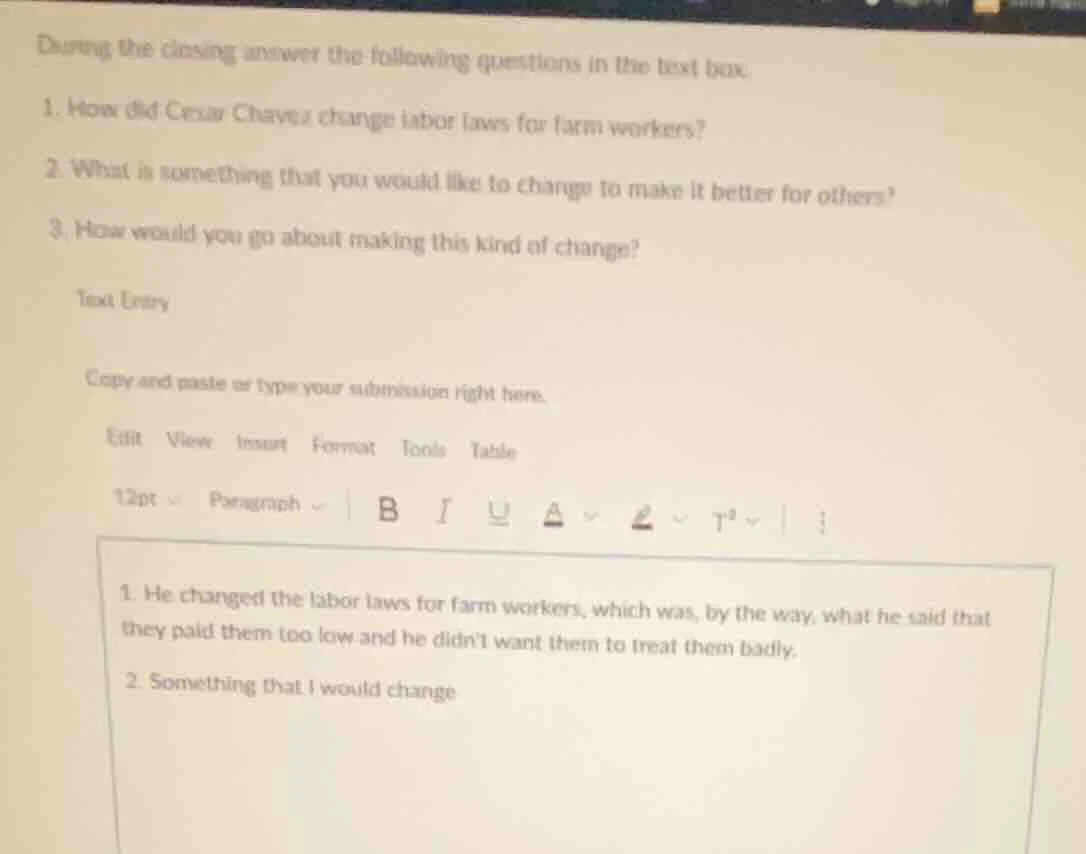
during the closing answer the following questions in the text box.
- how did cesar chavez change labor laws for farm workers?
- what is something that you would like to change to make it better for others?
- how would you go about making this kind of change?
text entry
copy and paste or type your submission right here.
edit view insert format tools table
12pt paragraph b i u a
- he changed the labor laws for farm workers, which was, by the way, what he said that they paid them too low and he didnt want them to treat them badly.
- something that i would change
Brief Explanations
- For the first question: Cesar Chavez organized farmworkers (via the United Farm Workers union) to strike, boycott, and advocate, leading to California's 1975 Agricultural Labor Relations Act. This law granted farmworkers the right to unionize, bargain collectively, and protected them from unfair labor practices like retaliation for organizing.
- For the second question: A common impactful change to propose is improving access to affordable mental health care for underserved communities, as this addresses a widespread unmet need that harms well-being.
- For the third question: To make this change, one could start by advocating to local policymakers for expanded funding for community mental health clinics, organizing grassroots campaigns to raise awareness of the gap, and partnering with mental health professionals to offer low-cost or sliding-scale care in underserved areas.

Snap & solve any problem in the app
Get step-by-step solutions on Sovi AI
Photo-based solutions with guided steps
Explore more problems and detailed explanations
- Cesar Chavez led the United Farm Workers (UFW) in strikes, boycotts, and advocacy efforts that pressured California to pass the 1975 Agricultural Labor Relations Act. This law gave farmworkers the legal right to form unions, engage in collective bargaining for better wages and working conditions, and protected them from employer retaliation for organizing.
- I would like to improve access to affordable, culturally competent mental health care for low-income and rural communities.
- I would first organize local grassroots awareness campaigns to highlight the gap in care, then advocate to state legislators to allocate additional funding for community mental health clinics in underserved areas, and partner with local mental health providers to establish sliding-scale fee systems and mobile care units to reach rural populations.