QUESTION IMAGE
Question
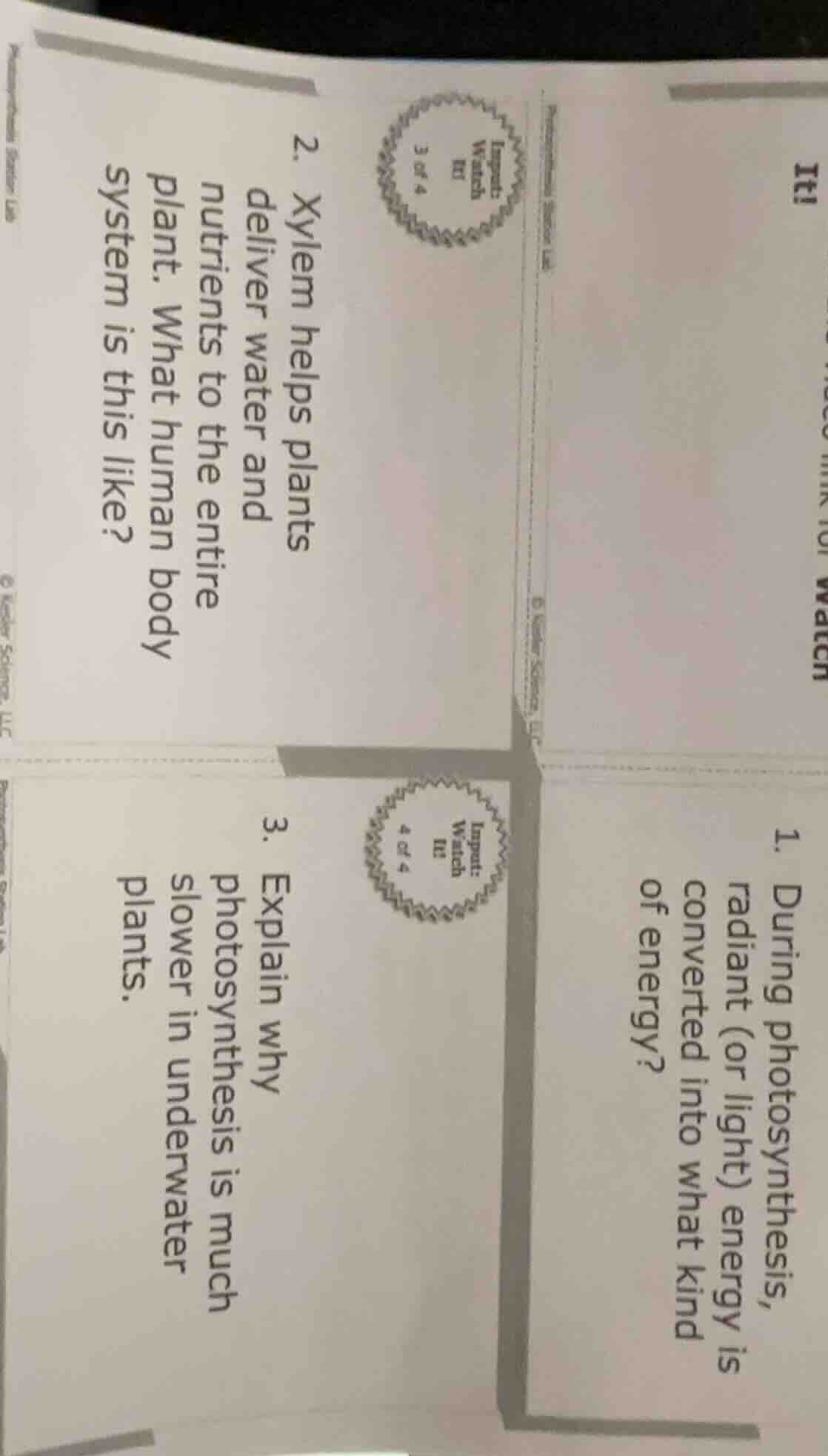
- during photosynthesis, radiant (or light) energy is converted into what kind of energy? 2. xylem helps plants deliver water and nutrients to the entire plant. what human body system is this like? 3. explain why photosynthesis is much slower in underwater plants.
Question 1
Step1: Recall Photosynthesis Energy Conversion
During photosynthesis, plants use light (radiant) energy. The process involves converting this light energy into chemical energy, which is stored in the bonds of glucose (or other organic molecules) produced. The overall reaction of photosynthesis is \(6CO_2 + 6H_2O \xrightarrow{\text{light energy}} C_6H_{12}O_6 + 6O_2\), where light energy is transformed into the chemical energy of glucose.
Xylem in plants transports water and nutrients from roots to other parts. The human circulatory system (specifically the cardiovascular system with blood vessels like arteries/veins/capillaries) transports blood (carrying water, nutrients, oxygen, etc.) throughout the body. Both systems function to distribute essential substances (water, nutrients for plants; blood - containing nutrients, oxygen for humans) to all parts of the organism to support metabolism and growth.
Step1: Identify Limiting Factor (Light Availability)
Photosynthesis requires light energy. Underwater, light has to pass through water. Water absorbs and scatters light, especially the wavelengths (like red and blue, which are important for photosynthesis) that plants use. So the amount of light (photon) energy available for underwater plants to perform photosynthesis is much less compared to plants on land (which have direct access to air - transmitted light with less absorption/scattering).
Step2: Relate Light to Photosynthesis Rate
The rate of photosynthesis is directly related to the amount of light energy available (assuming other factors like \(CO_2\) and temperature are not limiting). Since underwater plants receive less light energy (due to absorption and scattering by water), the rate of photosynthesis (the process of converting light energy to chemical energy in glucose) is slower. Also, the deeper the underwater plant, the more light is absorbed/scattered, further reducing the photosynthesis rate.

Snap & solve any problem in the app
Get step-by-step solutions on Sovi AI
Photo-based solutions with guided steps
Explore more problems and detailed explanations
During photosynthesis, radiant (light) energy is converted into chemical energy (stored in the bonds of glucose or other organic compounds produced by the plant).