QUESTION IMAGE
Question
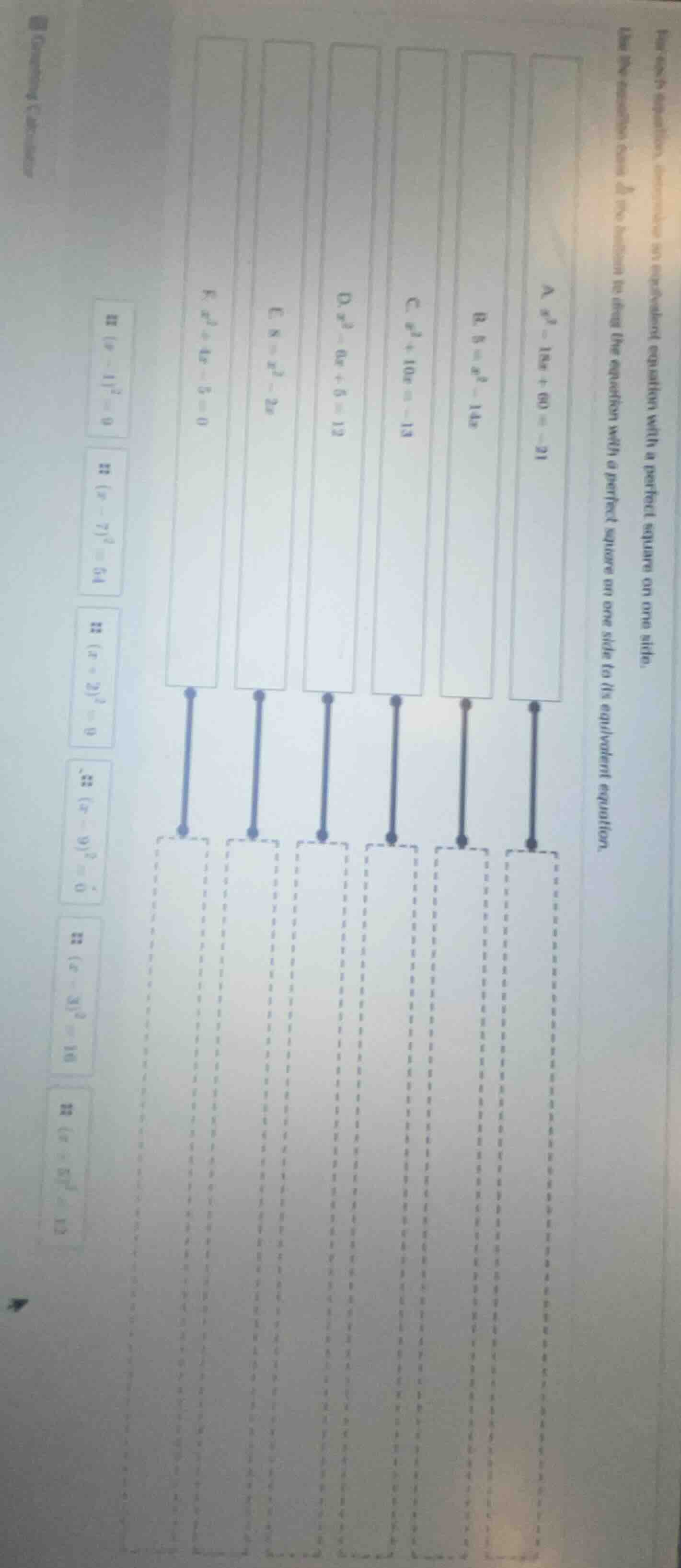
for each equation, determine an equivalent equation with a perfect square on one side. use the addition property of equality to transform the equation with a perfect square on one side to its equivalent equation.
a. $x^2 - 18x + 60 = -31$
b. $5 = x^2 - 13x$
c. $x^2 + 10x = -13$
d. $x^2 - 6x + 5 = 13$
e. $8 = x^2 - 2x$
f. $x^2 + 4x - 5 = 0$
- $(x - 1)^2 = 0$
- $(x - 7)^2 = 64$
- $(x + 2)^2 = 9$
- $(x - 9)^2 = 0$
- $(x - 3)^2 = 16$
- $(x + 5)^2 = 13$
Step1: Rearrange Equation A
$x^2 - 18x + 60 = -21$
$x^2 - 18x = -81$
Step2: Complete the square for A
Take half of $-18$: $\frac{-18}{2}=-9$, square it: $(-9)^2=81$
$x^2 - 18x + 81 = -81 + 81$
$(x-9)^2=0$
Step1: Rearrange Equation B
$5 = x^2 - 14x$
$x^2 - 14x = 5$
Step2: Complete the square for B
Take half of $-14$: $\frac{-14}{2}=-7$, square it: $(-7)^2=49$
$x^2 - 14x + 49 = 5 + 49$
$(x-7)^2=54$
Step1: Rearrange Equation C
$x^2 + 10x = -13$
Step2: Complete the square for C
Take half of $10$: $\frac{10}{2}=5$, square it: $5^2=25$
$x^2 + 10x + 25 = -13 + 25$
$(x+5)^2=12$
Step1: Rearrange Equation D
$x^2 - 6x + 5 = 12$
$x^2 - 6x = 7$
Step2: Complete the square for D
Take half of $-6$: $\frac{-6}{2}=-3$, square it: $(-3)^2=9$
$x^2 - 6x + 9 = 7 + 9$
$(x-3)^2=16$
Step1: Rearrange Equation E
$8 = x^2 - 2x$
$x^2 - 2x = 8$
Step2: Complete the square for E
Take half of $-2$: $\frac{-2}{2}=-1$, square it: $(-1)^2=1$
$x^2 - 2x + 1 = 8 + 1$
$(x-1)^2=9$
Step1: Rearrange Equation F
$x^2 + 4x - 5 = 0$
$x^2 + 4x = 5$
Step2: Complete the square for F
Take half of $4$: $\frac{4}{2}=2$, square it: $2^2=4$
$x^2 + 4x + 4 = 5 + 4$
$(x+2)^2=9$

Snap & solve any problem in the app
Get step-by-step solutions on Sovi AI
Photo-based solutions with guided steps
Explore more problems and detailed explanations
- A. $x^2 - 18x + 60 = -21$ $\boldsymbol{
ightarrow}$ $(x-9)^2=0$
- B. $5 = x^2 - 14x$ $\boldsymbol{
ightarrow}$ $(x-7)^2=54$
- C. $x^2 + 10x = -13$ $\boldsymbol{
ightarrow}$ $(x+5)^2=12$
- D. $x^2 - 6x + 5 = 12$ $\boldsymbol{
ightarrow}$ $(x-3)^2=16$
- E. $8 = x^2 - 2x$ $\boldsymbol{
ightarrow}$ $(x-1)^2=9$
- F. $x^2 + 4x - 5 = 0$ $\boldsymbol{
ightarrow}$ $(x+2)^2=9$