QUESTION IMAGE
Question
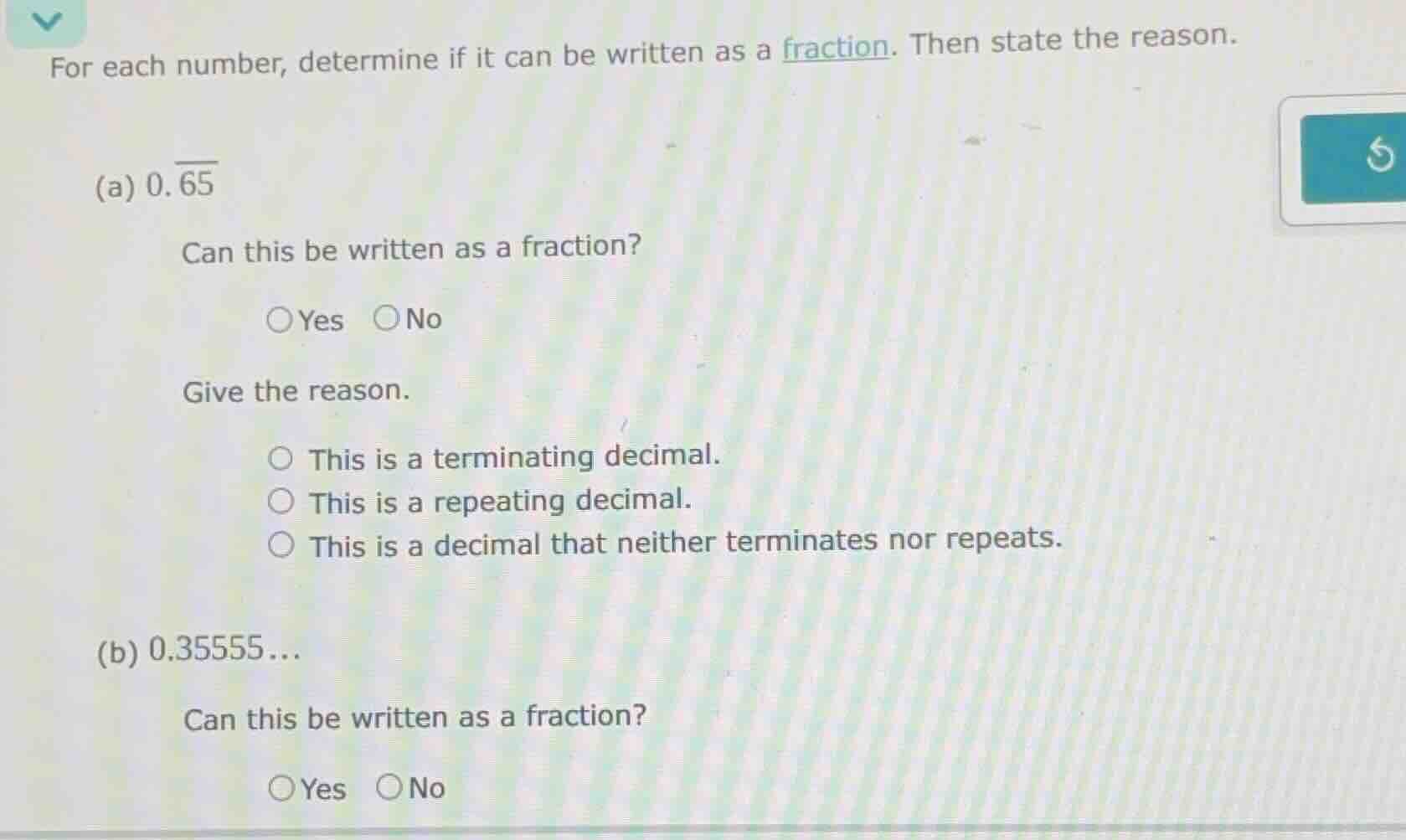
for each number, determine if it can be written as a fraction. then state the reason.
(a) (0.overline{65})
can this be written as a fraction?
(\bigcirc)yes (\bigcirc)no
give the reason.
(\bigcirc) this is a terminating decimal.
(\bigcirc) this is a repeating decimal.
(\bigcirc) this is a decimal that neither terminates nor repeats.
(b) (0.35555ldots)
can this be written as a fraction?
(\bigcirc)yes (\bigcirc)no
Part (a)
Step 1: Identify Decimal Type
The number \(0.\overline{65}\) has a repeating bar over "65", meaning the digits "65" repeat indefinitely. Repeating decimals are rational numbers, and all rational numbers can be written as fractions.
Step 2: Choose Reason
Since \(0.\overline{65}\) is a repeating decimal (the "65" repeats), it is a rational number and can be expressed as a fraction. A terminating decimal has a finite number of digits after the decimal point, and a non - repeating, non - terminating decimal is irrational (cannot be a fraction). So the reason is that it is a repeating decimal.
Step 1: Identify Decimal Type
The number \(0.35555\ldots\) has the digit "5" repeating indefinitely. Repeating decimals are rational numbers, and all rational numbers can be written as fractions.
Step 2: Conclusion on Fraction Representation
Since \(0.35555\ldots\) is a repeating decimal (the "5" repeats), it is a rational number and thus can be written as a fraction.

Snap & solve any problem in the app
Get step-by-step solutions on Sovi AI
Photo-based solutions with guided steps
Explore more problems and detailed explanations
Can this be written as a fraction? \(\boldsymbol{\text{Yes}}\)
Give the reason. \(\boldsymbol{\text{This is a repeating decimal.}}\)