QUESTION IMAGE
Question
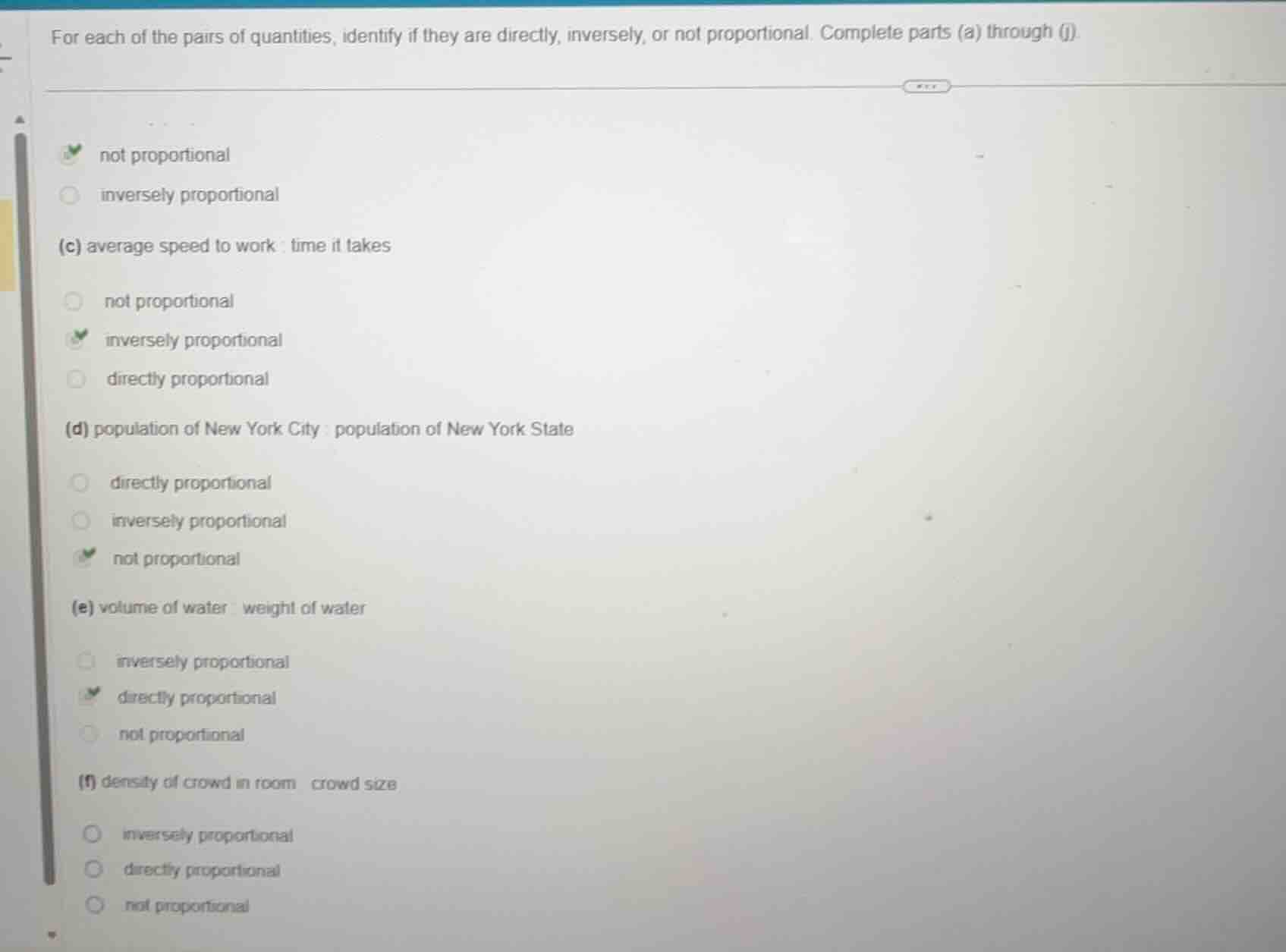
for each of the pairs of quantities, identify if they are directly, inversely, or not proportional. complete parts (a) through (j).
...
not proportional
inversely proportional
(c) average speed to work time it takes
not proportional
inversely proportional
directly proportional
(d) population of new york city population of new york state
directly proportional
inversely proportional
not proportional
(e) volume of water weight of water
inversely proportional
directly proportional
not proportional
(f) density of crowd in room crowd size
inversely proportional
directly proportional
not proportional
Part (f)
To determine the relationship between the density of the crowd in a room and the crowd size, we recall the formula for density: \( \text{Density} = \frac{\text{Crowd Size}}{\text{Room Area}} \). Assuming the room area is constant, if the crowd size (numerator) increases, the density (which is \( \frac{\text{Crowd Size}}{\text{Constant}} \)) will increase proportionally. So, when one quantity (crowd size) increases, the other (density) increases as well, given a constant room area. This fits the definition of direct proportionality (where \( y = kx \) for a constant \( k \), here \( k=\frac{1}{\text{Room Area}} \)).

Snap & solve any problem in the app
Get step-by-step solutions on Sovi AI
Photo-based solutions with guided steps
Explore more problems and detailed explanations
directly proportional