QUESTION IMAGE
Question
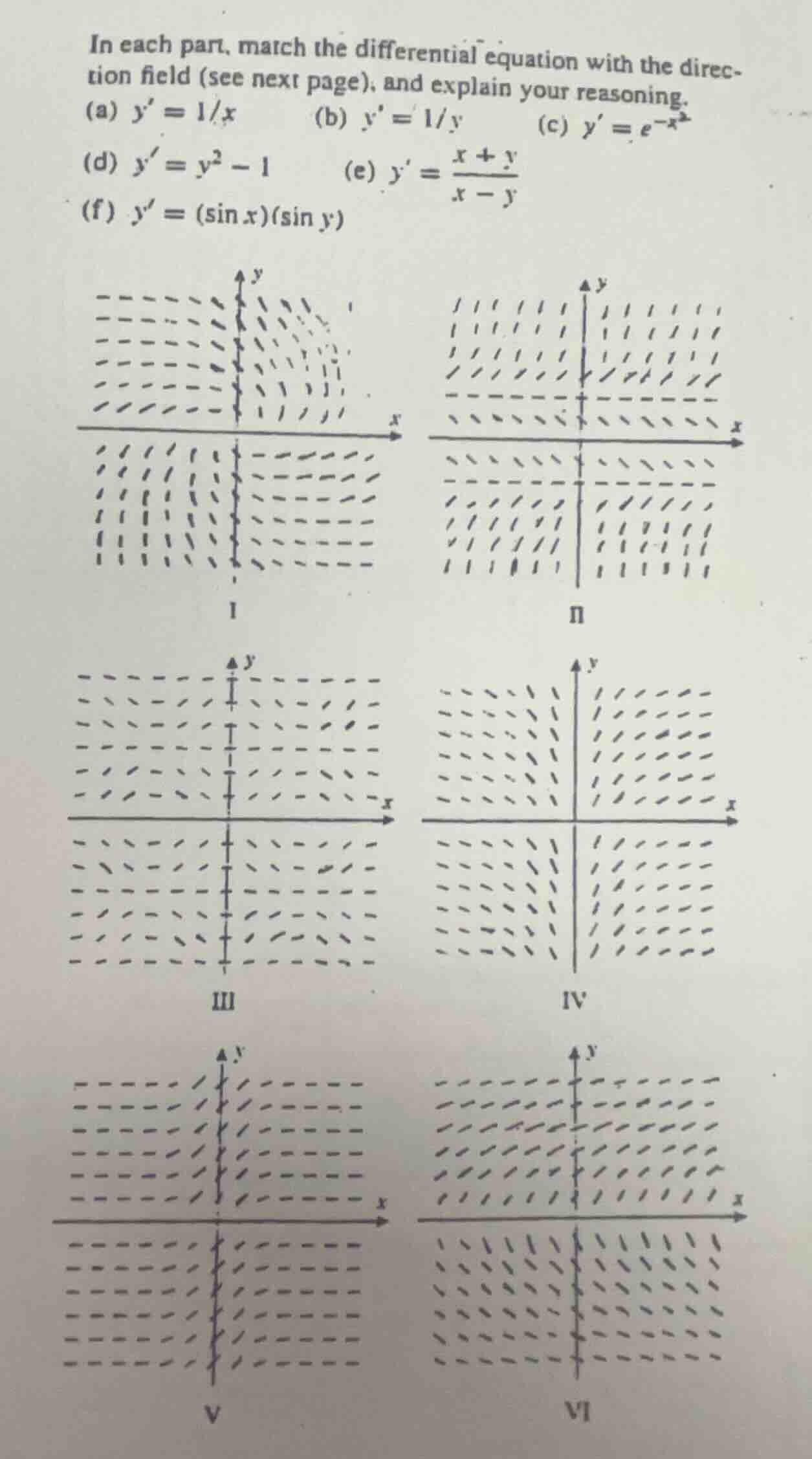
in each part, match the differential equation with the direction field (see next page), and explain your reasoning.
(a) $y = \frac{1}{x}$
(b) $y = \frac{1}{y}$
(c) $y = e^{-x^2}$
(d) $y = y^2 - 1$
(e) $y = \frac{x + y}{x - y}$
(f) $y = (\sin x)(\sin y)$
(a) $y' = \frac{1}{x}$
The slope only depends on $x$, is undefined at $x=0$, positive for $x>0$, negative for $x<0$. This matches Field V, where slopes flip sign across $x=0$ and are constant for fixed $x$.
(b) $y' = \frac{1}{y}$
The slope only depends on $y$, undefined at $y=0$, positive for $y>0$, negative for $y<0$. This matches Field III, where slopes flip sign across $y=0$ and are constant for fixed $y$.
(c) $y' = e^{-x^2}$
The slope is always positive (exponential is positive), approaches 0 as $|x|\to\infty$, and is maximum at $x=0$. This matches Field II, where all slopes are positive, flattest far from the y-axis, steepest at $x=0$.
(d) $y' = y^2 - 1$
The slope is 0 when $y=\pm1$, positive for $|y|>1$, negative for $|y|<1$. This matches Field VI, where slopes are zero along $y=\pm1$, positive outside this range, negative inside.
(e) $y' = \frac{x+y}{x-y}$
Rewrite as $y' = \frac{1+\frac{y}{x}}{1-\frac{y}{x}}$, a homogeneous function (slope depends only on $\frac{y}{x}$). This means slopes are constant along lines through the origin, which matches Field I.
(f) $y' = (\sin x)(\sin y)$
The slope is 0 when $x=k\pi$ or $y=k\pi$ (integer $k$), and changes sign at these lines. This matches Field IV, where slopes are zero along grid lines $x=k\pi, y=k\pi$ and alternate sign in regions between them.

Snap & solve any problem in the app
Get step-by-step solutions on Sovi AI
Photo-based solutions with guided steps
Explore more problems and detailed explanations
(a) Matches Field V
(b) Matches Field III
(c) Matches Field II
(d) Matches Field VI
(e) Matches Field I
(f) Matches Field IV