QUESTION IMAGE
Question
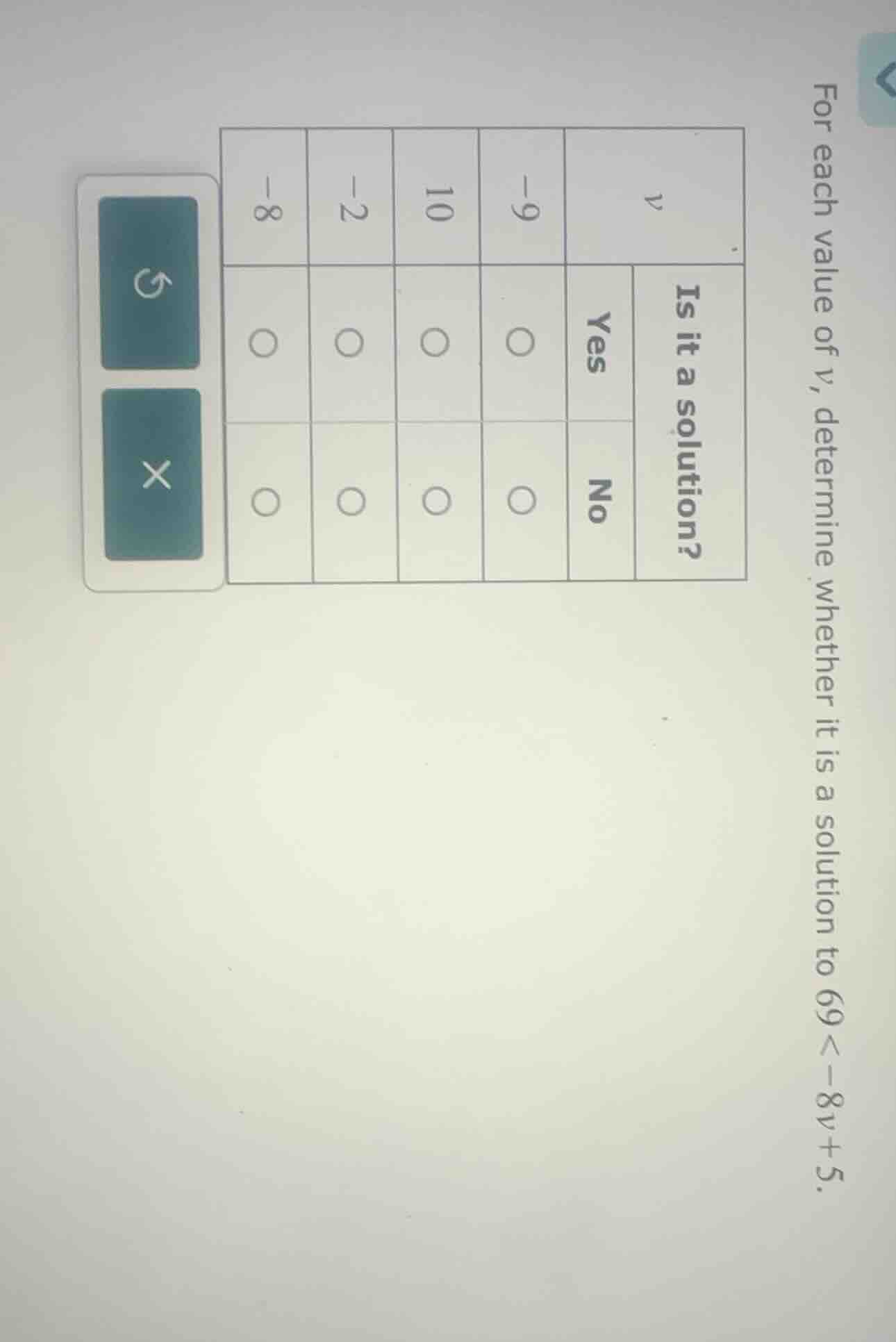
for each value of v, determine whether it is a solution to 69 < -8v + 5.
is it a solution?
yes \t no
v \t \t
-9 \t circ \t circ
10 \t circ \t circ
-2 \t circ \t circ
-8 \t circ \t circ
To determine if a value of \( v \) is a solution to the inequality \( 69 < -8v + 5 \), we first solve the inequality for \( v \):
Step 1: Subtract 5 from both sides
Subtract 5 from both sides of the inequality to isolate the term with \( v \):
\[
69 - 5 < -8v + 5 - 5
\]
\[
64 < -8v
\]
Step 2: Divide both sides by -8 (and reverse the inequality sign)
Divide both sides by -8. Remember that when dividing or multiplying an inequality by a negative number, the inequality sign reverses:
\[
\frac{64}{-8} > \frac{-8v}{-8}
\]
\[
-8 > v
\]
or equivalently,
\[
v < -8
\]
Now we check each value of \( v \) to see if it satisfies \( v < -8 \):
- For \( v = -9 \):
Check if \( -9 < -8 \). Since \( -9 \) is less than \( -8 \), this is true. So \( -9 \) is a solution (Yes).
- For \( v = 10 \):
Check if \( 10 < -8 \). Since \( 10 \) is greater than \( -8 \), this is false. So \( 10 \) is not a solution (No).
- For \( v = -2 \):
Check if \( -2 < -8 \). Since \( -2 \) is greater than \( -8 \), this is false. So \( -2 \) is not a solution (No).
- For \( v = -8 \):
Check if \( -8 < -8 \). Since \( -8 \) is not less than \( -8 \) (it is equal), this is false. So \( -8 \) is not a solution (No).
Final Answers (Filling the Table):
| \( v \) | Is it a solution? Yes | Is it a solution? No |
|---|---|---|
| \( 10 \) | \( \circ \) | |
| \( -2 \) | \( \circ \) | |
| \( -8 \) | \( \circ \) |
(Mark "Yes" for \( -9 \) and "No" for \( 10 \), \( -2 \), \( -8 \) as shown above.)

Snap & solve any problem in the app
Get step-by-step solutions on Sovi AI
Photo-based solutions with guided steps
Explore more problems and detailed explanations
To determine if a value of \( v \) is a solution to the inequality \( 69 < -8v + 5 \), we first solve the inequality for \( v \):
Step 1: Subtract 5 from both sides
Subtract 5 from both sides of the inequality to isolate the term with \( v \):
\[
69 - 5 < -8v + 5 - 5
\]
\[
64 < -8v
\]
Step 2: Divide both sides by -8 (and reverse the inequality sign)
Divide both sides by -8. Remember that when dividing or multiplying an inequality by a negative number, the inequality sign reverses:
\[
\frac{64}{-8} > \frac{-8v}{-8}
\]
\[
-8 > v
\]
or equivalently,
\[
v < -8
\]
Now we check each value of \( v \) to see if it satisfies \( v < -8 \):
- For \( v = -9 \):
Check if \( -9 < -8 \). Since \( -9 \) is less than \( -8 \), this is true. So \( -9 \) is a solution (Yes).
- For \( v = 10 \):
Check if \( 10 < -8 \). Since \( 10 \) is greater than \( -8 \), this is false. So \( 10 \) is not a solution (No).
- For \( v = -2 \):
Check if \( -2 < -8 \). Since \( -2 \) is greater than \( -8 \), this is false. So \( -2 \) is not a solution (No).
- For \( v = -8 \):
Check if \( -8 < -8 \). Since \( -8 \) is not less than \( -8 \) (it is equal), this is false. So \( -8 \) is not a solution (No).
Final Answers (Filling the Table):
| \( v \) | Is it a solution? Yes | Is it a solution? No |
|---|---|---|
| \( 10 \) | \( \circ \) | |
| \( -2 \) | \( \circ \) | |
| \( -8 \) | \( \circ \) |
(Mark "Yes" for \( -9 \) and "No" for \( 10 \), \( -2 \), \( -8 \) as shown above.)