QUESTION IMAGE
Question
ecology review packet
name:
per
levels of organization:
- list the levels of ecological organization from smallest to largest:
____ __ __ __ ____
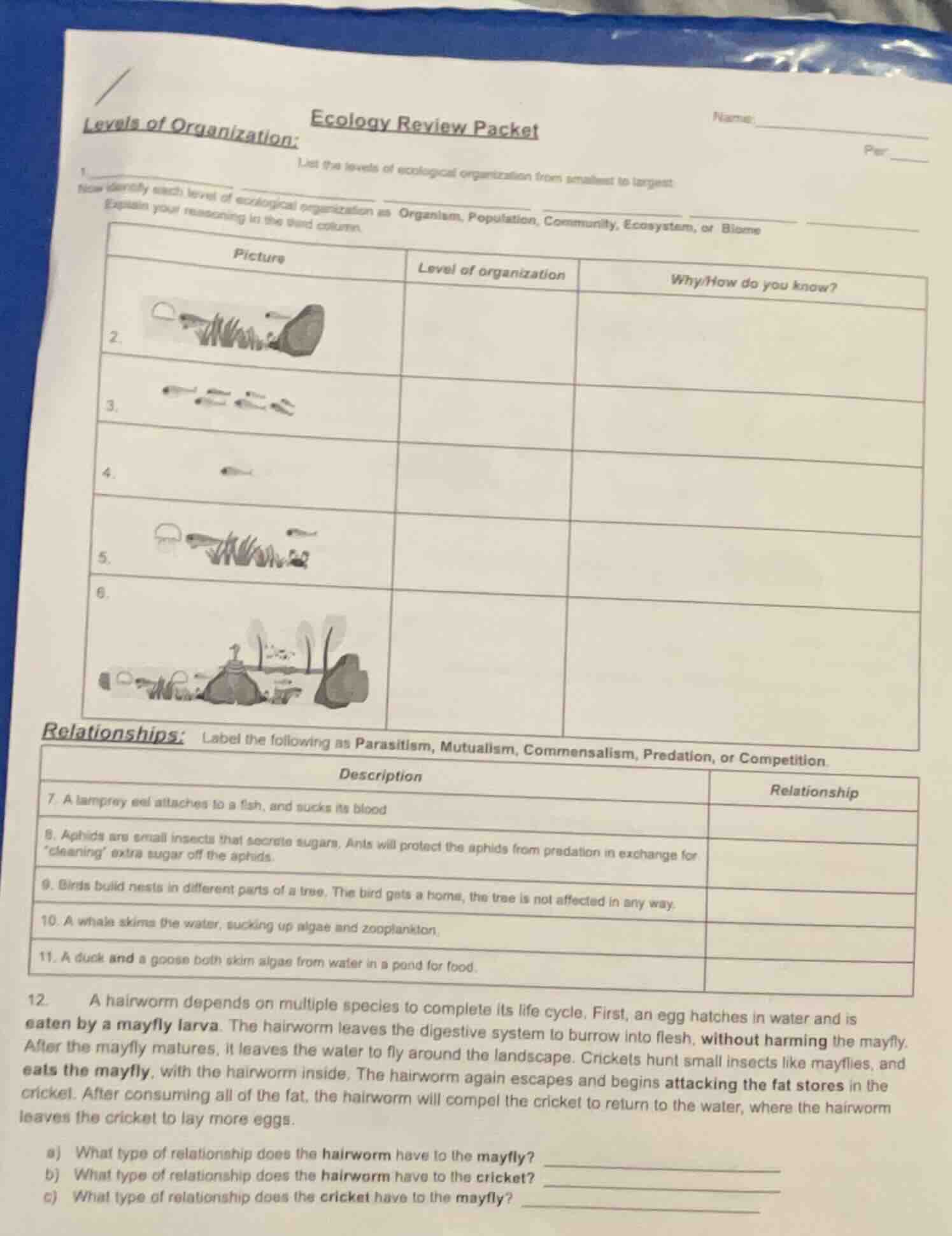
now identify each level of ecological organization as organism, population, community, ecosystem, or biome
explain your reasoning in the third column.
| picture | level of organization | why/how do you know? |
|---|---|---|
| 3. image of multiple similar fish | ||
| 4. image of a single fish | ||
| 5. image of a scene with a fish, grass, and other small organisms | ||
| 6. image of a larger landscape with rocks, trees, and various organisms |
relationships: label the following as parasitism, mutualism, commensalism, predation, or competition.
| description | relationship |
|---|---|
| 8. aphids are small insects that secrete sugar, ants will protect the aphids from predation in exchange for cleaning extra sugar off the aphids. | |
| 9. birds build nests in different parts of a tree. the bird gets a home, the tree is not affected in any way. | |
| 10. a whale skims the water, sucking up algae and zooplankton. | |
| 11. a duck and a goose both skim algae from water in a pond for food. |
- a hairworm depends on multiple species to complete its life cycle. first, an egg hatches in water and is eaten by a mayfly larva. the hairworm leaves the digestive system to burrow into flesh, without harming the mayfly. after the mayfly matures, it leaves the water to fly around the landscape. crickets hunt small insects like mayflies, and eats the mayfly, with the hairworm inside. the hairworm again escapes and begins attacking the fat stores in the cricket. after consuming all of the fat, the hairworm will compel the cricket to return to the water, where the hairworm leaves the cricket to lay more eggs.
a) what type of relationship does the hairworm have to the mayfly? ______
b) what type of relationship does the hairworm have to the cricket? ______
c) what type of relationship does the cricket have to the mayfly? ______
Step1: Address Levels of Organization
1. List levels smallest to largest
Organism → Population → Community → Ecosystem → Biome
2. Classify each image
Step2: Classify image 2 (plants, rock, water)
Ecosystem: It has living + nonliving parts.
Step3: Classify image 3 (group of same fish)
Population: Same species in one area.
Step4: Classify image 4 (single fish)
Organism: Individual living thing.
Step5: Classify image 5 (multiple species)
Community: Multiple species interacting.
Step6: Classify image 6 (large landscape)
Biome: Broad regional ecosystem with distinct features.
Step7: Address Ecological Relationships
7. Lamprey + fish
Parasitism: One benefits, one is harmed.
8. Aphids + ants
Mutualism: Both species benefit.
9. Birds + tree
Commensalism: One benefits, other unharmed.
10. Whale + algae/zooplankton
Predation: One hunts/eats another.
11. Duck + goose
Competition: Both fight for same resource.
12a. Hairworm + mayfly
Commensalism: Hairworm benefits, mayfly unharmed.
12b. Hairworm + cricket
Parasitism: Hairworm benefits, cricket is harmed.
12c. Cricket + mayfly
Predation: Cricket hunts and eats mayfly.

Snap & solve any problem in the app
Get step-by-step solutions on Sovi AI
Photo-based solutions with guided steps
Explore more problems and detailed explanations
Levels of Organization
- Smallest to largest: Organism, Population, Community, Ecosystem, Biome
2.
| Picture | Level of organization | Why/How do you know? |
|---|---|---|
| 3. | Population | Group of the same type of fish (single species) in one area. |
| 4. | Organism | A single individual fish. |
| 5. | Community | Multiple different species (fish, plants, invertebrates) interacting. |
| 6. | Biome | A large, distinct regional ecosystem with specific climate and organisms. |
Relationships
- Parasitism
- Mutualism
- Commensalism
- Predation
- Competition
12.
a) Commensalism
b) Parasitism
c) Predation