QUESTION IMAGE
Question
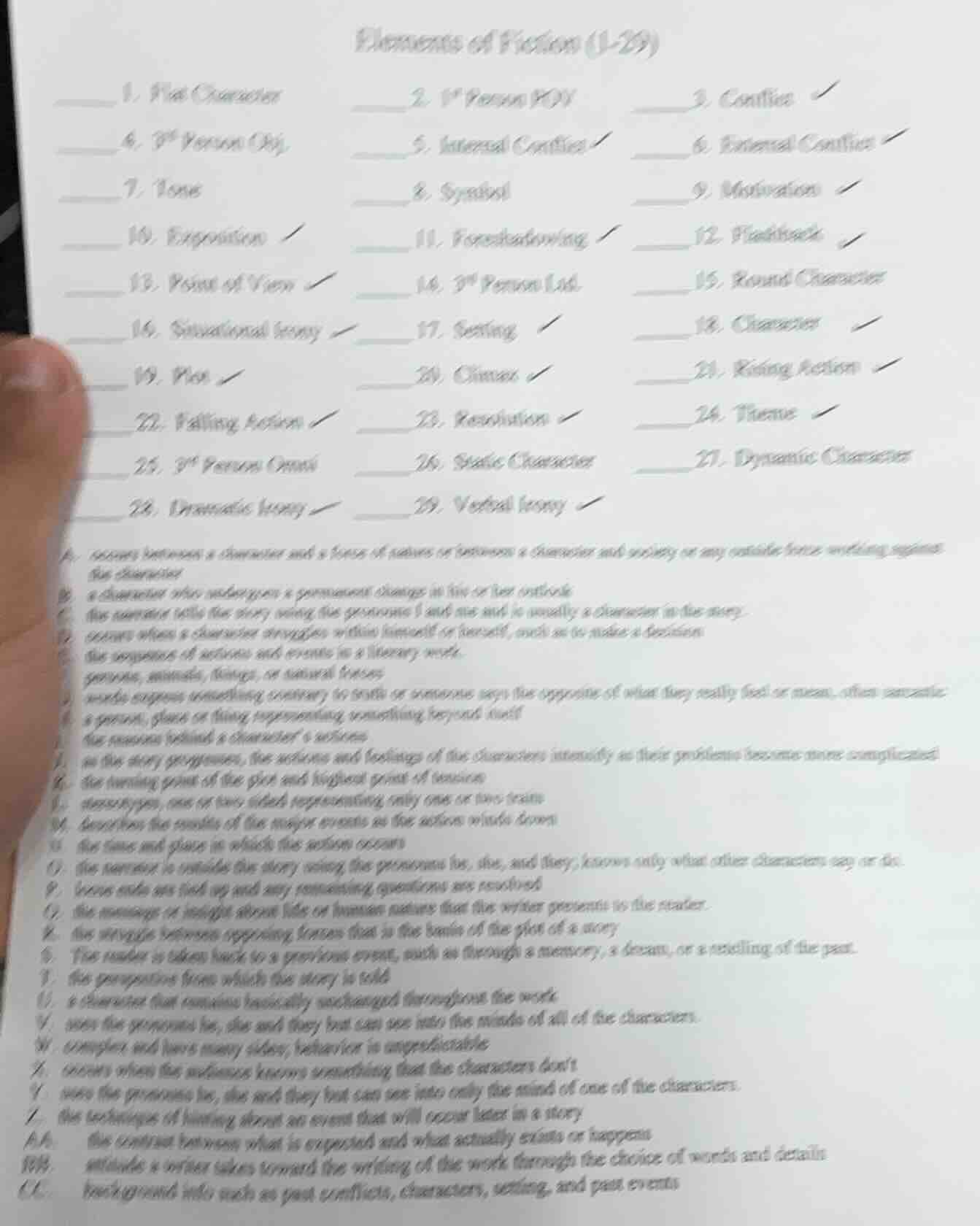
elements of fiction (1-29)
___ 1. flat character _ 2. 1st person pov ___ 3. conflict
___ 4. 3rd person obj. _ 5. internal conflict ___ 6. external conflict
___ 7. tone _ 8. symbol ___ 9. motivation
___ 10. exposition _ 11. foreshadowing ___ 12. flashback
___ 13. point of view _ 14. 3rd person ltd. ___ 15. round character
___ 16. situational irony _ 17. setting ___ 18. character
___ 19. plot _ 20. climax ___ 21. rising action
___ 22. falling action _ 23. resolution ___ 24. theme
___ 25. 3rd person omni _ 26. static character ___ 27. dynamic character
___ 28. dramatic irony ___ 29. verbal irony
a. occurs between a character and a force of nature or between a character and society or any outside force working against the character
b. a character who undergoes a permanent change in his or her outlook
c. the narrator tells the story using the pronouns i and me and is usually a character in the story.
d. occurs when a character struggles within himself or herself, such as to make a decision
e. the sequence of actions and events in a literary work.
f. persons, animals, things, or natural forces
g. words suppose something contrary to truth or someone says the opposite of what they really feel or mean, often sarcastic
h. a person, place or thing representing something beyond itself
i. the reasons behind a character’s actions
j. as the story progresses, the actions and feelings of the characters intensify as their problems become more complicated
k. the turning point of the plot and highest point of tension
l. stereotype, one or two - sided representing only one or two traits
m. describes the results of the major events as the action winds down
n. the time and place in which the action occurs
o. the narrator is outside the story using the pronouns he, she, and they; knows only what other characters say or do.
p. loose ends are tied up and any remaining questions are resolved
q. the message or insight about life or human nature that the writer presents to the reader.
r. the struggle between opposing forces that is the basis of the plot of a story
s. the reader is taken back to a previous event, such as through a memory, a dream, or a retelling of the past.
t. the perspective from which the story is told
u. a character that remains basically unchanged throughout the work
v. uses the pronouns he, she and they but can see into the minds of all of the characters.
w. complex and has many sides; behavior is unpredictable
x. occurs when the audience knows something that the characters dont
y. uses the pronouns he, she and they but can see into only the mind of one of the characters.
z. the technique of hinting about an event that will occur later in a story
aa. the contrast between what is expected and what actually exists or happens
bb. attitude a writer takes toward the writing of the work through the choice of words and detail
cc. background info such as past conflicts, characters, setting, and past events
To solve this matching exercise on elements of fiction, we analyze each term and match it with the correct definition:
1. Flat Character
A flat character is a stereotype, one - or two - sided, representing only one or two traits. So it matches with I: stereotypes, one or two - sided representing only one or two traits.
2. 1st Person POV
In first - person point of view, the narrator tells the story using the pronouns “I” and “me” and is usually a character in the story. So it matches with C: the narrator tells the story using the pronouns I and me and is usually a character in the story.
3. Conflict
Conflict is the struggle between opposing forces that is the basis of the plot of a story. So it matches with R: the struggle between opposing forces that is the basis of the plot of a story.
4. 3rd Person Obj. (Objective)
In third - person objective point of view, the narrator is outside the story using the pronouns he, she, and they; knows only what other characters say or do. So it matches with O: the narrator is outside the story using the pronouns he, she, and they; knows only what other characters say or do.
5. Internal Conflict
Internal conflict occurs when a character struggles within himself or herself, such as to make a decision. So it matches with D: occurs when a character struggles within himself or herself, such as to make a decision.
6. External Conflict
External conflict occurs between a character and a force of nature or between a character and society or any outside force working against the character. So it matches with A: occurs between a character and a force of nature or between a character and society or any outside force working against the character.
7. Tone
Tone is the attitude a writer takes toward the writing of the work through the choice of words and detail. So it matches with BB: attitude a writer takes toward the writing of the work through the choice of words and detail.
8. Symbol
A symbol is a person, place or thing representing something beyond itself. So it matches with H: a person, place or thing representing something beyond itself.
9. Motivation
Motivation is the reason behind a character’s actions. So it matches with I: the reason behind a character’s actions (Note: There was a typo earlier, the correct definition for motivation is the reason behind a character's actions, and the corresponding option should be the one that says this. If we assume the correct option for motivation is the one with the description of the reason behind a character's actions, let's say it's the option with that text. Let's re - check, if we have an option like "the reason behind a character’s actions", that's the one for motivation).
10. Exposition
Exposition is background info such as past conflicts, characters, setting, and past events. So it matches with CC: background info such as past conflicts, characters, setting, and past events.
11. Foreshadowing
Foreshadowing is the technique of hinting about an event that will occur later in a story. So it matches with Z: the technique of hinting about an event that will occur later in a story.
12. Flashback
Flashback is when the reader is taken back to a previous event, such as through a memory, a dream, or a retelling of the past. So it matches with S: the reader is taken back to a previous event, such as through a memory, a dream, or a retelling of the past.
13. Point of View
Point of view is the perspective from which the story is told. So it matches with **T: th…

Snap & solve any problem in the app
Get step-by-step solutions on Sovi AI
Photo-based solutions with guided steps
Explore more problems and detailed explanations
To solve this matching exercise on elements of fiction, we analyze each term and match it with the correct definition:
1. Flat Character
A flat character is a stereotype, one - or two - sided, representing only one or two traits. So it matches with I: stereotypes, one or two - sided representing only one or two traits.
2. 1st Person POV
In first - person point of view, the narrator tells the story using the pronouns “I” and “me” and is usually a character in the story. So it matches with C: the narrator tells the story using the pronouns I and me and is usually a character in the story.
3. Conflict
Conflict is the struggle between opposing forces that is the basis of the plot of a story. So it matches with R: the struggle between opposing forces that is the basis of the plot of a story.
4. 3rd Person Obj. (Objective)
In third - person objective point of view, the narrator is outside the story using the pronouns he, she, and they; knows only what other characters say or do. So it matches with O: the narrator is outside the story using the pronouns he, she, and they; knows only what other characters say or do.
5. Internal Conflict
Internal conflict occurs when a character struggles within himself or herself, such as to make a decision. So it matches with D: occurs when a character struggles within himself or herself, such as to make a decision.
6. External Conflict
External conflict occurs between a character and a force of nature or between a character and society or any outside force working against the character. So it matches with A: occurs between a character and a force of nature or between a character and society or any outside force working against the character.
7. Tone
Tone is the attitude a writer takes toward the writing of the work through the choice of words and detail. So it matches with BB: attitude a writer takes toward the writing of the work through the choice of words and detail.
8. Symbol
A symbol is a person, place or thing representing something beyond itself. So it matches with H: a person, place or thing representing something beyond itself.
9. Motivation
Motivation is the reason behind a character’s actions. So it matches with I: the reason behind a character’s actions (Note: There was a typo earlier, the correct definition for motivation is the reason behind a character's actions, and the corresponding option should be the one that says this. If we assume the correct option for motivation is the one with the description of the reason behind a character's actions, let's say it's the option with that text. Let's re - check, if we have an option like "the reason behind a character’s actions", that's the one for motivation).
10. Exposition
Exposition is background info such as past conflicts, characters, setting, and past events. So it matches with CC: background info such as past conflicts, characters, setting, and past events.
11. Foreshadowing
Foreshadowing is the technique of hinting about an event that will occur later in a story. So it matches with Z: the technique of hinting about an event that will occur later in a story.
12. Flashback
Flashback is when the reader is taken back to a previous event, such as through a memory, a dream, or a retelling of the past. So it matches with S: the reader is taken back to a previous event, such as through a memory, a dream, or a retelling of the past.
13. Point of View
Point of view is the perspective from which the story is told. So it matches with T: the perspective from which the story is told.
14. 3rd Person Ltd. (Limited)
In third - person limited point of view, the narrator uses the pronouns he, she and they but can see into only the mind of one of the characters. So it matches with Y: uses the pronouns he, she and they but can see into only the mind of one of the characters.
15. Round Character
A round character is complex and has many sides; behavior is unpredictable. So it matches with W: complex and has many sides; behavior is unpredictable.
16. Situational Irony
Situational irony is the contrast between what is expected and what actually exists or happens. So it matches with AA: the contrast between what is expected and what actually exists or happens.
17. Setting
Setting is the time and place in which the action occurs. So it matches with U: the time and place in which the action occurs.
18. Character
A character can be a person, animal, thing, or natural force. So it matches with F: person, animal, thing, or natural force.
19. Plot
Plot is the sequence of actions and events in a literary work. So it matches with E: the sequence of actions and events in a literary work.
20. Climax
Climax is the turning point of the plot and highest point of tension. So it matches with K: the turning point of the plot and highest point of tension.
21. Rising Action
Rising action is when, as the story progresses, the actions and feelings of the characters intensify as their problems become more complicated. So it matches with J: as the story progresses, the actions and feelings of the characters intensify as their problems become more complicated.
22. Falling Action
Falling action describes the results of the major events as the action winds down. So it matches with M: describes the results of the major events as the action winds down.
23. Resolution
Resolution is when loose ends are tied up and any remaining questions are resolved. So it matches with P: loose ends are tied up and any remaining questions are resolved.
24. Theme
Theme is the message or insight about life or human nature that the writer presents to the reader. So it matches with Q: the message or insight about life or human nature that the writer presents to the reader.
25. 3rd Person Omni (Omniscient)
In third - person omniscient point of view, the narrator uses the pronouns he, she and they but can see into the minds of all of the characters. So it matches with V: uses the pronouns he, she and they but can see into the minds of all of the characters.
26. Static Character
A static character is a character that remains basically unchanged throughout the work. So it matches with U: a character that remains basically unchanged throughout the work (Note: There was a typo earlier, the correct option for static character is the one that says a character remains unchanged. Let's assume the option with that text is the one for static character).
27. Dynamic Character
A dynamic character is a character who undergoes a permanent change in his or her outlook. So it matches with B: a character who undergoes a permanent change in his or her outlook.
28. Dramatic Irony
Dramatic irony occurs when the audience knows something that the characters don't. So it matches with X: occurs when the audience knows something that the characters don't.
29. Verbal Irony
Verbal irony is when words express something contrary to truth or someone says the opposite of what they really feel or mean, often sarcastic. So it matches with G: words express something contrary to truth or someone says the opposite of what they really feel or mean, often sarcastic.
Here are the answers for each number:
- I
- C
- R
- O
- D
- A
- BB
- H
- (the option with the reason behind a character's actions)
- CC
- Z
- S
- T
- Y
- W
- AA
- U
- F
- E
- K
- J
- M
- P
- Q
- V
- (the option with static character definition)
- B
- X
- G
(Note: Some option labels might have been mis - typed in the original problem, but the above is the correct matching based on the definitions of each element of fiction.)