QUESTION IMAGE
Question
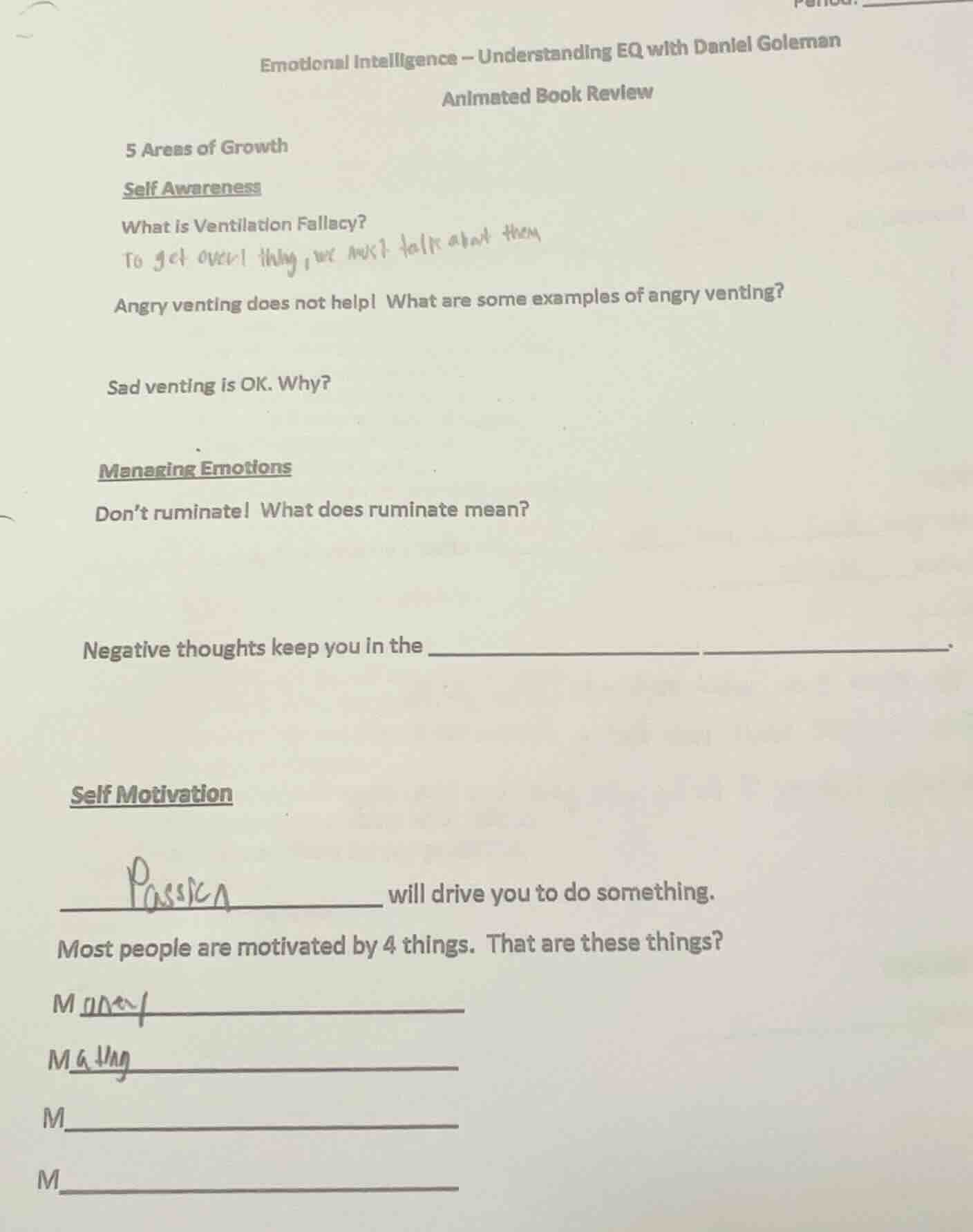
emotional intelligence – understanding eq with daniel goleman
animated book review
5 areas of growth
self awareness
what is ventilation fallacy?
to get over a thing, we must talk about them
angry venting does not help! what are some examples of angry venting?
sad venting is ok. why?
managing emotions
don’t ruminate! what does ruminate mean?
negative thoughts keep you in the ____________ ____________.
self motivation
__________ will drive you to do something.
most people are motivated by 4 things. that are these things?
m______
m______
m______
m______
All answers are based on Daniel Goleman's framework of Emotional Intelligence:
- Ventilation Fallacy: The false belief that expressing anger aggressively will resolve it.
- Angry venting examples: Yelling insults at someone, slamming objects while ranting, or repeatedly rehashing a slight with hostile language.
- Sad venting is OK: It fosters connection, allows emotional processing, and reduces feelings of isolation rather than escalating harm.
- Ruminate: To repeatedly dwell on negative thoughts or feelings without productive resolution.
- Negative thoughts fill-in: Negative thoughts keep you in the past (or a cycle of negativity).
- Self Motivation fill-in: Passion will drive you to do something.
- Four motivators (starting with M): Based on common EQ frameworks, these are Mastery, Meaning, Money, and Recognition (or "Membership/Belonging").

Snap & solve any problem in the app
Get step-by-step solutions on Sovi AI
Photo-based solutions with guided steps
Explore more problems and detailed explanations
- Ventilation Fallacy: The myth that aggressive anger release fixes negative feelings.
- Angry venting examples: Yelling at a coworker, smashing a cup while complaining, or sending hostile, repetitive texts about a conflict.
- Sad venting is OK: It builds empathy, helps process grief/loss, and lowers emotional distress.
- Ruminate: To obsess over negative experiences/thoughts loopingly.
- Negative thoughts keep you in the cycle of negative emotion (or past).
- Passion will drive you to do something.
- The four motivators:
- Mastery
- Meaning
- Money
- Membership (Belonging/Recognition)