QUESTION IMAGE
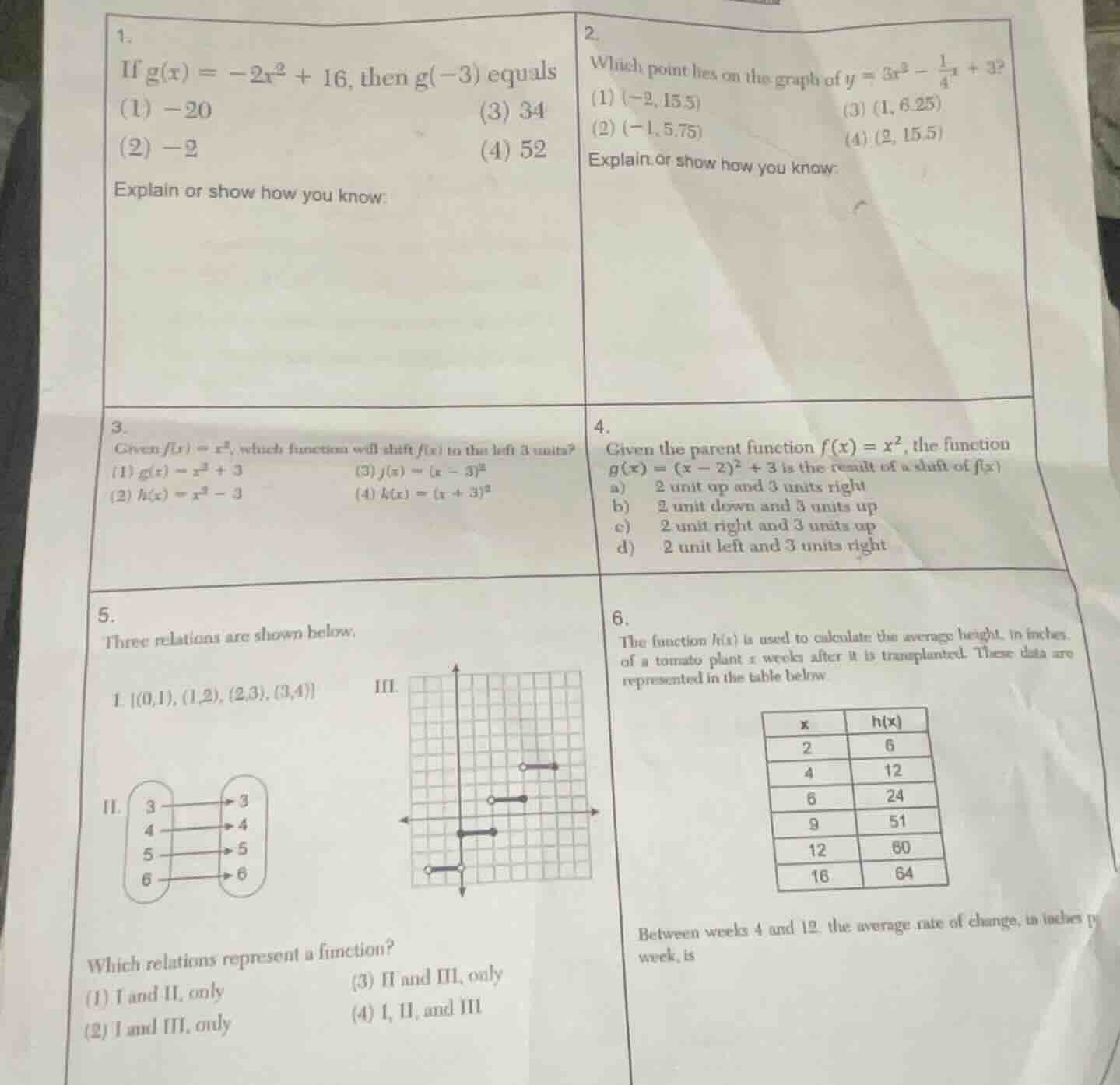
Question
1.
if $g(x) = -2x^2 + 16$, then $g(-3)$ equals
(1) $-20$ \t\t\t(3) $34$
(2) $-2$ \t\t\t(4) $52$
explain or show how you know:
2.
which point lies on the graph of $y = 3x^2 - \frac{1}{4}x + 3$?
(1) $(-2, 15.5)$ \t\t(3) $(1, 6.25)$
(2) $(-1, 5.75)$ \t\t(4) $(2, 15.5)$
explain or show how you know:
3.
given $f(x) = x^2$, which function will shift $f(x)$ to the left 3 units?
(1) $g(x) = x^2 + 3$ \t\t(3) $j(x) = (x - 3)^2$
(2) $h(x) = x^2 - 3$ \t\t(4) $k(x) = (x + 3)^2$
4.
given the parent function $f(x) = x^2$, the function $g(x) = (x - 2)^2 + 3$ is the result of a shift of $f(x)$
a) 2 unit up and 3 units right
b) 2 unit down and 3 units up
c) 2 unit right and 3 units up
d) 2 unit left and 3 units right
5.
three relations are shown below:
i. ${(0,1), (1,2), (2,3), (3,4)}$
ii.
diagram of a mapping from 3,4,5,6 to 3,4,5,6
iii.
diagram of a graph with points
which relations represent a function?
(1) i and ii, only \t\t(3) ii and iii, only
(2) i and iii, only \t\t(4) i, ii, and iii
6.
the function $h(x)$ is used to calculate the average height, in inches, of a tomato plant $x$ weeks after it is transplanted. these data are represented in the table below:
| $x$ | $h(x)$ |
|---|---|
| 4 | 12 |
| 6 | 24 |
| 9 | 51 |
| 12 | 80 |
| 16 | 64 |
between weeks 4 and 12, the average rate of change, in inches per week, is
Question 1
Step1: Substitute \( x = -3 \) into \( g(x) \)
\( g(-3) = -2(-3)^2 + 16 \)
Step2: Calculate the square and multiply
\( (-3)^2 = 9 \), so \( -2\times9 = -18 \)
Step3: Add 16 to the result
\( -18 + 16 = -2 \)
We check each point by substituting \( x \) into the equation \( y = 3x^2 - \frac{1}{4}x + 3 \) and see if \( y \) matches.
For point (1) \((-2, 15.5)\):
\( y = 3(-2)^2 - \frac{1}{4}(-2) + 3 = 3\times4 + 0.5 + 3 = 12 + 0.5 + 3 = 15.5 \). This matches. But let's check others to be sure.
For point (2) \((-1, 5.75)\):
\( y = 3(-1)^2 - \frac{1}{4}(-1) + 3 = 3 + 0.25 + 3 = 6.25
eq 5.75 \)
For point (3) \((1, 6.25)\):
\( y = 3(1)^2 - \frac{1}{4}(1) + 3 = 3 - 0.25 + 3 = 5.75
eq 6.25 \)
For point (4) \((2, 15.5)\):
\( y = 3(2)^2 - \frac{1}{4}(2) + 3 = 12 - 0.5 + 3 = 14.5
eq 15.5 \)
So only point (1) lies on the graph.
The transformation rule for horizontal shifts of a function \( f(x) \) is: \( f(x + h) \) shifts \( f(x) \) left by \( h \) units, \( f(x - h) \) shifts \( f(x) \) right by \( h \) units. For vertical shifts, \( f(x) + k \) shifts up by \( k \), \( f(x)-k \) shifts down by \( k \). Here we need a left shift of 3 units for \( f(x)=x^2 \), so the function should be \( f(x + 3)=(x + 3)^2 \), which is \( k(x)=(x + 3)^2 \).

Snap & solve any problem in the app
Get step-by-step solutions on Sovi AI
Photo-based solutions with guided steps
Explore more problems and detailed explanations
(2) \(-2\)