QUESTION IMAGE
Question
equations: linear combinations
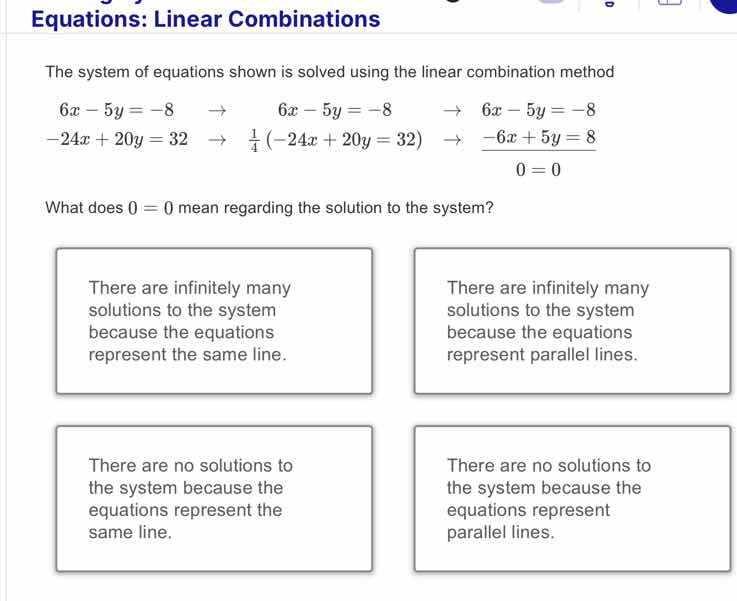
the system of equations shown is solved using the linear combination method
$6x - 5y = -8 \quad \to \quad 6x - 5y = -8 \quad \to \quad 6x - 5y = -8$
$-24x + 20y = 32 \quad \to \quad \frac{1}{4}(-24x + 20y = 32) \quad \to \quad \underline{-6x + 5y = 8}$
$\quad \quad \quad \quad \quad \quad \quad \quad \quad \quad \quad \quad \quad \quad \quad \quad \quad \quad \quad 0 = 0$
what does $0 = 0$ mean regarding the solution to the system?
- there are infinitely many solutions to the system because the equations represent the same line.
- there are infinitely many solutions to the system because the equations represent parallel lines.
- there are no solutions to the system because the equations represent the same line.
- there are no solutions to the system because the equations represent parallel lines.
- First, recall the properties of systems of linear equations:
- If we have a system of two linear equations \(a_1x + b_1y=c_1\) and \(a_2x + b_2y = c_2\), when we use the linear combination method (elimination method) and end up with a statement like \(0 = 0\), it means the two equations are dependent (they represent the same line).
- Let's analyze the given equations. The second equation \(-24x + 20y=32\) can be simplified. If we multiply the first equation \(6x - 5y=-8\) by \(- 4\), we get \(-24x+20y = 32\), which is exactly the second equation. So the two equations are not parallel (parallel lines would have the same slope but different y - intercepts, and would lead to a contradiction like \(0 = k\) where \(k
eq0\) when using elimination). When the two equations represent the same line, every point on the line is a solution, so there are infinitely many solutions.
- Now let's analyze the options:
- Option 1: "There are infinitely many solutions to the system because the equations represent the same line." This is correct.
- Option 2: "There are infinitely many solutions to the system because the equations represent parallel lines." Parallel lines have no solutions (they never intersect), so this is incorrect.
- Option 3: "There are no solutions to the system because the equations represent the same line." If two equations represent the same line, they have infinitely many solutions (all points on the line), so this is incorrect.
- Option 4: "There are no solutions to the system because the equations represent parallel lines." While parallel lines have no solutions, in our case the equations are not parallel (they are the same line), so this is incorrect.

Snap & solve any problem in the app
Get step-by-step solutions on Sovi AI
Photo-based solutions with guided steps
Explore more problems and detailed explanations
There are infinitely many solutions to the system because the equations represent the same line.