QUESTION IMAGE
Question
equivalent experience_ma.912.ar.5.6
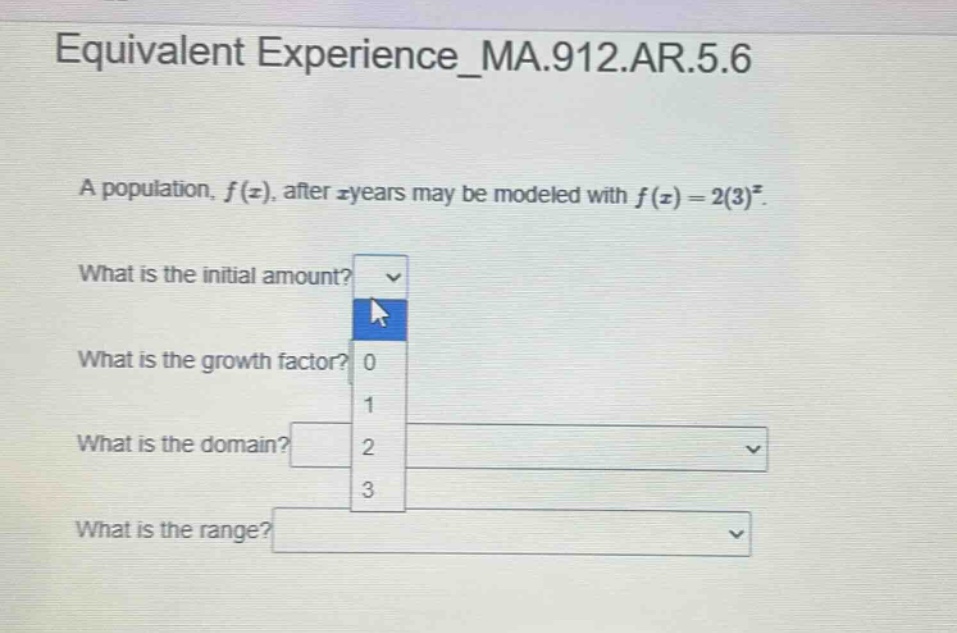
a population, f(x), after x years may be modeled with f(x) = 2(3)^x.
what is the initial amount?
what is the growth factor?
what is the domain?
what is the range?
Step1: Recall the exponential function form
The general form of an exponential function is \( f(x) = a(b)^x \), where \( a \) is the initial amount, \( b \) is the growth factor (\( b>1 \) for growth, \( 0 < b < 1 \) for decay), \( x \) is the independent variable (usually time).
Step2: Find the initial amount
For the function \( f(x)=2(3)^x \), compare with \( f(x) = a(b)^x \). When \( x = 0 \), \( f(0)=2(3)^0=2\times1 = 2 \). Also, by the form, \( a = 2 \), so the initial amount is \( 2 \).
Step3: Find the growth factor
Comparing \( f(x)=2(3)^x \) with \( f(x) = a(b)^x \), we see that \( b = 3 \). Since \( 3>1 \), it is a growth factor, so the growth factor is \( 3 \).
Step4: Determine the domain
The domain of an exponential function \( f(x)=a(b)^x \) is all real numbers because \( x \) (representing years here, but in the function, \( x \) can be any real number in the mathematical model) can take any real value. So the domain is all real numbers (or \( (-\infty, \infty) \)).
Step5: Determine the range
For the function \( f(x)=2(3)^x \), since \( 3^x>0 \) for all real \( x \), then multiplying by \( 2 \) (a positive number) gives \( 2(3)^x>0 \). So the range is all positive real numbers (or \( (0, \infty) \)).

Snap & solve any problem in the app
Get step-by-step solutions on Sovi AI
Photo-based solutions with guided steps
Explore more problems and detailed explanations
- Initial amount: \( 2 \)
- Growth factor: \( 3 \)
- Domain: All real numbers (or \( (-\infty, \infty) \))
- Range: All positive real numbers (or \( (0, \infty) \))