QUESTION IMAGE
Question
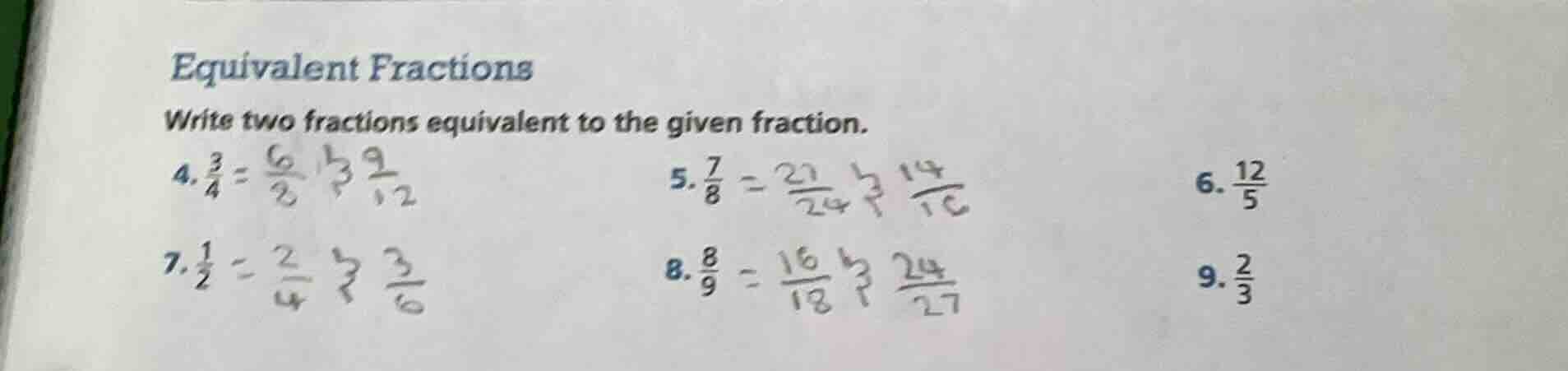
equivalent fractions
write two fractions equivalent to the given fraction.
- \\(\frac{3}{4}\\)
- \\(\frac{7}{8}\\)
- \\(\frac{12}{5}\\)
- \\(\frac{1}{2}\\)
- \\(\frac{8}{9}\\)
- \\(\frac{2}{3}\\)
Let's solve each problem one by one. The key concept is that to find equivalent fractions, we multiply the numerator and the denominator by the same non - zero number.
Problem 4: $\boldsymbol{\frac{3}{4}}$
Step 1: Multiply numerator and denominator by 2
To get an equivalent fraction, we multiply both the numerator and the denominator of $\frac{3}{4}$ by 2.
The formula for equivalent fractions is $\frac{a}{b}=\frac{a\times k}{b\times k}$, where $k
eq0$.
For $k = 2$, we have $\frac{3\times2}{4\times2}=\frac{6}{8}$.
Step 2: Multiply numerator and denominator by 3
For $k=3$, we calculate $\frac{3\times3}{4\times3}=\frac{9}{12}$.
So two equivalent fractions of $\frac{3}{4}$ are $\frac{6}{8}$ and $\frac{9}{12}$.
Problem 5: $\boldsymbol{\frac{7}{8}}$
Step 1: Multiply numerator and denominator by 2
Using the formula $\frac{a}{b}=\frac{a\times k}{b\times k}$ with $a = 7$, $b = 8$ and $k = 2$.
We get $\frac{7\times2}{8\times2}=\frac{14}{16}$.
Step 2: Multiply numerator and denominator by 3
For $k = 3$, we have $\frac{7\times3}{8\times3}=\frac{21}{24}$.
So two equivalent fractions of $\frac{7}{8}$ are $\frac{14}{16}$ and $\frac{21}{24}$.
Problem 6: $\boldsymbol{\frac{12}{5}}$
Step 1: Multiply numerator and denominator by 2
Applying the formula $\frac{a}{b}=\frac{a\times k}{b\times k}$ with $a = 12$, $b = 5$ and $k = 2$.
We obtain $\frac{12\times2}{5\times2}=\frac{24}{10}$.
Step 2: Multiply numerator and denominator by 3
For $k = 3$, we calculate $\frac{12\times3}{5\times3}=\frac{36}{15}$.
So two equivalent fractions of $\frac{12}{5}$ are $\frac{24}{10}$ and $\frac{36}{15}$.
Problem 7: $\boldsymbol{\frac{1}{2}}$
Step 1: Multiply numerator and denominator by 2
Using the formula $\frac{a}{b}=\frac{a\times k}{b\times k}$ with $a = 1$, $b = 2$ and $k = 2$.
We get $\frac{1\times2}{2\times2}=\frac{2}{4}$.
Step 2: Multiply numerator and denominator by 3
For $k = 3$, we have $\frac{1\times3}{2\times3}=\frac{3}{6}$.
So two equivalent fractions of $\frac{1}{2}$ are $\frac{2}{4}$ and $\frac{3}{6}$.
Problem 8: $\boldsymbol{\frac{8}{9}}$
Step 1: Multiply numerator and denominator by 2
Applying the formula $\frac{a}{b}=\frac{a\times k}{b\times k}$ with $a = 8$, $b = 9$ and $k = 2$.
We obtain $\frac{8\times2}{9\times2}=\frac{16}{18}$.
Step 2: Multiply numerator and denominator by 3
For $k = 3$, we calculate $\frac{8\times3}{9\times3}=\frac{24}{27}$.
So two equivalent fractions of $\frac{8}{9}$ are $\frac{16}{18}$ and $\frac{24}{27}$.
Problem 9: $\boldsymbol{\frac{2}{3}}$
Step 1: Multiply numerator and denominator by 2
Using the formula $\frac{a}{b}=\frac{a\times k}{b\times k}$ with $a = 2$, $b = 3$ and $k = 2$.
We get $\frac{2\times2}{3\times2}=\frac{4}{6}$.
Step 2: Multiply numerator and denominator by 3
For $k = 3$, we have $\frac{2\times3}{3\times3}=\frac{6}{9}$.
So two equivalent fractions of $\frac{2}{3}$ are $\frac{4}{6}$ and $\frac{6}{9}$.
Final Answers
- $\frac{6}{8}$, $\frac{9}{12}$
- $\frac{14}{16}$, $\frac{21}{24}$
- $\frac{24}{10}$, $\frac{36}{15}$
- $\frac{2}{4}$, $\frac{3}{6}$
- $\frac{16}{18}$, $\frac{24}{27}$
- $\frac{4}{6}$, $\frac{6}{9}$

Snap & solve any problem in the app
Get step-by-step solutions on Sovi AI
Photo-based solutions with guided steps
Explore more problems and detailed explanations
Let's solve each problem one by one. The key concept is that to find equivalent fractions, we multiply the numerator and the denominator by the same non - zero number.
Problem 4: $\boldsymbol{\frac{3}{4}}$
Step 1: Multiply numerator and denominator by 2
To get an equivalent fraction, we multiply both the numerator and the denominator of $\frac{3}{4}$ by 2.
The formula for equivalent fractions is $\frac{a}{b}=\frac{a\times k}{b\times k}$, where $k
eq0$.
For $k = 2$, we have $\frac{3\times2}{4\times2}=\frac{6}{8}$.
Step 2: Multiply numerator and denominator by 3
For $k=3$, we calculate $\frac{3\times3}{4\times3}=\frac{9}{12}$.
So two equivalent fractions of $\frac{3}{4}$ are $\frac{6}{8}$ and $\frac{9}{12}$.
Problem 5: $\boldsymbol{\frac{7}{8}}$
Step 1: Multiply numerator and denominator by 2
Using the formula $\frac{a}{b}=\frac{a\times k}{b\times k}$ with $a = 7$, $b = 8$ and $k = 2$.
We get $\frac{7\times2}{8\times2}=\frac{14}{16}$.
Step 2: Multiply numerator and denominator by 3
For $k = 3$, we have $\frac{7\times3}{8\times3}=\frac{21}{24}$.
So two equivalent fractions of $\frac{7}{8}$ are $\frac{14}{16}$ and $\frac{21}{24}$.
Problem 6: $\boldsymbol{\frac{12}{5}}$
Step 1: Multiply numerator and denominator by 2
Applying the formula $\frac{a}{b}=\frac{a\times k}{b\times k}$ with $a = 12$, $b = 5$ and $k = 2$.
We obtain $\frac{12\times2}{5\times2}=\frac{24}{10}$.
Step 2: Multiply numerator and denominator by 3
For $k = 3$, we calculate $\frac{12\times3}{5\times3}=\frac{36}{15}$.
So two equivalent fractions of $\frac{12}{5}$ are $\frac{24}{10}$ and $\frac{36}{15}$.
Problem 7: $\boldsymbol{\frac{1}{2}}$
Step 1: Multiply numerator and denominator by 2
Using the formula $\frac{a}{b}=\frac{a\times k}{b\times k}$ with $a = 1$, $b = 2$ and $k = 2$.
We get $\frac{1\times2}{2\times2}=\frac{2}{4}$.
Step 2: Multiply numerator and denominator by 3
For $k = 3$, we have $\frac{1\times3}{2\times3}=\frac{3}{6}$.
So two equivalent fractions of $\frac{1}{2}$ are $\frac{2}{4}$ and $\frac{3}{6}$.
Problem 8: $\boldsymbol{\frac{8}{9}}$
Step 1: Multiply numerator and denominator by 2
Applying the formula $\frac{a}{b}=\frac{a\times k}{b\times k}$ with $a = 8$, $b = 9$ and $k = 2$.
We obtain $\frac{8\times2}{9\times2}=\frac{16}{18}$.
Step 2: Multiply numerator and denominator by 3
For $k = 3$, we calculate $\frac{8\times3}{9\times3}=\frac{24}{27}$.
So two equivalent fractions of $\frac{8}{9}$ are $\frac{16}{18}$ and $\frac{24}{27}$.
Problem 9: $\boldsymbol{\frac{2}{3}}$
Step 1: Multiply numerator and denominator by 2
Using the formula $\frac{a}{b}=\frac{a\times k}{b\times k}$ with $a = 2$, $b = 3$ and $k = 2$.
We get $\frac{2\times2}{3\times2}=\frac{4}{6}$.
Step 2: Multiply numerator and denominator by 3
For $k = 3$, we have $\frac{2\times3}{3\times3}=\frac{6}{9}$.
So two equivalent fractions of $\frac{2}{3}$ are $\frac{4}{6}$ and $\frac{6}{9}$.
Final Answers
- $\frac{6}{8}$, $\frac{9}{12}$
- $\frac{14}{16}$, $\frac{21}{24}$
- $\frac{24}{10}$, $\frac{36}{15}$
- $\frac{2}{4}$, $\frac{3}{6}$
- $\frac{16}{18}$, $\frac{24}{27}$
- $\frac{4}{6}$, $\frac{6}{9}$