QUESTION IMAGE
Question
es of the russian revoluti
cause five: revolutions of march, 1917
date:
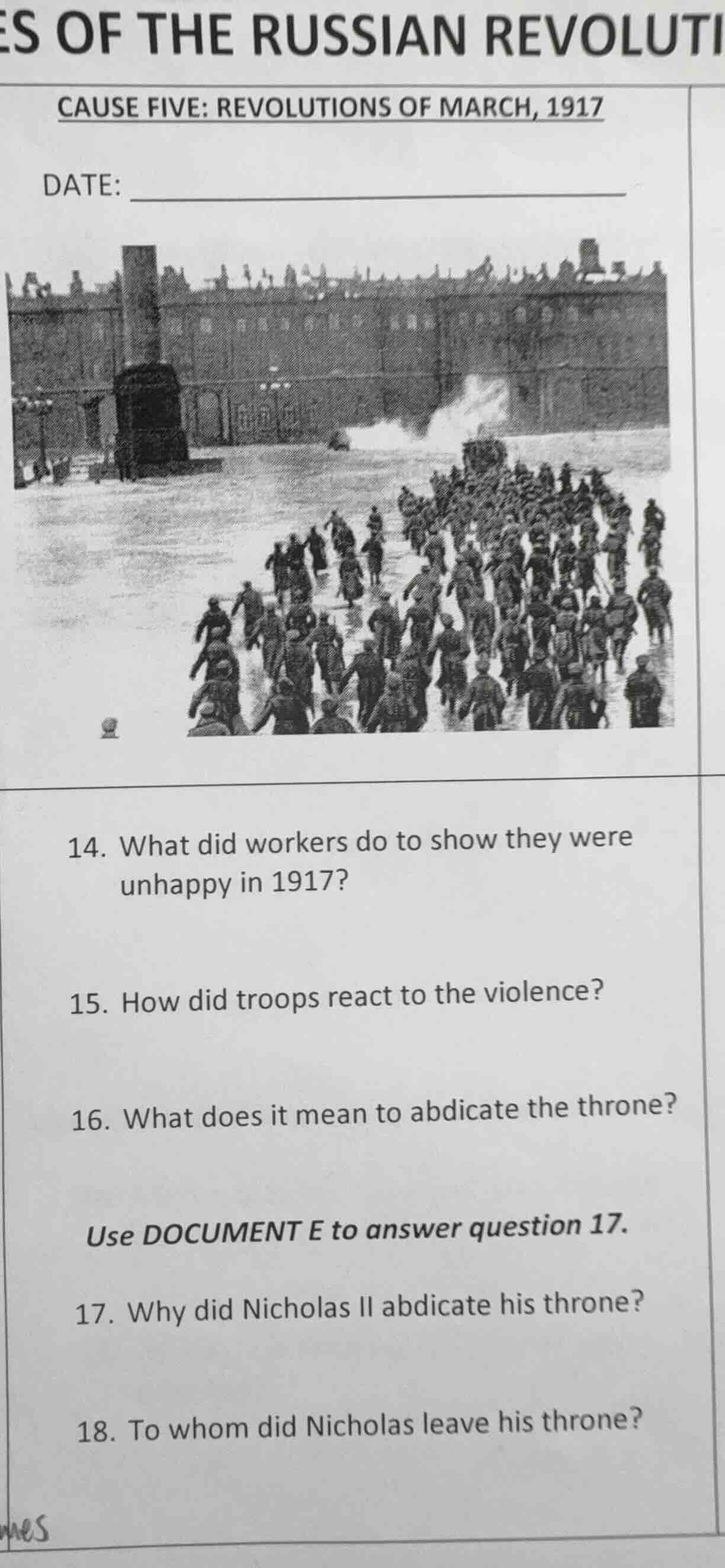
- what did workers do to show they were unhappy in 1917?
- how did troops react to the violence?
- what does it mean to abdicate the throne?
use document e to answer question 17.
- why did nicholas ii abdicate his throne?
- to whom did nicholas leave his throne?
Brief Explanations
- Workers in 1917 held mass strikes, organized protests, and marched in cities like Petrograd (St. Petersburg) to voice their anger over food shortages, poor working conditions, and Russia's involvement in World War I. Many also joined or supported revolutionary groups.
- Many troops sent to suppress the uprisings refused to fire on the protesters; instead, they defected and joined the revolutionary crowds, as they shared the same grievances over the war and poor conditions.
- To abdicate the throne means to voluntarily give up one's position as a monarch (king, tsar, emperor) and renounce all royal power and claim to the throne.
- (Note: Document E is not provided, but based on historical context) Nicholas II abdicated because widespread civil unrest, military defection, and loss of support from the ruling class and public made it impossible for him to maintain control of the government. The March 1917 revolution had completely undermined his authority.
- Nicholas II first tried to pass the throne to his brother, Grand Duke Michael Alexandrovich, but Michael refused to accept it without popular support. Effectively, he left no legitimate monarch in place, clearing the way for the provisional government.

Snap & solve any problem in the app
Get step-by-step solutions on Sovi AI
Photo-based solutions with guided steps
Explore more problems and detailed explanations
- They held mass strikes, protests, and marches (e.g., in Petrograd) over food shortages, poor working conditions, and World War I, and many joined revolutionary efforts.
- Many troops defected, refusing to fire on protesters and joining the revolutionary crowds instead.
- To voluntarily give up one's position and power as a monarch.
- (Historical context answer) He abdicated due to widespread civil unrest, military defection, and total loss of political authority amid the March 1917 revolution.
- He attempted to pass the throne to his brother Grand Duke Michael Alexandrovich, who refused to accept it, leaving no legitimate monarch in power.