QUESTION IMAGE
Question
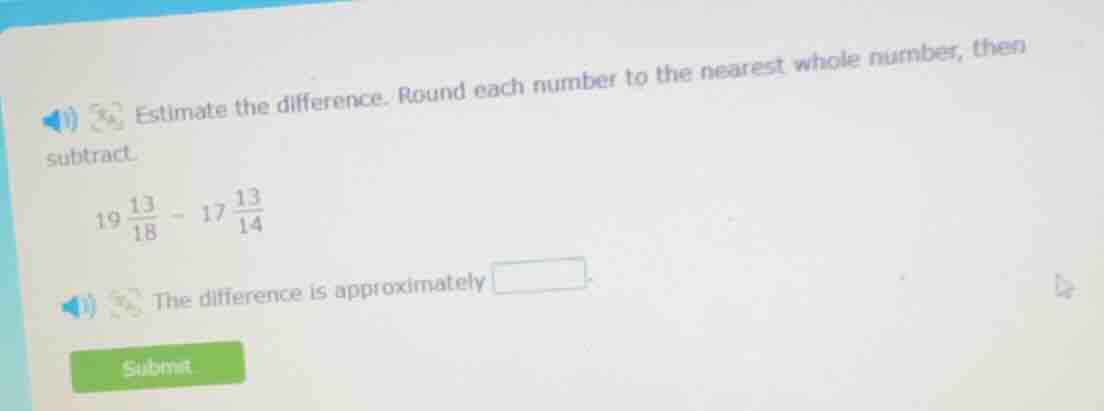
estimate the difference. round each number to the nearest whole number, then subtract.
$19 \frac{13}{18} - 17 \frac{13}{14}$
the difference is approximately \boxed{}.
Step1: Round \(19\frac{13}{18}\) to nearest whole number
Since \(\frac{13}{18}<\frac{1}{2}\)? No, \(\frac{13}{18}\approx0.72\), which is greater than \(0.5\)? Wait, no, to round to nearest whole number, for a mixed number \(a\frac{b}{c}\), if \(\frac{b}{c}\geq0.5\), we round up, else down. But actually, \(19\frac{13}{18}\): \(\frac{13}{18}\approx0.72\), so \(19 + 0.72\approx19.72\), nearest whole number is 20? Wait no, wait \(19\frac{13}{18}\): the fractional part is \(\frac{13}{18}\), which is more than \(\frac{1}{2}\) (since \(\frac{1}{2}=\frac{9}{18}\)), so we round up? Wait no, \(19\frac{13}{18}\) is between 19 and 20. \(\frac{13}{18}\approx0.72\), so \(19.72\), so nearest whole number is 20? Wait no, wait the problem says "round each number to the nearest whole number". Wait \(19\frac{13}{18}\): the integer part is 19, fractional part \(\frac{13}{18}\approx0.72\), so when rounding to nearest whole number, 19.72 rounds to 20? Wait no, 19.72 is closer to 20? Wait 19.72 - 19 = 0.72, 20 - 19.72 = 0.28, so yes, rounds to 20? Wait no, wait 19.72 is 19 + 0.72, so the nearest whole number is 20? Wait no, 19.72 is closer to 20? Wait 19.5 is the midpoint. 19.72 > 19.5, so yes, rounds to 20.
Wait, no, wait \(19\frac{13}{18}\): let's compute \(19 + \frac{13}{18}\). \(\frac{13}{18}\approx0.722\), so \(19.722\), which is closer to 20? Wait 19.722 - 19 = 0.722, 20 - 19.722 = 0.278, so yes, rounds to 20.
Now \(17\frac{13}{14}\): \(\frac{13}{14}\approx0.928\), so \(17 + 0.928 = 17.928\), which is closer to 18? Wait 17.928 - 17 = 0.928, 18 - 17.928 = 0.072, so rounds to 18.
Wait, but wait, maybe I made a mistake. Wait, the problem says "round each number to the nearest whole number". So \(19\frac{13}{18}\): the fractional part is \(\frac{13}{18}\), which is more than \(\frac{1}{2}\) (since \(\frac{1}{2}=\frac{9}{18}\)), so we round up the whole number part? Wait no, the whole number part is 19, and the fractional part is \(\frac{13}{18}\), so \(19\frac{13}{18}\) is 19 + 0.722, so when rounding to the nearest whole number, we look at the decimal part. If the decimal part is 0.5 or more, we round up, else down. So 0.722 >= 0.5, so round 19 up to 20? Wait no, 19.722 is between 19 and 20, and since 0.722 > 0.5, we round to 20.
For \(17\frac{13}{14}\): \(\frac{13}{14}\approx0.928\), so 17.928, which is between 17 and 18, and 0.928 > 0.5, so round to 18.
Wait, but wait, maybe the problem is that when the fractional part is less than 1, but maybe I messed up. Wait, let's check again.
Wait \(19\frac{13}{18}\): the fractional part is \(\frac{13}{18}\), which is less than 1, so the number is 19 + a fraction less than 1. To round to nearest whole number, we see if the fraction is >= 0.5. \(\frac{13}{18}\approx0.72\), which is >= 0.5, so we round up the whole number: 19 + 1 = 20? Wait no, rounding a mixed number to the nearest whole number: if the fraction is >= 0.5, we add 1 to the whole number, else keep the whole number. So \(19\frac{13}{18}\): \(\frac{13}{18}\approx0.72\geq0.5\), so round to 20. \(17\frac{13}{14}\): \(\frac{13}{14}\approx0.93\geq0.5\), so round to 18.
Step2: Subtract the rounded numbers
Now subtract the rounded numbers: 20 - 18 = 2? Wait, but wait, maybe I made a mistake in rounding. Wait, let's check again.
Wait, \(19\frac{13}{18}\): the fractional part is \(\frac{13}{18}\), which is less than 1, so the number is 19.722..., so nearest whole number is 20? Wait 19.722 is closer to 20 than 19? Yes, because 19.722 - 19 = 0.722, 20 - 19.722 = 0.278, so yes, 20.
\(17\frac{13}{14}\): 17.928..., which is closer to 18 than 17? 17.…

Snap & solve any problem in the app
Get step-by-step solutions on Sovi AI
Photo-based solutions with guided steps
Explore more problems and detailed explanations
2