QUESTION IMAGE
Question
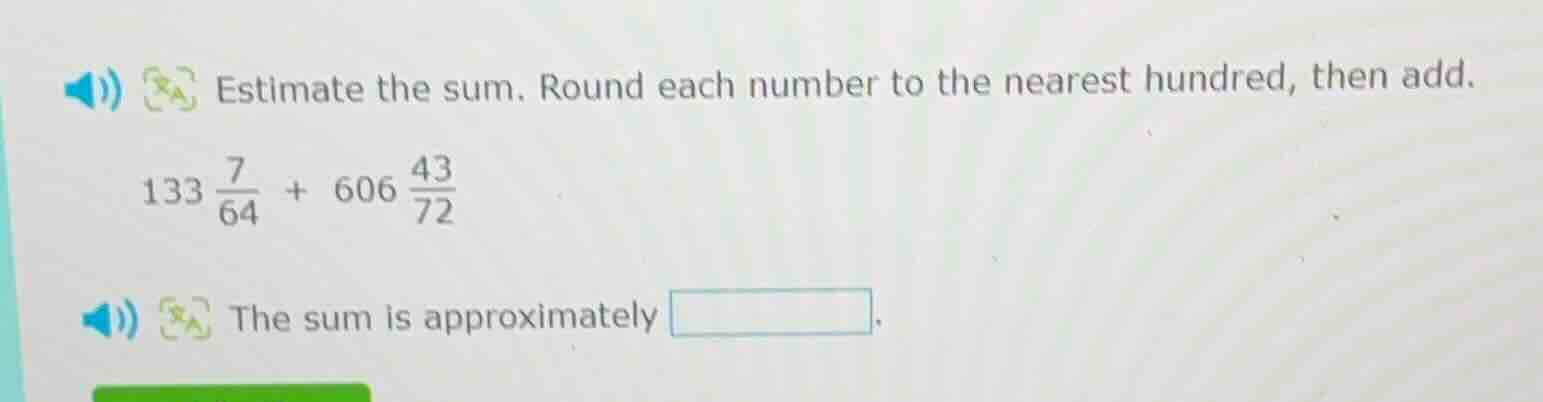
estimate the sum. round each number to the nearest hundred, then add.
$133\frac{7}{64} + 606\frac{43}{72}$
the sum is approximately \boxed{}
Step1: Round the first number
The first number is \(133\frac{7}{64}\). The whole number part is 133. To round to the nearest hundred, we look at the tens digit (3), which is less than 5, so we round down to 100.
Step2: Round the second number
The second number is \(606\frac{43}{72}\). The whole number part is 606. To round to the nearest hundred, we look at the tens digit (0), and since the hundreds digit is 6, and the tens and units are 06, we round to 600 (wait, no, 606 to the nearest hundred: the hundreds digit is 6, the tens digit is 0, so we look at the number 606. The nearest hundred to 606 is 600? Wait, no, 606 is closer to 600 or 700? The distance from 606 to 600 is 6, to 700 is 94. So we round 606 to 600? Wait, no, wait, 133 to the nearest hundred: 133 is between 100 and 200, closer to 100. 606 is between 600 and 700, closer to 600? Wait, no, 606: the hundreds digit is 6, the tens digit is 0, so when rounding to the nearest hundred, we look at the digit in the tens place. If the tens digit is less than 5, we round down, if 5 or more, round up. Wait, 606: tens digit is 0, so we round down to 600? Wait, no, 606 is 6 hundreds and 6 ones. Wait, no, 133: 1 hundred, 3 tens, 3 ones. Rounding to nearest hundred: 100. 606: 6 hundreds, 0 tens, 6 ones. Rounding to nearest hundred: 600? Wait, but 606 is 600 + 6, so the nearest hundred is 600? Wait, no, 600 is 600, 700 is 700. 606 - 600 = 6, 700 - 606 = 94. So yes, 606 rounds to 600. Wait, but wait, maybe I made a mistake. Wait, 133: 133 is 100 + 33, so nearest hundred is 100. 606: 606 is 600 + 6, so nearest hundred is 600. Then we add the rounded numbers: 100 + 600 = 700? Wait, but wait, let's check again. Wait, the first number is \(133\frac{7}{64}\), which is approximately 133 (since the fraction is small). 133 rounded to the nearest hundred: 100? Wait, 133 is closer to 100 than 200? Wait, 133 - 100 = 33, 200 - 133 = 67. So yes, 133 rounds to 100. 606: 606 - 600 = 6, 700 - 606 = 94, so 600. Then 100 + 600 = 700. Wait, but maybe I messed up the rounding. Wait, the problem says "round each number to the nearest hundred". So the numbers are \(133\frac{7}{64}\) and \(606\frac{43}{72}\). So we take the whole number part, 133 and 606, and round each to the nearest hundred. So 133 rounded to nearest hundred: 100. 606 rounded to nearest hundred: 600. Then add them: 100 + 600 = 700.

Snap & solve any problem in the app
Get step-by-step solutions on Sovi AI
Photo-based solutions with guided steps
Explore more problems and detailed explanations
700