QUESTION IMAGE
Question
ethics (18181)
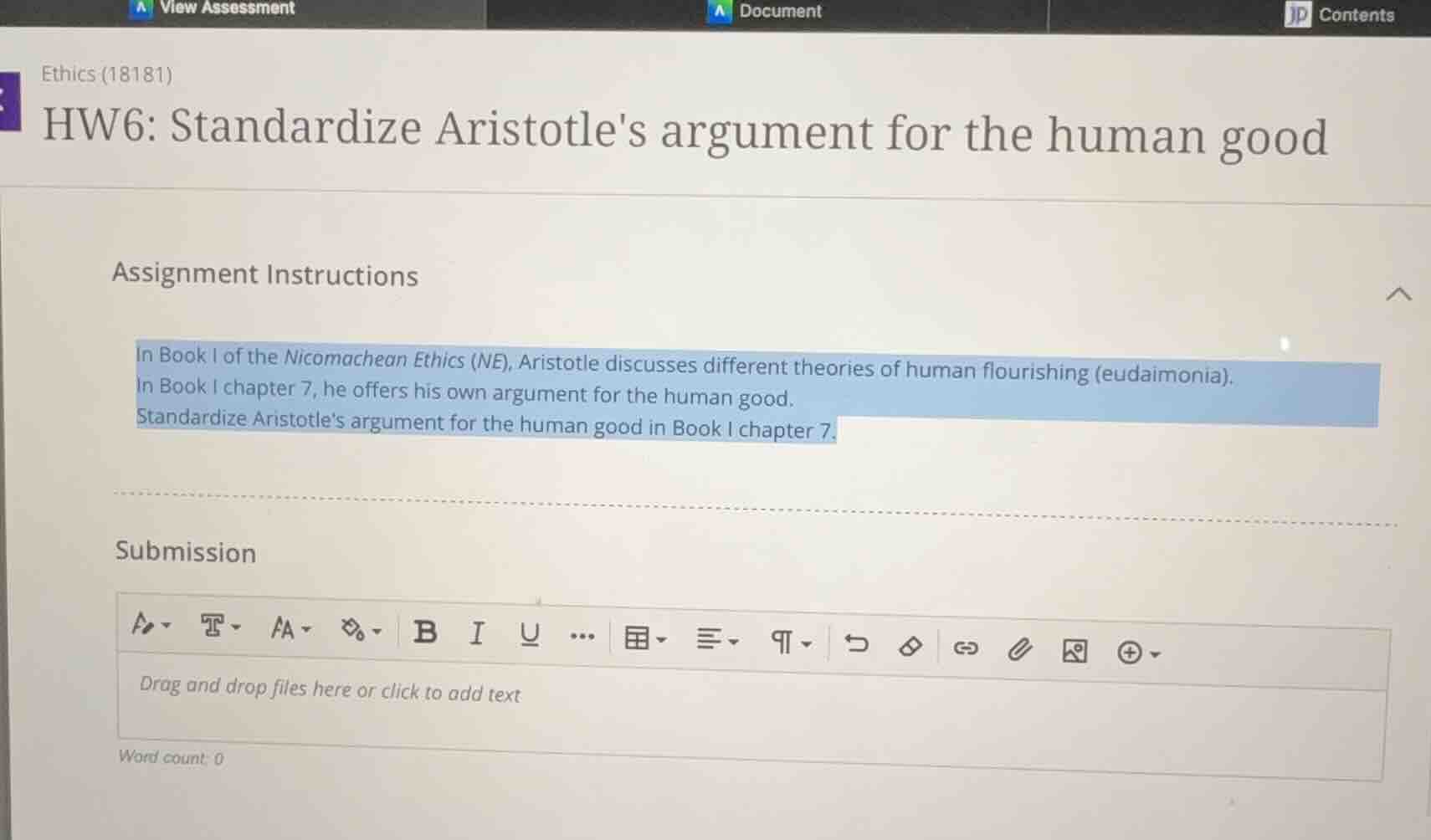
hw6: standardize aristotles argument for the human good
assignment instructions
in book i of the nicomachean ethics (ne), aristotle discusses different theories of human flourishing (eudaimonia).
in book i chapter 7, he offers his own argument for the human good.
standardize aristotles argument for the human good in book i chapter 7.
submission
drag and drop files here or click to add text
word count: 0
This standardization breaks down Aristotle's core deductive argument from Nicomachean Ethics Book I, Chapter 7, into clear, sequential premises leading to his conclusion about the human good.
- Premise 1: All things have a specific function (ergon) that defines their proper activity.
- Premise 2: Humans have a unique function, distinct from the functions of plants (growth/nutrition) and animals (sensation/appetite). This unique function is rational activity (activity of the soul in accordance with reason, or not without reason).
- Premise 3: The good of a thing lies in performing its function well.
- Premise 4: Performing a function well means doing it in accordance with the appropriate virtue (excellence) of that thing.
- Conclusion: Therefore, the human good (eudaimonia) is activity of the soul in accordance with virtue, and if there are multiple virtues, in accordance with the highest and most complete virtue, over a complete life.

Snap & solve any problem in the app
Get step-by-step solutions on Sovi AI
Photo-based solutions with guided steps
Explore more problems and detailed explanations
Standardized Argument for Aristotle's Human Good (NE I.7):
- Every natural thing has a characteristic function (ergon).
- The human function is rational activity (activity of the soul in accord with reason, or not without reason), as it is the activity unique to humans (separating them from plants and non-rational animals).
- The good of a thing consists in performing its function well.
- Performing a function well requires acting in accordance with the relevant virtue (excellence) of that thing.
- Thus, the human good (eudaimonia) is activity of the soul in accordance with virtue, and if there are multiple virtues, in accordance with the highest and most complete virtue, exercised over a complete lifetime.