QUESTION IMAGE
Question
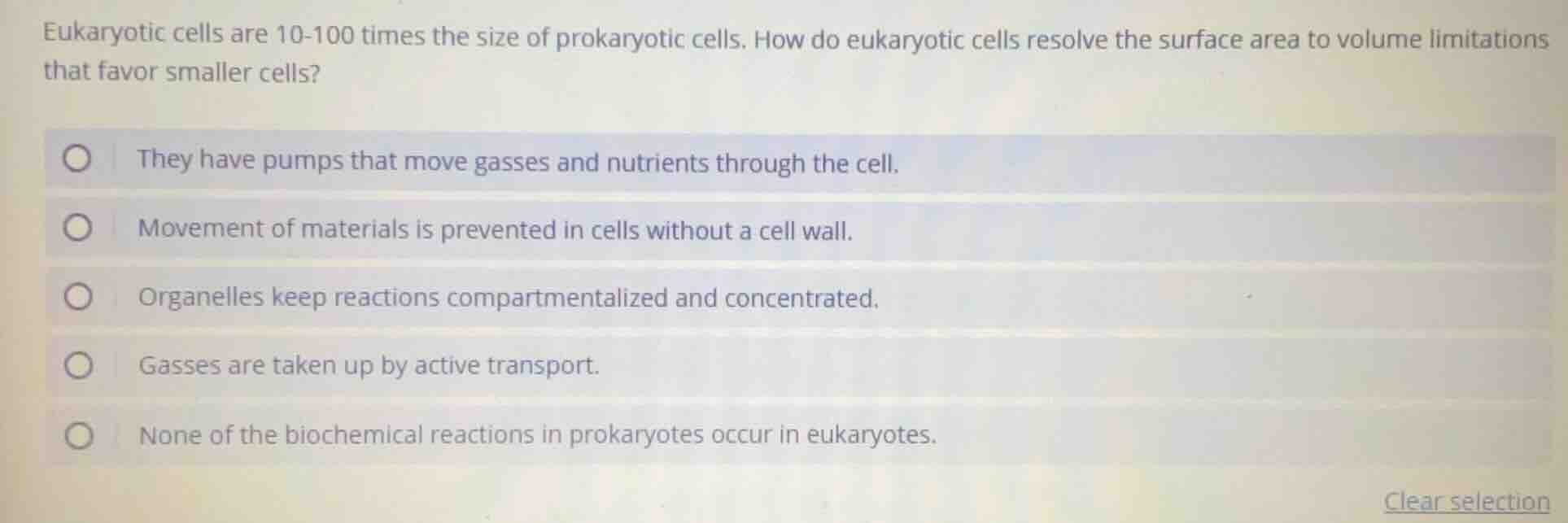
eukaryotic cells are 10-100 times the size of prokaryotic cells. how do eukaryotic cells resolve the surface area to volume limitations that favor smaller cells? they have pumps that move gasses and nutrients through the cell. movement of materials is prevented in cells without a cell wall. organelles keep reactions compartmentalized and concentrated. gasses are taken up by active transport. none of the biochemical reactions in prokaryotes occur in eukaryotes.
Larger cells face surface area to volume issues where the surface area (for nutrient/gas exchange) does not scale with volume. Eukaryotes solve this by using membrane-bound organelles that compartmentalize reactions, reducing the effective volume each region needs to service, and concentrating reactants to support efficient metabolism despite the larger cell size. Other options are incorrect: pumps do not resolve the core surface area/volume limitation, movement is not prevented in wall-less cells, gases use passive transport, and eukaryotes share many biochemical reactions with prokaryotes.

Snap & solve any problem in the app
Get step-by-step solutions on Sovi AI
Photo-based solutions with guided steps
Explore more problems and detailed explanations
Organelles keep reactions compartmentalized and concentrated.