QUESTION IMAGE
Question
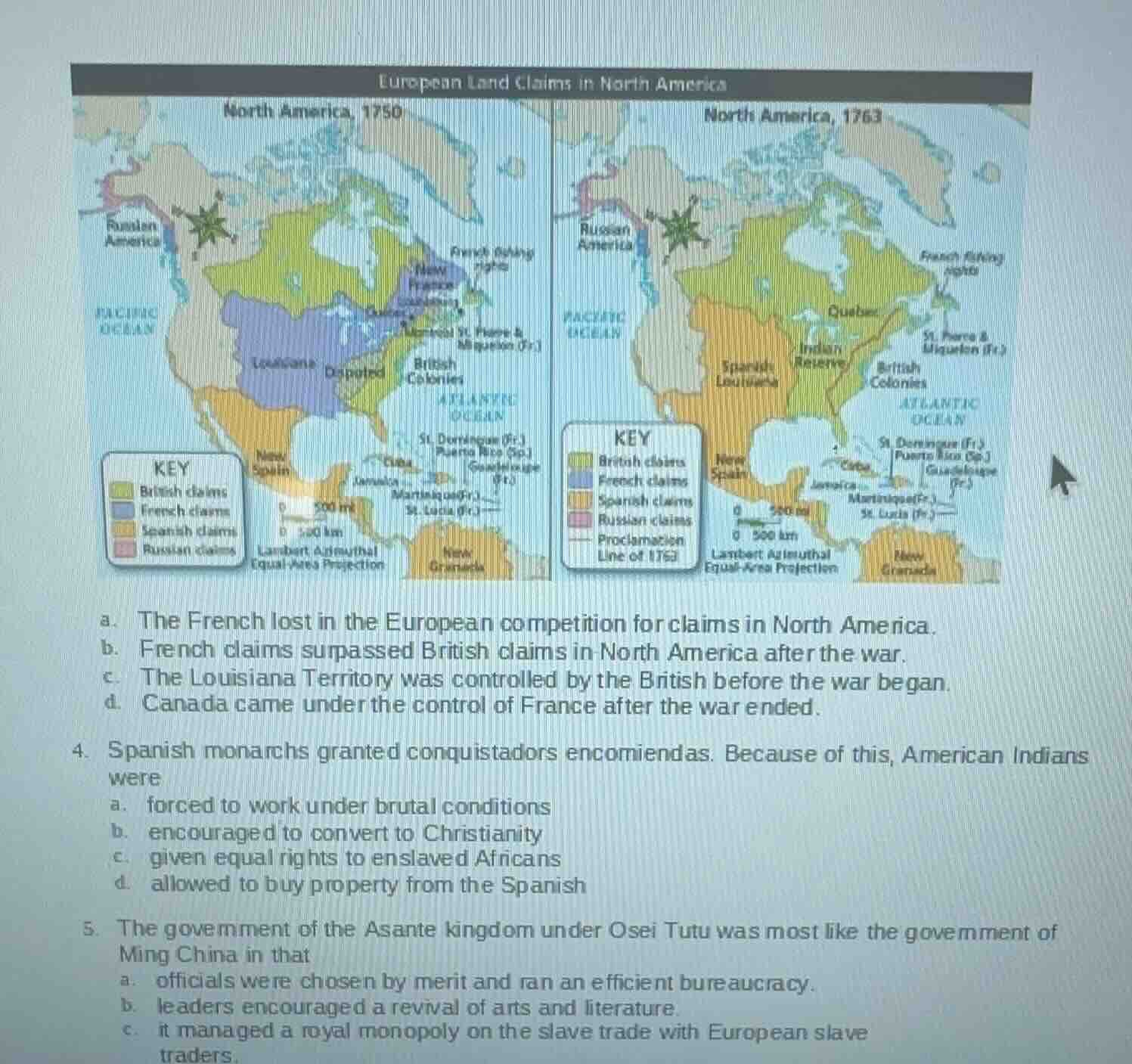
european land claims in north america
north america, 1750
north america, 1763
key
british claims
french claims
spanish claims
russian claims
0 500 mi
0 500 km
lambert azimuthal equal-area projection
key
british claims
french claims
spanish claims
russian claims
proclamation line of 1763
0 500 mi
0 500 km
lambert azimuthal equal-area projection
a. the french lost in the european competition for claims in north america.
b. french claims surpassed british claims in north america after the war.
c. the louisiana territory was controlled by the british before the war began.
d. canada came under the control of france after the war ended.
- spanish monarchs granted conquistadors encomiendas. because of this, american indians were
a. forced to work under brutal conditions
b. encouraged to convert to christianity
c. given equal rights to enslaved africans
d. allowed to buy property from the spanish
- the government of the asante kingdom under osei tutu was most like the government of ming china in that
a. officials were chosen by merit and ran an efficient bureaucracy.
b. leaders encouraged a revival of arts and literature.
c. it managed a royal monopoly on the slave trade with european slave traders.
For the map-based question (question 3):
- Compare the 1750 and 1763 maps: French claims (purple in 1750) are nearly gone in 1763, meaning France lost most North American land claims. Option b is wrong because British claims expanded beyond French ones. Option c is wrong because Louisiana was French-controlled before the war. Option d is wrong because Canada became British after the war.
For question 4:
Encomiendas were a system where conquistadors were granted land and the labor of Indigenous peoples, who were forced to work under harsh, brutal conditions. Option b is a related but not direct effect of the encomienda system itself; options c and d are false as Indigenous people had no such rights.
For question 5:
Osei Tutu's Asante kingdom had a centralized, merit-based bureaucracy with efficient administrative officials, similar to Ming China's merit-based civil service system. Option b is not a shared trait, option c is incorrect as Ming China did not have a slave trade monopoly with Europeans.

Snap & solve any problem in the app
Get step-by-step solutions on Sovi AI
Photo-based solutions with guided steps
Explore more problems and detailed explanations
- a. The French lost in the European competition for claims in North America.
- a. forced to work under brutal conditions
- a. officials were chosen by merit and ran an efficient bureaucracy.