QUESTION IMAGE
Question
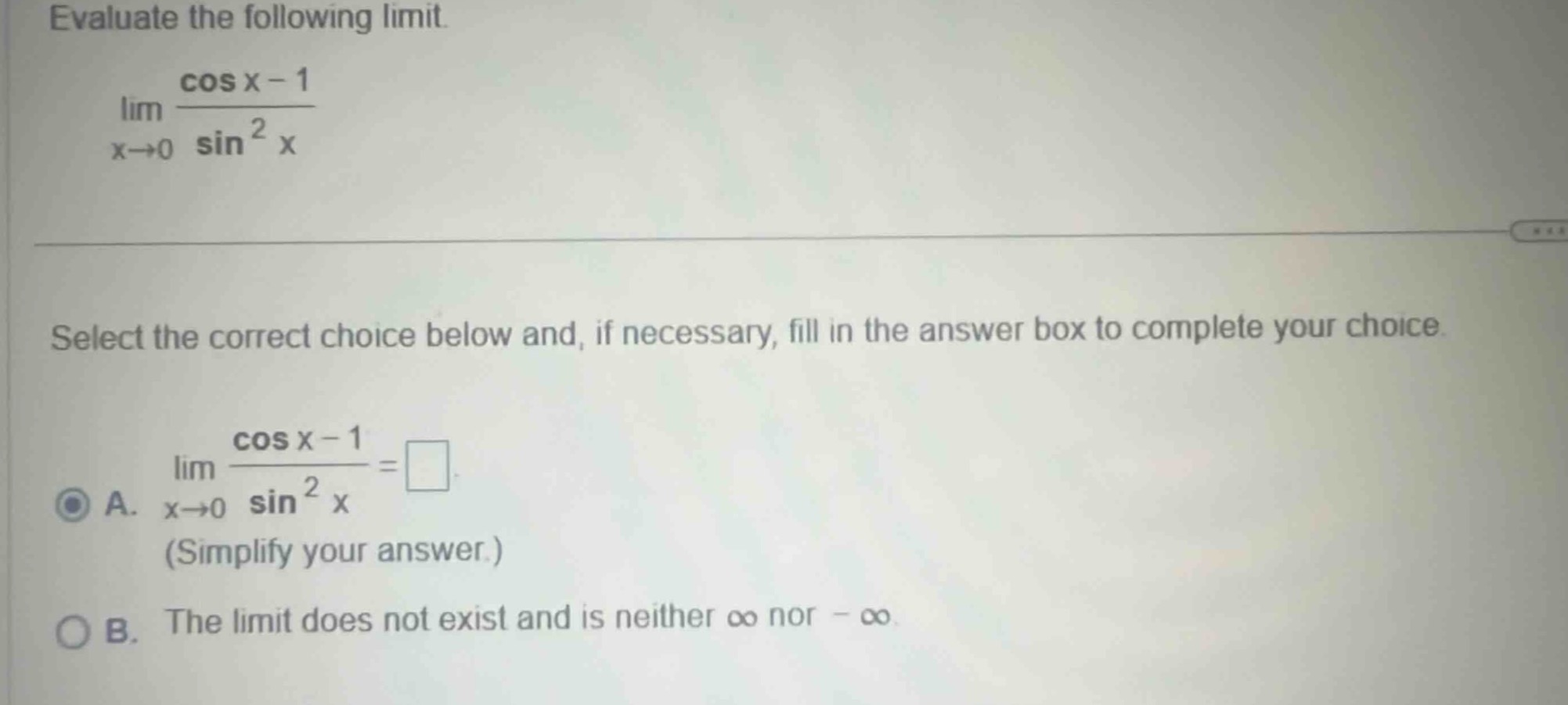
evaluate the following limit.
\lim_{x\to 0} \frac{\cos x - 1}{\sin^2 x}
select the correct choice below and, if necessary, fill in the answer box to complete your choice.
\bigcirc a. \lim_{x\to 0} \frac{\cos x - 1}{\sin^2 x} = \square.
(simplify your answer.)
\bigcirc b. the limit does not exist and is neither \infty nor -\infty.
Step1: Use trigonometric identity
Recall the Pythagorean identity \( \sin^{2}x = 1-\cos^{2}x=(1 - \cos x)(1+\cos x) \). Substitute this into the denominator of the limit:
\[
\lim_{x
ightarrow0}\frac{\cos x - 1}{\sin^{2}x}=\lim_{x
ightarrow0}\frac{\cos x - 1}{(1 - \cos x)(1+\cos x)}
\]
Step2: Simplify the fraction
Notice that \( \cos x - 1=-(1 - \cos x) \). So we can rewrite the numerator:
\[
\lim_{x
ightarrow0}\frac{-(1 - \cos x)}{(1 - \cos x)(1+\cos x)}
\]
Cancel out the common factor \( (1 - \cos x) \) (since \( x
ightarrow0 \), \( 1-\cos x
eq0 \) when \( x\) is near but not equal to 0):
\[
\lim_{x
ightarrow0}\frac{- 1}{1+\cos x}
\]
Step3: Evaluate the limit
Now we can substitute \( x = 0 \) into the simplified expression. Since \( \cos(0)=1 \), we have:
\[
\frac{-1}{1 + 1}=-\frac{1}{2}
\]

Snap & solve any problem in the app
Get step-by-step solutions on Sovi AI
Photo-based solutions with guided steps
Explore more problems and detailed explanations
\( -\frac{1}{2} \)