QUESTION IMAGE
Question
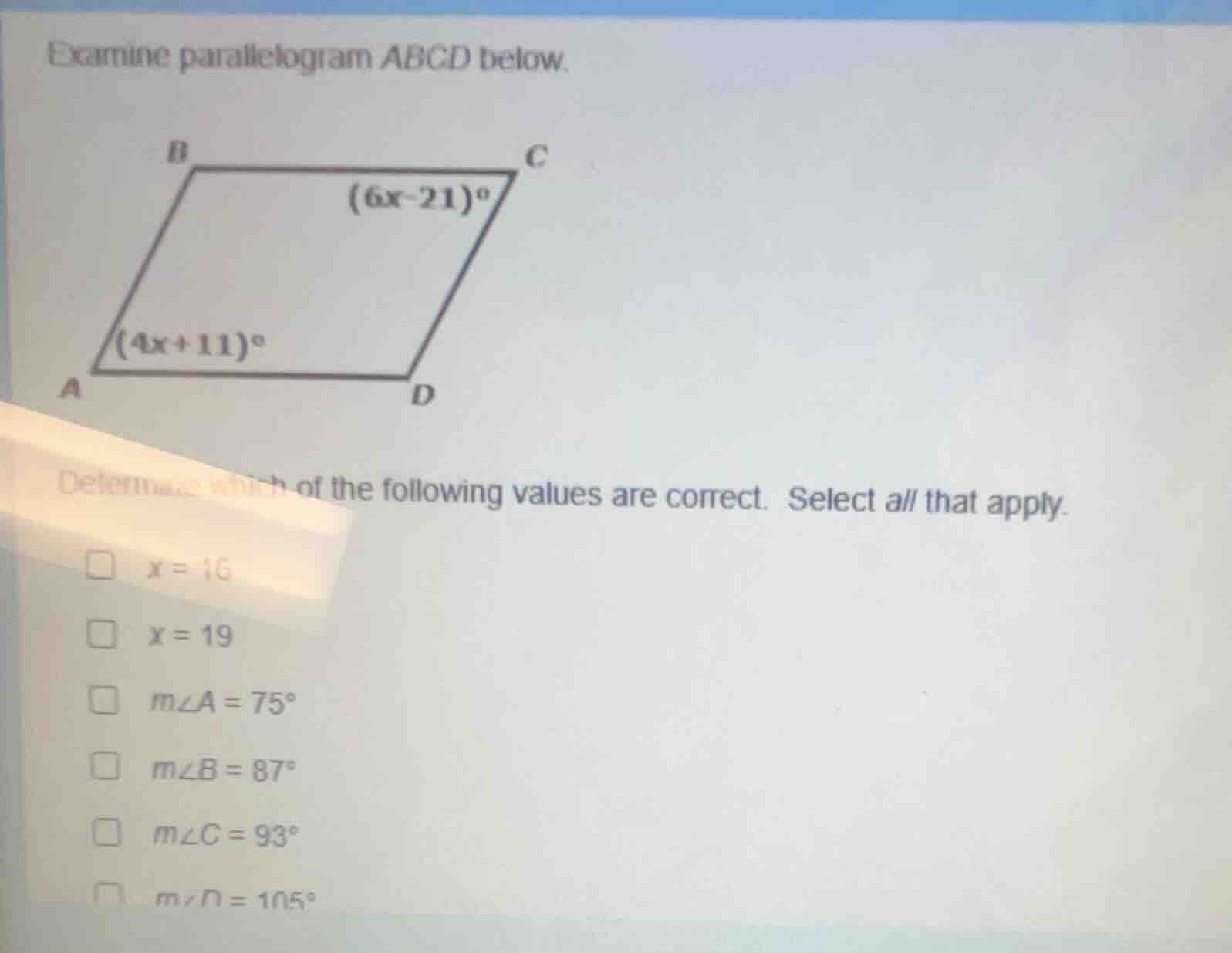
examine parallelogram abcd below.
determine which of the following values are correct. select all that apply.
□ x = 16
□ x = 19
□ m∠a = 75°
□ m∠b = 87°
□ m∠c = 93°
□ m∠d = 105°
Step1: Recall parallelogram angle property
In a parallelogram, consecutive angles are supplementary (sum to \(180^\circ\)), and opposite angles are equal. Here, \(\angle A\) and \(\angle C\) are opposite? Wait, no, \(\angle A\) and \(\angle B\) are consecutive? Wait, no, in parallelogram \(ABCD\), \(AB \parallel CD\) and \(AD \parallel BC\), so \(\angle A\) and \(\angle D\) are consecutive, \(\angle A\) and \(\angle B\) are consecutive? Wait, no, actually, \(\angle A\) and \(\angle C\) are opposite, \(\angle B\) and \(\angle D\) are opposite. Also, consecutive angles (like \(\angle A\) and \(\angle B\)) are supplementary? Wait, no, in a parallelogram, consecutive angles (adjacent angles) are supplementary. Wait, looking at the diagram, \(\angle A\) is at vertex \(A\), \(\angle C\) is at vertex \(C\). Wait, actually, in parallelogram \(ABCD\), \(AB \parallel CD\) and \(AD \parallel BC\), so \(\angle A\) and \(\angle B\) are adjacent (consecutive), \(\angle B\) and \(\angle C\) are adjacent, etc. Wait, but the angles given are \(\angle A = (4x + 11)^\circ\) and \(\angle C = (6x - 21)^\circ\). But in a parallelogram, opposite angles are equal. Wait, \(\angle A\) and \(\angle C\) are opposite? Wait, no, in parallelogram \(ABCD\), the vertices are in order, so \(A\) connected to \(B\) and \(D\), \(B\) connected to \(A\) and \(C\), \(C\) connected to \(B\) and \(D\), \(D\) connected to \(C\) and \(A\). So \(\angle A\) and \(\angle C\) are opposite angles, so they should be equal? Wait, but that would mean \(4x + 11 = 6x - 21\), but let's check. Wait, maybe I made a mistake. Wait, no, actually, in a parallelogram, consecutive angles are supplementary. Wait, \(\angle A\) and \(\angle B\) are consecutive, \(\angle B\) and \(\angle C\) are consecutive, so \(\angle A + \angle B = 180^\circ\), \(\angle B + \angle C = 180^\circ\), so \(\angle A = \angle C\) (opposite angles). Wait, yes, opposite angles in a parallelogram are equal. So \(\angle A = \angle C\)? Wait, no, wait, \(\angle A\) and \(\angle C\) are opposite, so they should be equal. Wait, but let's check the diagram again. The angle at \(A\) is \((4x + 11)^\circ\), angle at \(C\) is \((6x - 21)^\circ\). So if they are opposite, then \(4x + 11 = 6x - 21\). Let's solve that: \(4x + 11 = 6x - 21\) → \(11 + 21 = 6x - 4x\) → \(32 = 2x\) → \(x = 16\). Wait, but let's check another way. Wait, maybe \(\angle A\) and \(\angle B\) are consecutive, but the angles given are \(\angle A\) and \(\angle C\). Wait, maybe I misread the diagram. Wait, the diagram shows \(A\), \(B\), \(C\), \(D\) in order, so \(AB\) is top side? Wait, no, the diagram: \(A\) is bottom left, \(D\) is bottom right, \(B\) is top left, \(C\) is top right. So \(AD\) is bottom side, \(BC\) is top side, \(AB\) and \(CD\) are left and right sides. So \(\angle A\) is at bottom left, between \(AD\) and \(AB\); \(\angle C\) is at top right, between \(BC\) and \(CD\). So \(AB \parallel CD\) and \(AD \parallel BC\), so \(\angle A\) and \(\angle D\) are consecutive (along \(AD\)), \(\angle A\) and \(\angle B\) are consecutive (along \(AB\)). Wait, but the angles given are \(\angle A = (4x + 11)^\circ\) and \(\angle C = (6x - 21)^\circ\). In a parallelogram, opposite angles are equal, so \(\angle A = \angle C\)? Wait, no, \(\angle A\) and \(\angle C\) are opposite, so they should be equal. Wait, but if that's the case, then \(4x + 11 = 6x - 21\), solving: \(11 + 21 = 6x - 4x\) → \(32 = 2x\) → \(x = 16\). Let's check \(x = 16\): \(\angle A = 4(16) + 11 = 64 + 11 = 75^\circ\), \(\angle C = 6(16) - 21 = 96 - 21 = 75^\circ\). Then, since c…

Snap & solve any problem in the app
Get step-by-step solutions on Sovi AI
Photo-based solutions with guided steps
Explore more problems and detailed explanations
Step1: Recall parallelogram angle property
In a parallelogram, consecutive angles are supplementary (sum to \(180^\circ\)), and opposite angles are equal. Here, \(\angle A\) and \(\angle C\) are opposite? Wait, no, \(\angle A\) and \(\angle B\) are consecutive? Wait, no, in parallelogram \(ABCD\), \(AB \parallel CD\) and \(AD \parallel BC\), so \(\angle A\) and \(\angle D\) are consecutive, \(\angle A\) and \(\angle B\) are consecutive? Wait, no, actually, \(\angle A\) and \(\angle C\) are opposite, \(\angle B\) and \(\angle D\) are opposite. Also, consecutive angles (like \(\angle A\) and \(\angle B\)) are supplementary? Wait, no, in a parallelogram, consecutive angles (adjacent angles) are supplementary. Wait, looking at the diagram, \(\angle A\) is at vertex \(A\), \(\angle C\) is at vertex \(C\). Wait, actually, in parallelogram \(ABCD\), \(AB \parallel CD\) and \(AD \parallel BC\), so \(\angle A\) and \(\angle B\) are adjacent (consecutive), \(\angle B\) and \(\angle C\) are adjacent, etc. Wait, but the angles given are \(\angle A = (4x + 11)^\circ\) and \(\angle C = (6x - 21)^\circ\). But in a parallelogram, opposite angles are equal. Wait, \(\angle A\) and \(\angle C\) are opposite? Wait, no, in parallelogram \(ABCD\), the vertices are in order, so \(A\) connected to \(B\) and \(D\), \(B\) connected to \(A\) and \(C\), \(C\) connected to \(B\) and \(D\), \(D\) connected to \(C\) and \(A\). So \(\angle A\) and \(\angle C\) are opposite angles, so they should be equal? Wait, but that would mean \(4x + 11 = 6x - 21\), but let's check. Wait, maybe I made a mistake. Wait, no, actually, in a parallelogram, consecutive angles are supplementary. Wait, \(\angle A\) and \(\angle B\) are consecutive, \(\angle B\) and \(\angle C\) are consecutive, so \(\angle A + \angle B = 180^\circ\), \(\angle B + \angle C = 180^\circ\), so \(\angle A = \angle C\) (opposite angles). Wait, yes, opposite angles in a parallelogram are equal. So \(\angle A = \angle C\)? Wait, no, wait, \(\angle A\) and \(\angle C\) are opposite, so they should be equal. Wait, but let's check the diagram again. The angle at \(A\) is \((4x + 11)^\circ\), angle at \(C\) is \((6x - 21)^\circ\). So if they are opposite, then \(4x + 11 = 6x - 21\). Let's solve that: \(4x + 11 = 6x - 21\) → \(11 + 21 = 6x - 4x\) → \(32 = 2x\) → \(x = 16\). Wait, but let's check another way. Wait, maybe \(\angle A\) and \(\angle B\) are consecutive, but the angles given are \(\angle A\) and \(\angle C\). Wait, maybe I misread the diagram. Wait, the diagram shows \(A\), \(B\), \(C\), \(D\) in order, so \(AB\) is top side? Wait, no, the diagram: \(A\) is bottom left, \(D\) is bottom right, \(B\) is top left, \(C\) is top right. So \(AD\) is bottom side, \(BC\) is top side, \(AB\) and \(CD\) are left and right sides. So \(\angle A\) is at bottom left, between \(AD\) and \(AB\); \(\angle C\) is at top right, between \(BC\) and \(CD\). So \(AB \parallel CD\) and \(AD \parallel BC\), so \(\angle A\) and \(\angle D\) are consecutive (along \(AD\)), \(\angle A\) and \(\angle B\) are consecutive (along \(AB\)). Wait, but the angles given are \(\angle A = (4x + 11)^\circ\) and \(\angle C = (6x - 21)^\circ\). In a parallelogram, opposite angles are equal, so \(\angle A = \angle C\)? Wait, no, \(\angle A\) and \(\angle C\) are opposite, so they should be equal. Wait, but if that's the case, then \(4x + 11 = 6x - 21\), solving: \(11 + 21 = 6x - 4x\) → \(32 = 2x\) → \(x = 16\). Let's check \(x = 16\): \(\angle A = 4(16) + 11 = 64 + 11 = 75^\circ\), \(\angle C = 6(16) - 21 = 96 - 21 = 75^\circ\). Then, since consecutive angles are supplementary, \(\angle A + \angle B = 180^\circ\), so \(\angle B = 180 - 75 = 105^\circ\), and \(\angle D = 105^\circ\) (opposite to \(\angle B\)). Wait, but let's check the other option \(x = 19\): \(\angle A = 4(19) + 11 = 76 + 11 = 87^\circ\), \(\angle C = 6(19) - 21 = 114 - 21 = 93^\circ\). But in a parallelogram, opposite angles should be equal, so \(\angle A\) and \(\angle C\) should be equal, but 87 ≠ 93. Wait, so maybe I was wrong about which angles are opposite. Wait, maybe \(\angle A\) and \(\angle B\) are consecutive, and \(\angle A\) and \(\angle D\) are consecutive, but the angles given are \(\angle A\) and \(\angle C\), which are opposite, so they should be equal. Wait, but if \(x = 19\), \(\angle A = 87\), \(\angle C = 93\), which are not equal. But if \(x = 16\), \(\angle A = 75\), \(\angle C = 75\), which are equal. Then, let's check the other angles. \(\angle B\) is opposite to \(\angle D\), and \(\angle A + \angle B = 180\), so \(\angle B = 180 - 75 = 105\), so \(\angle D = 105\). Now, let's check the options:
- \(x = 16\): Let's see if that's correct. From above, \(x = 16\) makes \(\angle A = \angle C = 75^\circ\), which is correct for opposite angles.
- \(x = 19\): As above, \(\angle A = 87\), \(\angle C = 93\), not equal, so incorrect.
- \(m\angle A = 75^\circ\): When \(x = 16\), \(4(16) + 11 = 75\), correct.
- \(m\angle B = 87^\circ\): \(\angle B = 180 - 75 = 105^\circ\), so incorrect.
- \(m\angle C = 93^\circ\): When \(x = 16\), \(\angle C = 75^\circ\), so incorrect. Wait, but wait, maybe I made a mistake in opposite angles. Wait, maybe \(\angle A\) and \(\angle B\) are consecutive, and \(\angle A\) and \(\angle D\) are consecutive, but the angles given are \(\angle A\) and \(\angle C\), which are actually consecutive? No, in a parallelogram, opposite angles are equal, adjacent (consecutive) angles are supplementary. Wait, maybe the diagram is such that \(\angle A\) and \(\angle C\) are adjacent? No, that can't be. Wait, maybe the problem is that \(\angle A\) and \(\angle B\) are consecutive, but the angles given are \(\angle A\) and \(\angle C\), which are actually supplementary? Wait, that would make sense. Wait, maybe I mixed up opposite and consecutive. Let's re-express: in parallelogram \(ABCD\), \(AB \parallel CD\) and \(AD \parallel BC\), so \(\angle A + \angle B = 180^\circ\), \(\angle B + \angle C = 180^\circ\), \(\angle C + \angle D = 180^\circ\), \(\angle D + \angle A = 180^\circ\). Also, \(\angle A = \angle C\), \(\angle B = \angle D\). Wait, so if \(\angle A\) and \(\angle C\) are equal, then \(\angle A = \angle C\), so \(4x + 11 = 6x - 21\) → \(x = 16\), as before. Then \(\angle A = 75^\circ\), \(\angle C = 75^\circ\), \(\angle B = \angle D = 105^\circ\). But the options include \(m\angle D = 105^\circ\), which would be correct. Wait, let's check the options again:
Options:
- \(x = 16\): Correct, as \(x = 16\) satisfies \(\angle A = \angle C\) (opposite angles equal).
- \(x = 19\): Incorrect, as shown.
- \(m\angle A = 75^\circ\): Correct, since \(4(16) + 11 = 75\).
- \(m\angle B = 87^\circ\): Incorrect, \(\angle B = 180 - 75 = 105^\circ\).
- \(m\angle C = 93^\circ\): Incorrect, \(\angle C = 75^\circ\) when \(x = 16\). Wait, but if we consider that \(\angle A\) and \(\angle C\) are supplementary, then \(4x + 11 + 6x - 21 = 180\), solving: \(10x - 10 = 180\) → \(10x = 190\) → \(x = 19\). Then \(\angle A = 4(19) + 11 = 87^\circ\), \(\angle C = 6(19) - 21 = 93^\circ\), and since consecutive angles are supplementary, \(\angle A + \angle B = 180\) → \(\angle B = 93^\circ\)? No, that can't be. Wait, now I'm confused. Which is it: opposite angles equal or consecutive angles supplementary? Wait, in a parallelogram, both are true: opposite angles are equal, consecutive angles are supplementary. So if \(\angle A\) and \(\angle C\) are opposite, they should be equal. If they are consecutive, they should be supplementary. So the key is to determine if \(\angle A\) and \(\angle C\) are opposite or consecutive. Looking at the diagram: \(A\), \(B\), \(C\), \(D\) in order, so \(A\) to \(B\) to \(C\) to \(D\) to \(A\). So \(\angle A\) is at \(A\), between \(D\) and \(B\); \(\angle C\) is at \(C\), between \(B\) and \(D\). So \(AC\) is a diagonal? No, \(AB\) and \(CD\) are sides, \(AD\) and \(BC\) are sides. So \(\angle A\) and \(\angle C\) are opposite angles (since \(A\) and \(C\) are opposite vertices), so they should be equal. Therefore, \(4x + 11 = 6x - 21\) → \(x = 16\). Then \(\angle A = 75^\circ\), \(\angle C = 75^\circ\), \(\angle B = \angle D = 105^\circ\). Now, checking the options:
- \(x = 16\): Correct.
- \(x = 19\): Incorrect.
- \(m\angle A = 75^\circ\): Correct (4*16 + 11 = 75).
- \(m\angle B = 87^\circ\): Incorrect (180 - 75 = 105).
- \(m\angle C = 93^\circ\): Incorrect (75).
- \(m\angle D = 105^\circ\): Correct (since \(\angle D = \angle B = 105^\circ\)).
Wait, the original options include \(m\angle D = 105^\circ\) (I missed that earlier). So let's re-express:
If \(x = 16\), then:
- \(\angle A = 4(16) + 11 = 75^\circ\) (correct).
- \(\angle C = 6(16) - 21 = 75^\circ\) (but option says \(m\angle C = 93^\circ\), which is incorrect). Wait, but if we consider that \(\angle A\) and \(\angle C\) are supplementary, then \(x = 19\), \(\angle A = 87^\circ\), \(\angle C = 93^\circ\), and \(\angle B = 93^\circ\), \(\angle D = 87^\circ\). But that would mean opposite angles are not equal, which contradicts the parallelogram property. So there must be a mistake in my initial assumption. Wait, maybe the diagram is such that \(\angle A\) and \(\angle B\) are consecutive, and \(\angle A\) and \(\angle D\) are consecutive, but the angles given are \(\angle A\) and \(\angle C\), which are actually consecutive? No, that's impossible. Wait, let's check the problem statement again: "Examine parallelogram ABCD below." The angles at \(A\) is \((4x + 11)^\circ\), at \(C\) is \((6x - 21)^\circ\). In a parallelogram, adjacent angles are supplementary, so \(\angle A + \angle B = 180\), \(\angle B + \angle C = 180\), so \(\angle A = \angle C\) (transitive property). Therefore, \(\angle A = \angle C\), so \(4x + 11 = 6x - 21\) → \(x = 16\). Then \(\angle A = 75^\circ\), \(\angle C = 75^\circ\), \(\angle B = \angle D = 105^\circ\). Now, the options:
- \(x = 16\): Correct.
- \(x = 19\): Incorrect.
- \(m\angle A = 75^\circ\): Correct.
- \(m\angle B = 87^\circ\): Incorrect (105).
- \(m\angle C = 93^\circ\): Incorrect (75).
- \(m\angle D = 105^\circ\): Correct (since \(\angle D = 105^\circ\)).
So the correct options are \(x = 16\), \(m\angle A = 75^\circ\), and \(m\angle D = 105^\circ\). Wait, but let's check with \(x = 19\):
If \(x = 19\), \(\angle A = 4(19) + 11 = 87^\circ\), \(\angle C = 6(19) - 21 = 93^\circ\). Then \(\angle A + \angle C = 180^\circ\), which would mean they are supplementary, so they are consecutive angles. But in a parallelogram, consecutive angles are supplementary, so if \(\angle A\) and \(\angle C\) are consecutive, that would mean \(A\) and \(C\) are adjacent, which they are not. So the correct property is opposite angles equal, so \(x = 16\), \(\angle A = 75^\circ\), \(\angle D = 105^\circ\).
Step2: Verify each option
- \(x = 16\): Solved from