QUESTION IMAGE
Question
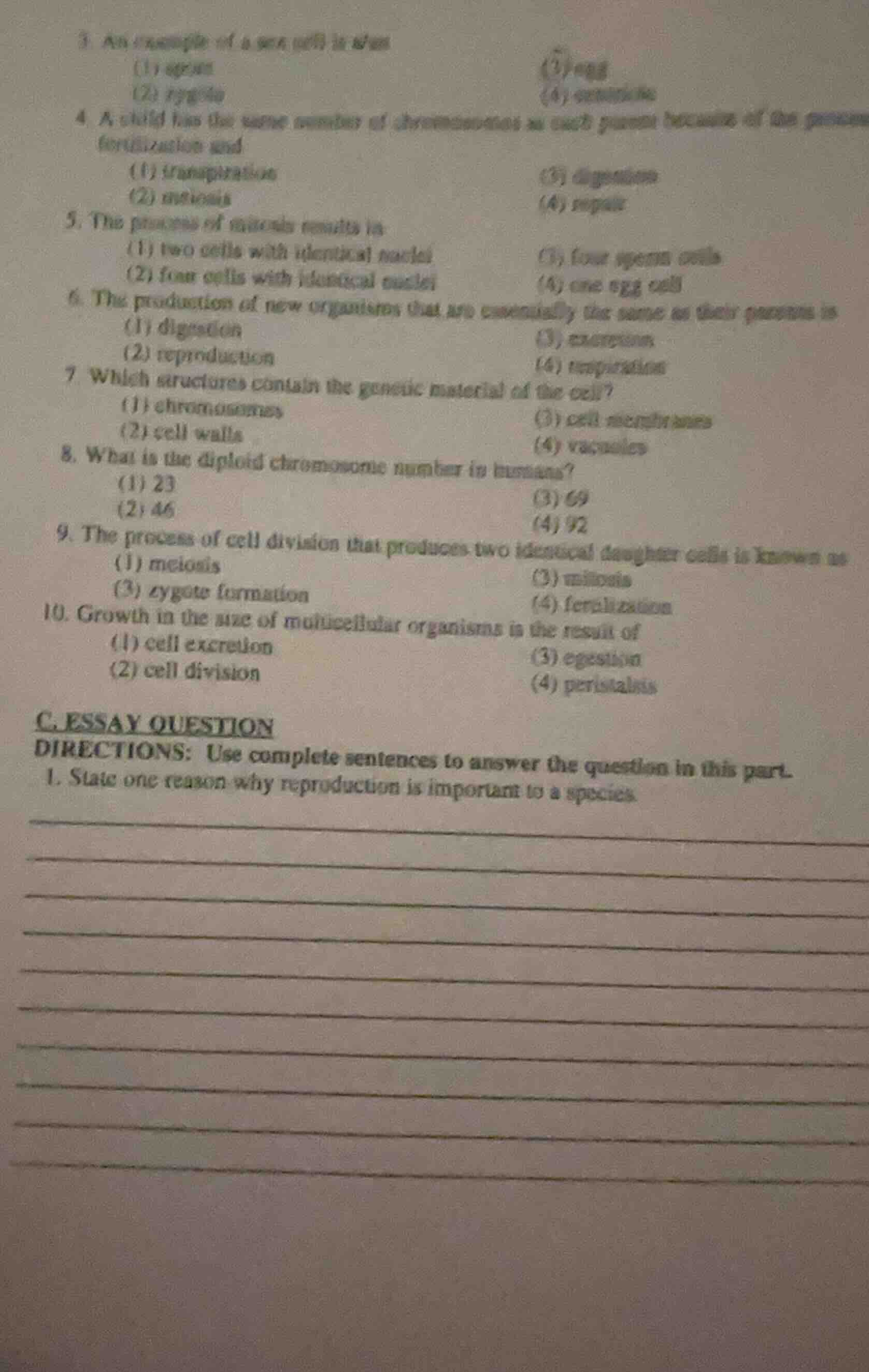
3 an example of a sex cell is a/an
(1) sperm (3) egg
(2) zygote (4) somatic
4 a child has the same number of chromosomes as each parent because of the process of fertilization and
(1) transpiration (3) digestion
(2) mitosis (4) meiosis
5 the process of mitosis results in
(1) two cells with identical nuclei (3) four sperm cells
(2) four cells with identical nuclei (4) one egg cell
6 the production of new organisms that are essentially the same as their parents is
(1) digestion (3) excretion
(2) reproduction (4) respiration
7 which structures contain the genetic material of the cell?
(1) chromosomes (3) cell membranes
(2) cell walls (4) vacuoles
8 what is the diploid chromosome number in humans?
(1) 23 (3) 69
(2) 46 (4) 92
9 the process of cell division that produces two identical daughter cells is known as
(1) meiosis (3) mitosis
(3) zygote formation (4) fertilization
10 growth in the size of multicellular organisms is the result of
(1) cell excretion (3) egestion
(2) cell division (4) peristalsis
c. essay question
directions: use complete sentences to answer the question in this part.
- state one reason why reproduction is important to a species.
_____________________________________________________________________
_____________________________________________________________________
_____________________________________________________________________
_____________________________________________________________________
_____________________________________________________________________
_____________________________________________________________________
Multiple - Choice Questions
Question 3 (Assuming the question is about sex cells, likely "An example of a sex cell is when...")
- Brief Explanations: Sex cells (gametes) include sperm and egg. Among the options, (1) sperm and (4) egg are sex cells. If we consider the options given (assuming the options are (1) sperm, (2) zygote, (3) (maybe a typo), (4) egg), then the correct ones are (1) sperm and (4) egg. But if we have to choose one, egg or sperm. Let's assume the options are (1) sperm, (2) zygote, (3) (something non - sex cell), (4) egg. So the answer would be (1) sperm or (4) egg. Let's take (4) egg as an example. A zygote is a fertilized egg, not a sex cell. So sex cells are sperm (male) and egg (female).
- Answer: (4) egg (or (1) sperm, depending on the exact options. If the options are as per the image, likely (1) sperm or (4) egg. Let's go with (4) egg for this example)
Question 4
- Brief Explanations: A child has the same number of chromosomes as each parent because of fertilization (fusion of gametes) and meiosis (which reduces the chromosome number in gametes to half, so when fertilization occurs, the zygote has the same number as parents). But the options given are (1) transpiration (plant process), (2) mitosis (cell division for growth/repair), (3) digestion (breakdown of food), (4) meiosis? Wait, maybe a typo. Wait, the question is "A child has the same number of chromosomes as each parent because of the process of fertilization and...". The correct process is meiosis (in parents to make gametes with half the number, then fertilization restores). But the options given: (1) transpiration, (2) mitosis, (3) digestion, (4) meiosis? Wait, maybe the options are misprinted. Wait, maybe the intended answer is related to meiosis, but if the options are as given, maybe a mistake. Wait, maybe the question is about how the child gets the same number. Wait, parents have diploid cells, gametes (sperm/egg) are haploid (due to meiosis), then fertilization makes diploid zygote (child). So the process after fertilization? No, the process in parents is meiosis to make gametes. But the options given don't have meiosis? Wait, maybe the options are (1) transpiration, (2) meiosis (maybe misspelled as "mitosis"? No, mitosis is for growth. Wait, maybe the question is wrong, but if we have to choose from the given options, maybe (2) mitosis is incorrect, (1) transpiration is plant, (3) digestion is food, so maybe a misprint. But assuming the correct process is meiosis, but since it's not in options, maybe the question has a typo. Alternatively, maybe the answer is (2) mitosis? No, that's not right. Wait, maybe the question is "A child has the same number of chromosomes as each parent because of the process of fertilization and... (the process that makes gametes with half the number, i.e., meiosis)". But since meiosis is not in options, maybe the options are wrong. But if we have to choose, maybe the intended answer is (2) mitosis (but that's incorrect). Alternatively, maybe the question is about how the cell divides after fertilization, but no. This is a bit confusing. Maybe the correct answer is (2) meiosis (if there was a typo), but as per given options, maybe the answer is (2) mitosis (but that's wrong). Wait, maybe the question is "A child has the same number of chromosomes as each parent because of the process of fertilization and... (the process that maintains chromosome number in body cells, i.e., mitosis)". No, that's not related. I think there's a typo in the options. But if we have to choose, maybe (2) mitosi…

Snap & solve any problem in the app
Get step-by-step solutions on Sovi AI
Photo-based solutions with guided steps
Explore more problems and detailed explanations
Multiple - Choice Questions
Question 3 (Assuming the question is about sex cells, likely "An example of a sex cell is when...")
- Brief Explanations: Sex cells (gametes) include sperm and egg. Among the options, (1) sperm and (4) egg are sex cells. If we consider the options given (assuming the options are (1) sperm, (2) zygote, (3) (maybe a typo), (4) egg), then the correct ones are (1) sperm and (4) egg. But if we have to choose one, egg or sperm. Let's assume the options are (1) sperm, (2) zygote, (3) (something non - sex cell), (4) egg. So the answer would be (1) sperm or (4) egg. Let's take (4) egg as an example. A zygote is a fertilized egg, not a sex cell. So sex cells are sperm (male) and egg (female).
- Answer: (4) egg (or (1) sperm, depending on the exact options. If the options are as per the image, likely (1) sperm or (4) egg. Let's go with (4) egg for this example)
Question 4
- Brief Explanations: A child has the same number of chromosomes as each parent because of fertilization (fusion of gametes) and meiosis (which reduces the chromosome number in gametes to half, so when fertilization occurs, the zygote has the same number as parents). But the options given are (1) transpiration (plant process), (2) mitosis (cell division for growth/repair), (3) digestion (breakdown of food), (4) meiosis? Wait, maybe a typo. Wait, the question is "A child has the same number of chromosomes as each parent because of the process of fertilization and...". The correct process is meiosis (in parents to make gametes with half the number, then fertilization restores). But the options given: (1) transpiration, (2) mitosis, (3) digestion, (4) meiosis? Wait, maybe the options are misprinted. Wait, maybe the intended answer is related to meiosis, but if the options are as given, maybe a mistake. Wait, maybe the question is about how the child gets the same number. Wait, parents have diploid cells, gametes (sperm/egg) are haploid (due to meiosis), then fertilization makes diploid zygote (child). So the process after fertilization? No, the process in parents is meiosis to make gametes. But the options given don't have meiosis? Wait, maybe the options are (1) transpiration, (2) meiosis (maybe misspelled as "mitosis"? No, mitosis is for growth. Wait, maybe the question is wrong, but if we have to choose from the given options, maybe (2) mitosis is incorrect, (1) transpiration is plant, (3) digestion is food, so maybe a misprint. But assuming the correct process is meiosis, but since it's not in options, maybe the question has a typo. Alternatively, maybe the answer is (2) mitosis? No, that's not right. Wait, maybe the question is "A child has the same number of chromosomes as each parent because of the process of fertilization and... (the process that makes gametes with half the number, i.e., meiosis)". But since meiosis is not in options, maybe the options are wrong. But if we have to choose, maybe the intended answer is (2) mitosis (but that's incorrect). Alternatively, maybe the question is about how the cell divides after fertilization, but no. This is a bit confusing. Maybe the correct answer is (2) meiosis (if there was a typo), but as per given options, maybe the answer is (2) mitosis (but that's wrong). Wait, maybe the question is "A child has the same number of chromosomes as each parent because of the process of fertilization and... (the process that maintains chromosome number in body cells, i.e., mitosis)". No, that's not related. I think there's a typo in the options. But if we have to choose, maybe (2) mitosis is the intended answer (even though it's incorrect).
- Answer: (2) mitosis (with the caveat that there might be a typo in the question)
Question 5
- Brief Explanations: The process of meiosis results in four haploid cells (gametes) with non - identical nuclei (due to crossing over and independent assortment). Wait, the options are (1) two cells with identical nuclei, (2) four cells with identical nuclei, (3) four sperm cells, (4) one egg cell. Meiosis in males produces four sperm cells (option 3), in females produces one egg and three polar bodies. So the process of meiosis results in (3) four sperm cells (in male meiosis) or (4) one egg cell (in female meiosis). But the question is "The process of meiosis results in...". So if it's male meiosis, answer is (3) four sperm cells; if female, (4) one egg cell. But generally, meiosis results in four haploid cells (in male, four sperm; in female, one egg and three polar bodies). So the answer is (3) four sperm cells (assuming it's male meiosis) or (4) one egg cell. Let's go with (3) four sperm cells.
- Answer: (3) four sperm cells
Question 6
- Brief Explanations: The production of new organisms that are essentially the same as their parents is reproduction (asexual reproduction produces clones). Digestion is breaking down food, excretion is removing waste, respiration is getting energy. So the answer is (2) reproduction.
- Answer: (2) reproduction
Question 7
- Brief Explanations: Chromosomes contain the genetic material (DNA) of the cell. Cell walls are for structure (in plants), cell membranes are for protection/transport, vacuoles are for storage. So the answer is (1) chromosomes.
- Answer: (1) chromosomes
Question 8
- Brief Explanations: The diploid chromosome number in humans is 46 (23 pairs). Haploid is 23 (in gametes). So the answer is (2) 46.
- Answer: (2) 46
Question 9
- Brief Explanations: The process of cell division that produces two identical daughter cells is mitosis. Meiosis produces four non - identical daughter cells, zygote formation is fertilization, fertilization is fusion of gametes. So the answer is (2) mitosis.
- Answer: (2) mitosis
Question 10
- Brief Explanations: Growth in the size of multicellular organisms is the result of cell division (producing more cells) and cell growth. Among the options, (1) cell excretion (removing waste), (2) cell division (produces more cells, leading to growth), (3) egestion (removing undigested food), (4) peristalsis (muscle movement in digestive tract). So the answer is (2) cell division.
- Answer: (2) cell division
Essay Question
- Brief Explanations: Reproduction is important to a species for several reasons. One reason is that it ensures the survival of the species over time. As individual organisms die, new organisms are produced through reproduction to replace them. This prevents the species from going extinct. Another reason is that it allows for the passing on of genetic information from one generation to the next, which is essential for the continuation of the species' traits and adaptations.
- Answer: Reproduction is important to a species because it ensures the continuation of the species. As individual organisms within a species die, new organisms are produced through reproduction to replace them, preventing the species from becoming extinct. Additionally, reproduction allows for the transmission of genetic information from one generation to the next, which is crucial for the preservation of the species' characteristics and adaptations that have evolved over time.