QUESTION IMAGE
Question
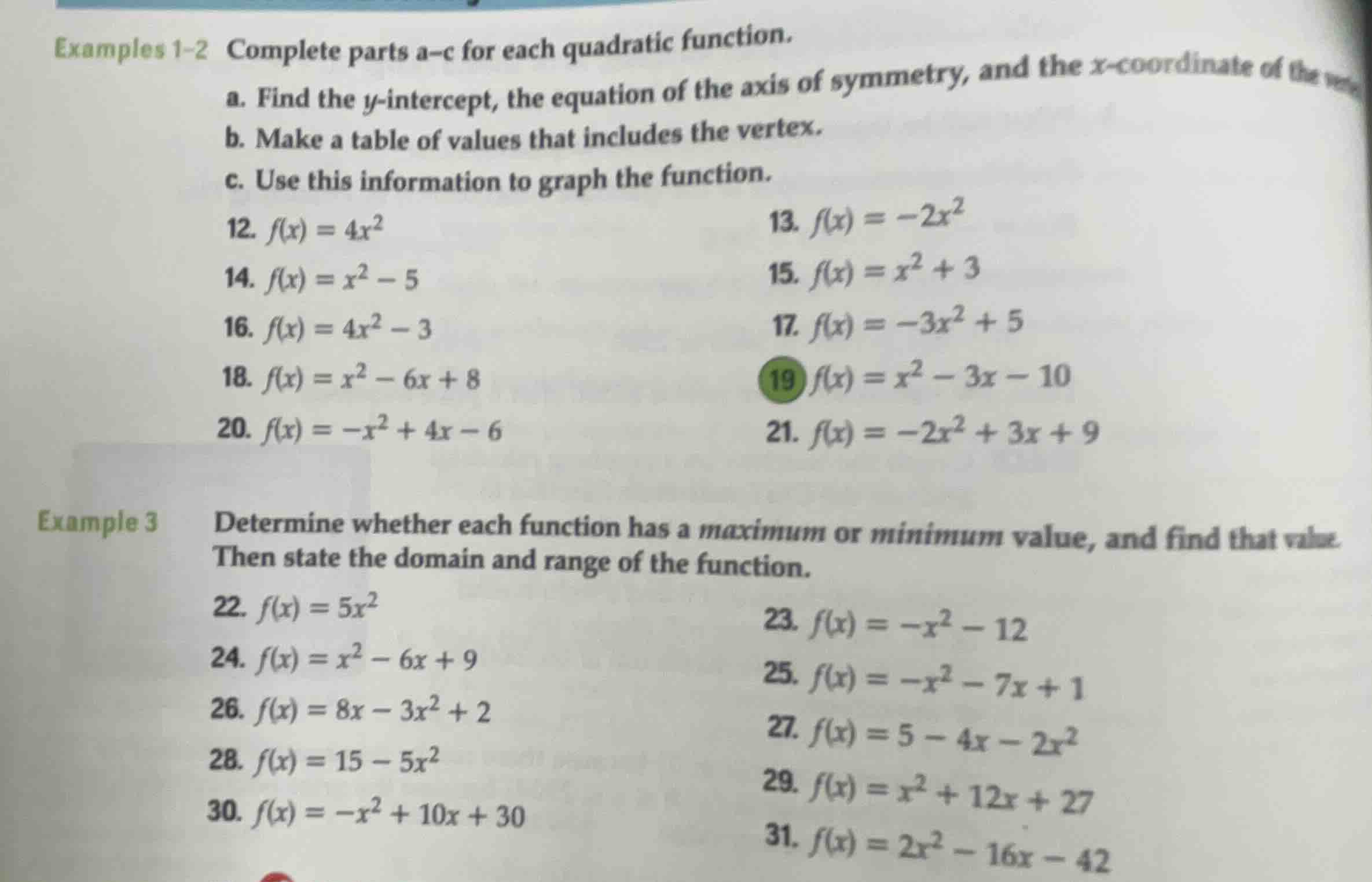
examples 1-2 complete parts a–c for each quadratic function.
a. find the y-intercept, the equation of the axis of symmetry, and the x-coordinate of the
b. make a table of values that includes the vertex.
c. use this information to graph the function.
- $f(x) = 4x^2$ 13. $f(x) = -2x^2$
- $f(x) = x^2 - 5$ 15. $f(x) = x^2 + 3$
- $f(x) = 4x^2 - 3$ 17. $f(x) = -3x^2 + 5$
- $f(x) = x^2 - 6x + 8$ 19 $f(x) = x^2 - 3x - 10$
- $f(x) = -x^2 + 4x - 6$ 21. $f(x) = -2x^2 + 3x + 9$
example 3 determine whether each function has a maximum or minimum value, and find that value. then state the domain and range of the function.
- $f(x) = 5x^2$ 23. $f(x) = -x^2 - 12$
- $f(x) = x^2 - 6x + 9$ 25. $f(x) = -x^2 - 7x + 1$
- $f(x) = 8x - 3x^2 + 2$ 27. $f(x) = 5 - 4x - 2x^2$
- $f(x) = 15 - 5x^2$ 29. $f(x) = x^2 + 12x + 27$
- $f(x) = -x^2 + 10x + 30$ 31. $f(x) = 2x^2 - 16x - 42$
Let's solve problem 19: \( f(x) = x^2 - 3x - 10 \) for part a (find y - intercept, axis of symmetry, x - coordinate of vertex), part b (table of values including vertex), and part c (graph the function).
Part a
Step 1: Find the y - intercept
The y - intercept of a function \( y = f(x) \) is found by setting \( x = 0 \).
For \( f(x)=x^{2}-3x - 10 \), when \( x = 0 \), we have \( f(0)=0^{2}-3(0)-10=- 10 \). So the y - intercept is \( (0,-10) \).
Step 2: Find the equation of the axis of symmetry and x - coordinate of the vertex
For a quadratic function in the form \( f(x)=ax^{2}+bx + c \) (here \( a = 1 \), \( b=-3 \), \( c=-10 \)), the formula for the axis of symmetry (and the x - coordinate of the vertex) is \( x=-\frac{b}{2a} \).
Substitute \( a = 1 \) and \( b=-3 \) into the formula: \( x =-\frac{-3}{2(1)}=\frac{3}{2}=1.5 \).
So the equation of the axis of symmetry is \( x = 1.5 \), and the x - coordinate of the vertex is \( x = 1.5 \).
Part b
First, find the y - coordinate of the vertex by substituting \( x = 1.5 \) into \( f(x) \):
\( f(1.5)=(1.5)^{2}-3(1.5)-10=2.25 - 4.5-10=-12.25 \)
So the vertex is \( (1.5,-12.25) \)
Now, we make a table of values. We can choose values of \( x \) around \( x = 1.5 \) (e.g., \( x = 0,1,2,3,4 \)):
| \( x \) | \( f(x)=x^{2}-3x - 10 \) |
|---|---|
| \( 1 \) | \( 1^{2}-3(1)-10=1 - 3-10=-12 \) |
| \( 1.5 \) | \( - 12.25 \) |
| \( 2 \) | \( 2^{2}-3(2)-10=4 - 6-10=-12 \) |
| \( 3 \) | \( 3^{2}-3(3)-10=9 - 9-10=-10 \) |
| \( 4 \) | \( 4^{2}-3(4)-10=16 - 12-10=-6 \) |
Part c
To graph the function:
- Plot the vertex \( (1.5,-12.25) \).
- Plot the y - intercept \( (0,-10) \).
- Plot the other points from the table (e.g., \( (1,-12) \), \( (2,-12) \), \( (3,-10) \), \( (4,-6) \)).
- Since \( a = 1>0 \), the parabola opens upwards. Draw a smooth curve through the plotted points.
Final Answers (for part a)
- y - intercept: \( \boldsymbol{(0, - 10)} \)
- Axis of symmetry: \( \boldsymbol{x = 1.5} \)
- x - coordinate of vertex: \( \boldsymbol{x = 1.5} \)
(For part b, the table is as shown above. For part c, the graph is a parabola opening upwards with vertex \( (1.5,-12.25) \) and passing through the points in the table)

Snap & solve any problem in the app
Get step-by-step solutions on Sovi AI
Photo-based solutions with guided steps
Explore more problems and detailed explanations
Let's solve problem 19: \( f(x) = x^2 - 3x - 10 \) for part a (find y - intercept, axis of symmetry, x - coordinate of vertex), part b (table of values including vertex), and part c (graph the function).
Part a
Step 1: Find the y - intercept
The y - intercept of a function \( y = f(x) \) is found by setting \( x = 0 \).
For \( f(x)=x^{2}-3x - 10 \), when \( x = 0 \), we have \( f(0)=0^{2}-3(0)-10=- 10 \). So the y - intercept is \( (0,-10) \).
Step 2: Find the equation of the axis of symmetry and x - coordinate of the vertex
For a quadratic function in the form \( f(x)=ax^{2}+bx + c \) (here \( a = 1 \), \( b=-3 \), \( c=-10 \)), the formula for the axis of symmetry (and the x - coordinate of the vertex) is \( x=-\frac{b}{2a} \).
Substitute \( a = 1 \) and \( b=-3 \) into the formula: \( x =-\frac{-3}{2(1)}=\frac{3}{2}=1.5 \).
So the equation of the axis of symmetry is \( x = 1.5 \), and the x - coordinate of the vertex is \( x = 1.5 \).
Part b
First, find the y - coordinate of the vertex by substituting \( x = 1.5 \) into \( f(x) \):
\( f(1.5)=(1.5)^{2}-3(1.5)-10=2.25 - 4.5-10=-12.25 \)
So the vertex is \( (1.5,-12.25) \)
Now, we make a table of values. We can choose values of \( x \) around \( x = 1.5 \) (e.g., \( x = 0,1,2,3,4 \)):
| \( x \) | \( f(x)=x^{2}-3x - 10 \) |
|---|---|
| \( 1 \) | \( 1^{2}-3(1)-10=1 - 3-10=-12 \) |
| \( 1.5 \) | \( - 12.25 \) |
| \( 2 \) | \( 2^{2}-3(2)-10=4 - 6-10=-12 \) |
| \( 3 \) | \( 3^{2}-3(3)-10=9 - 9-10=-10 \) |
| \( 4 \) | \( 4^{2}-3(4)-10=16 - 12-10=-6 \) |
Part c
To graph the function:
- Plot the vertex \( (1.5,-12.25) \).
- Plot the y - intercept \( (0,-10) \).
- Plot the other points from the table (e.g., \( (1,-12) \), \( (2,-12) \), \( (3,-10) \), \( (4,-6) \)).
- Since \( a = 1>0 \), the parabola opens upwards. Draw a smooth curve through the plotted points.
Final Answers (for part a)
- y - intercept: \( \boldsymbol{(0, - 10)} \)
- Axis of symmetry: \( \boldsymbol{x = 1.5} \)
- x - coordinate of vertex: \( \boldsymbol{x = 1.5} \)
(For part b, the table is as shown above. For part c, the graph is a parabola opening upwards with vertex \( (1.5,-12.25) \) and passing through the points in the table)