QUESTION IMAGE
Question
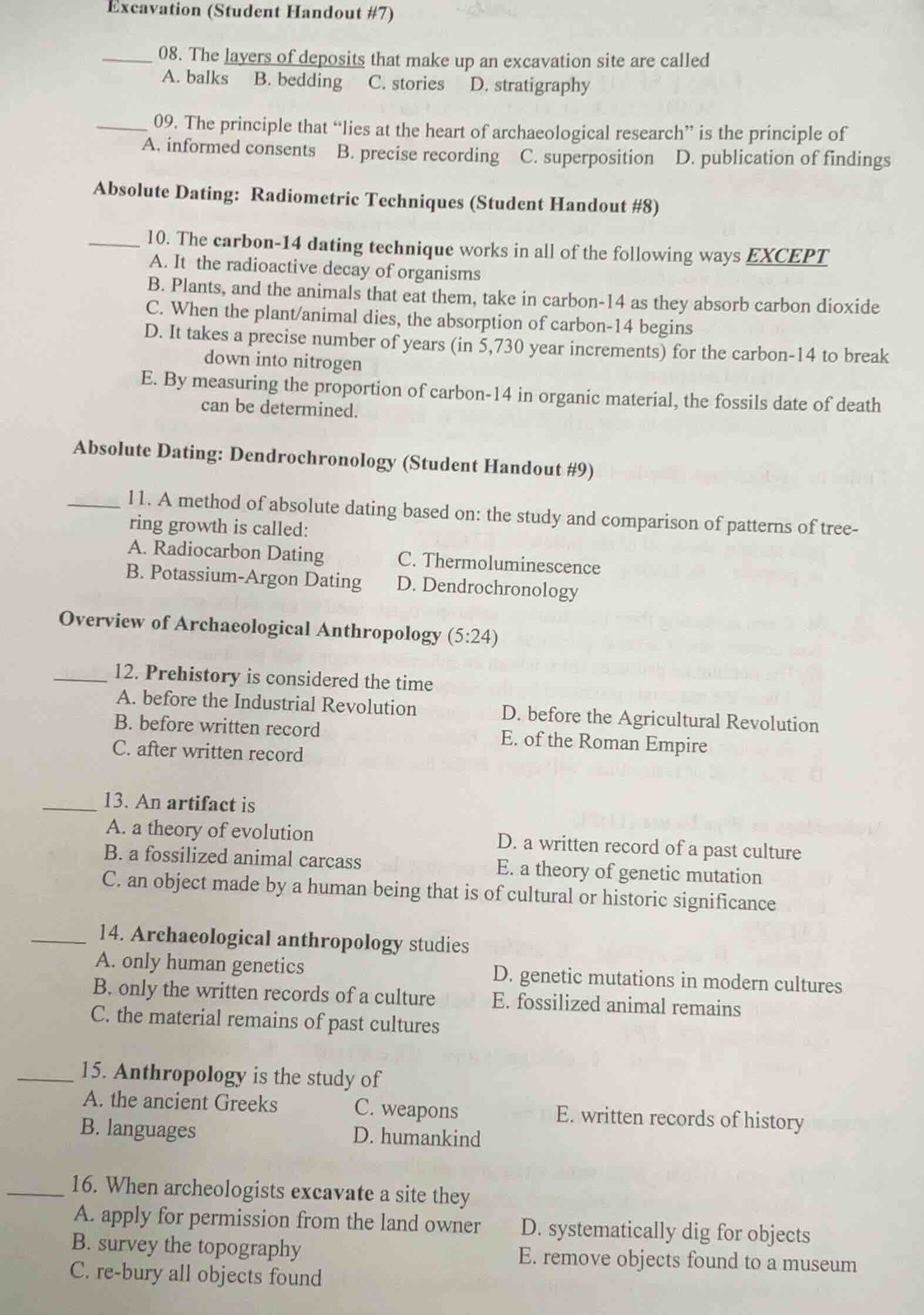
excavation (student handout #7)
______ 08. the layers of deposits that make up an excavation site are called
a. balks b. bedding c. stories d. stratigraphy
______ 09. the principle that \lies at the heart of archaeological research\ is the principle of
a. informed consents b. precise recording c. superposition d. publication of findings
absolute dating: radiometric techniques (student handout #8)
______ 10. the carbon-14 dating technique works in all of the following ways except
a. it the radioactive decay of organisms
b. plants, and the animals that eat them, take in carbon-14 as they absorb carbon dioxide
c. when the plant/animal dies, the absorption of carbon-14 begins
d. it takes a precise number of years (in 5,730 year increments) for the carbon-14 to break
down into nitrogen
e. by measuring the proportion of carbon-14 in organic material, the fossils date of death
can be determined.
absolute dating: dendrochronology (student handout #9)
______ 11. a method of absolute dating based on: the study and comparison of patterns of tree-
ring growth is called:
a. radiocarbon dating c. thermoluminescence
b. potassium-argon dating d. dendrochronology
overview of archaeological anthropology (5:24)
______ 12. prehistory is considered the time
a. before the industrial revolution d. before the agricultural revolution
b. before written record e. of the roman empire
c. after written record
______ 13. an artifact is
a. a theory of evolution d. a written record of a past culture
b. a fossilized animal carcass e. a theory of genetic mutation
c. an object made by a human being that is of cultural or historic significance
______ 14. archaeological anthropology studies
a. only human genetics d. genetic mutations in modern cultures
b. only the written records of a culture e. fossilized animal remains
c. the material remains of past cultures
______ 15. anthropology is the study of
a. the ancient greeks c. weapons e. written records of history
b. languages d. humankind
______ 16. when archeologists excavate a site they
a. apply for permission from the land owner d. systematically dig for objects
b. survey the topography e. remove objects found to a museum
c. re - bury all objects found
- Stratigraphy refers to the layered deposit structure at excavation sites; other options refer to excavation features or different geological terms.
- The principle of superposition (deeper layers are older) is foundational to archaeological excavation and dating.
- Carbon-14 absorption stops, not begins, when an organism dies, making this statement incorrect.
- Dendrochronology is defined as the absolute dating method using tree ring patterns.
- Prehistory is specifically the period before written historical records existed.
- An artifact is an object created by humans with cultural/historical importance.
- Archaeological anthropology focuses on analyzing the material remains left by past cultures.
- Anthropology is the broad study of humankind across all times and cultures.
- Archaeological excavation involves systematic, careful digging and recovery of materials from a site.

Snap & solve any problem in the app
Get step-by-step solutions on Sovi AI
Photo-based solutions with guided steps
Explore more problems and detailed explanations
- D. stratigraphy
- C. superposition
- C. When the plant/animal dies, the absorption of carbon-14 begins
- D. Dendrochronology
- B. before written record
- C. an object made by a human being that is of cultural or historic significance
- C. the material remains of past cultures
- D. humankind
- D. systematically dig for objects