QUESTION IMAGE
Question
excerpt from moby-dick
by herman melville
chapter 41
\moby dick\
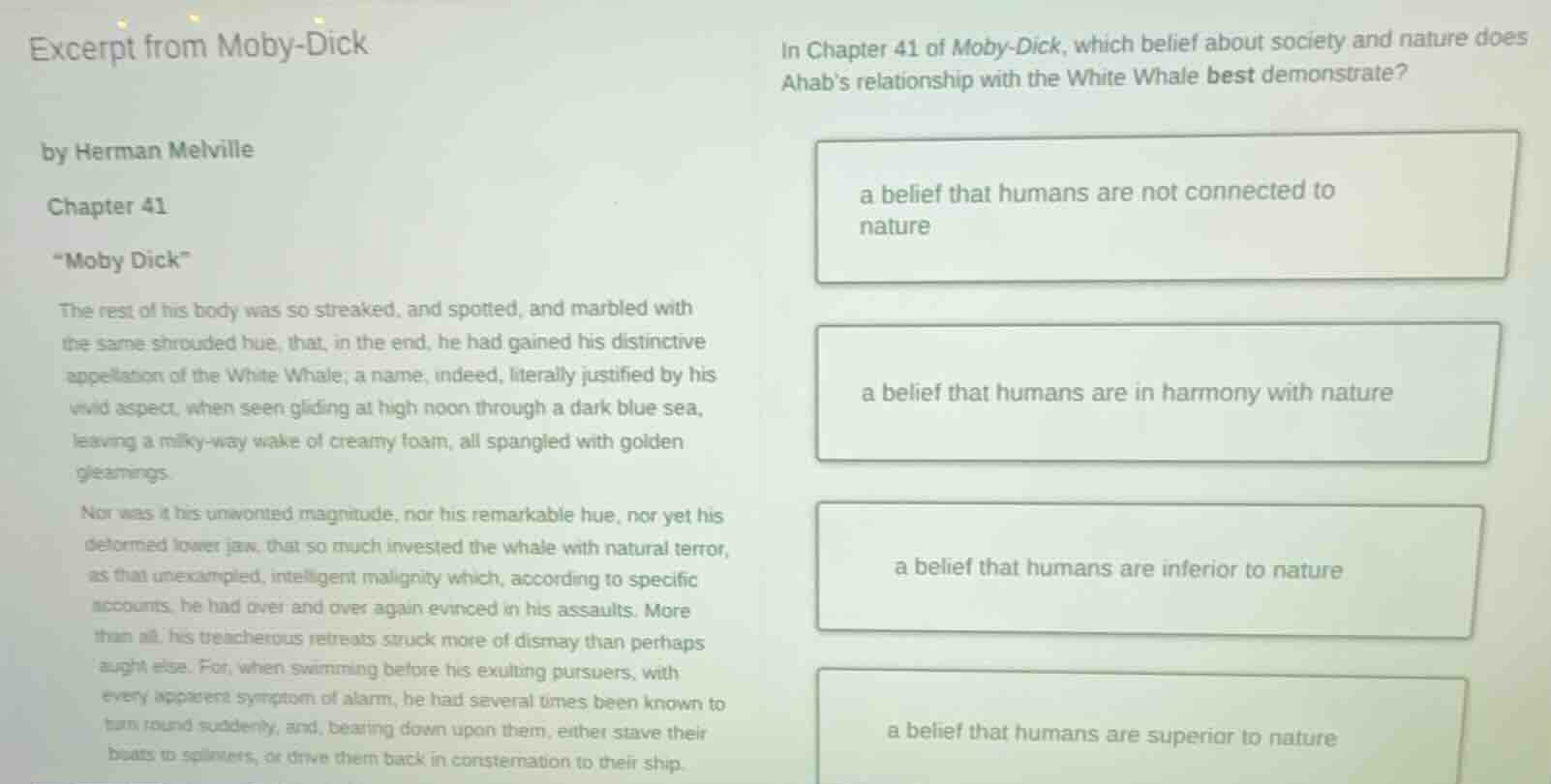
the rest of his body was so streaked, and spotted, and marbled with
the same shrouded hue, that, in the end, he had gained his distinctive
appellation of the white whale; a name, indeed, literally justified by his
vivid aspect, when seen gliding at high noon through a dark blue sea,
leaving a milky-way wake of creamy foam, all spangled with golden
gleamings.
nor was it his unwonted magnitude, nor his remarkable hue, nor yet his
deformed lower jaw, that so much invested the whale with natural terror,
as that unexampled, intelligent malignity which, according to specific
accounts, he had over and over again evinced in his assaults. more
than all, his treacherous retreats struck more of dismay than perhaps
aught else. for, when swimming before his exulting pursuers, with
every apparent symptom of alarm, he had several times been known to
turn round suddenly, and, bearing down upon them, either stave their
boats to splinters, or drive them back in consternation to their ship.
in chapter 41 of moby-dick, which belief about society and nature does
ahab’s relationship with the white whale best demonstrate?
a belief that humans are not connected to
nature
a belief that humans are in harmony with nature
a belief that humans are inferior to nature
a belief that humans are superior to nature
Ahab's obsession with hunting the White Whale in Moby - Dick reflects a view that humans can dominate nature. He sees the whale as an adversary to be conquered, showing the belief that humans are superior to nature. The other options don't fit: the whale's actions (like attacking boats) and Ahab's pursuit show a lack of harmony, a connection (so not "not connected"), and Ahab's drive to defeat the whale isn't about being inferior.

Snap & solve any problem in the app
Get step-by-step solutions on Sovi AI
Photo-based solutions with guided steps
Explore more problems and detailed explanations
D. a belief that humans are superior to nature