QUESTION IMAGE
Question
exercises 1.3 the fundamental theorem of calculus
score: 0/260 answered: 0/26
question 1
textbook videos +
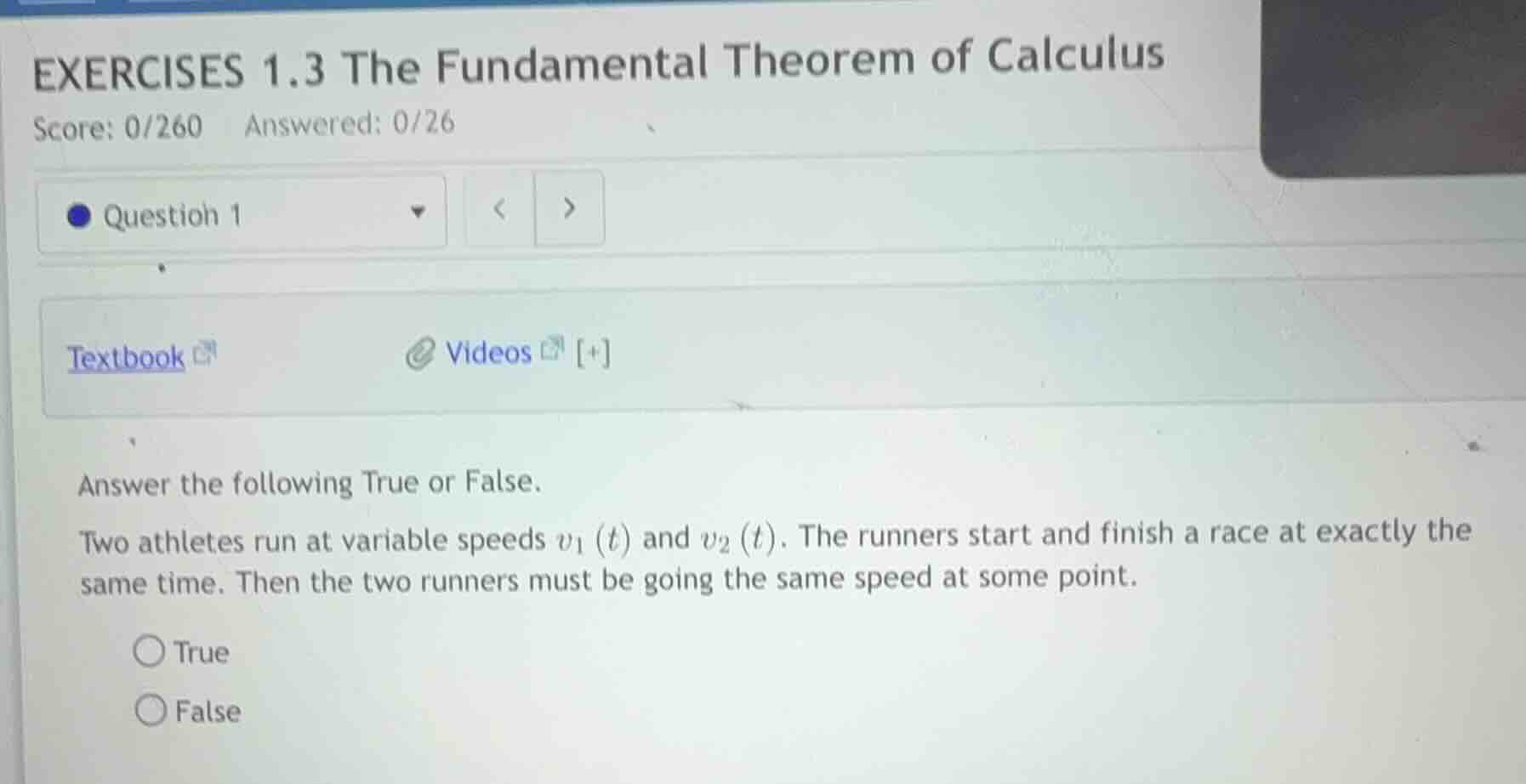
answer the following true or false.
two athletes run at variable speeds $v_1(t)$ and $v_2(t)$. the runners start and finish a race at exactly the same time. then the two runners must be going the same speed at some point.
true
false
Step1: Define position functions
Let $s_1(t)$ and $s_2(t)$ be the position functions of the two runners, where $s_1'(t)=v_1(t)$ and $s_2'(t)=v_2(t)$. Let the race run from time $t=a$ to $t=b$, so $s_1(a)=s_2(a)$ (start at same position) and $s_1(b)=s_2(b)$ (finish at same position).
Step2: Create difference function
Define $h(t) = s_1(t) - s_2(t)$. Then $h(a)=s_1(a)-s_2(a)=0$ and $h(b)=s_1(b)-s_2(b)=0$.
Step3: Apply Rolle's Theorem
Since $h(t)$ is continuous on $[a,b]$ and differentiable on $(a,b)$ (as position functions for runners are smooth), by Rolle's Theorem, there exists some $c\in(a,b)$ where $h'(c)=0$.
Step4: Relate to speed functions
$h'(t)=s_1'(t)-s_2'(t)=v_1(t)-v_2(t)$. So $h'(c)=0$ implies $v_1(c)=v_2(c)$.

Snap & solve any problem in the app
Get step-by-step solutions on Sovi AI
Photo-based solutions with guided steps
Explore more problems and detailed explanations
True