QUESTION IMAGE
Question
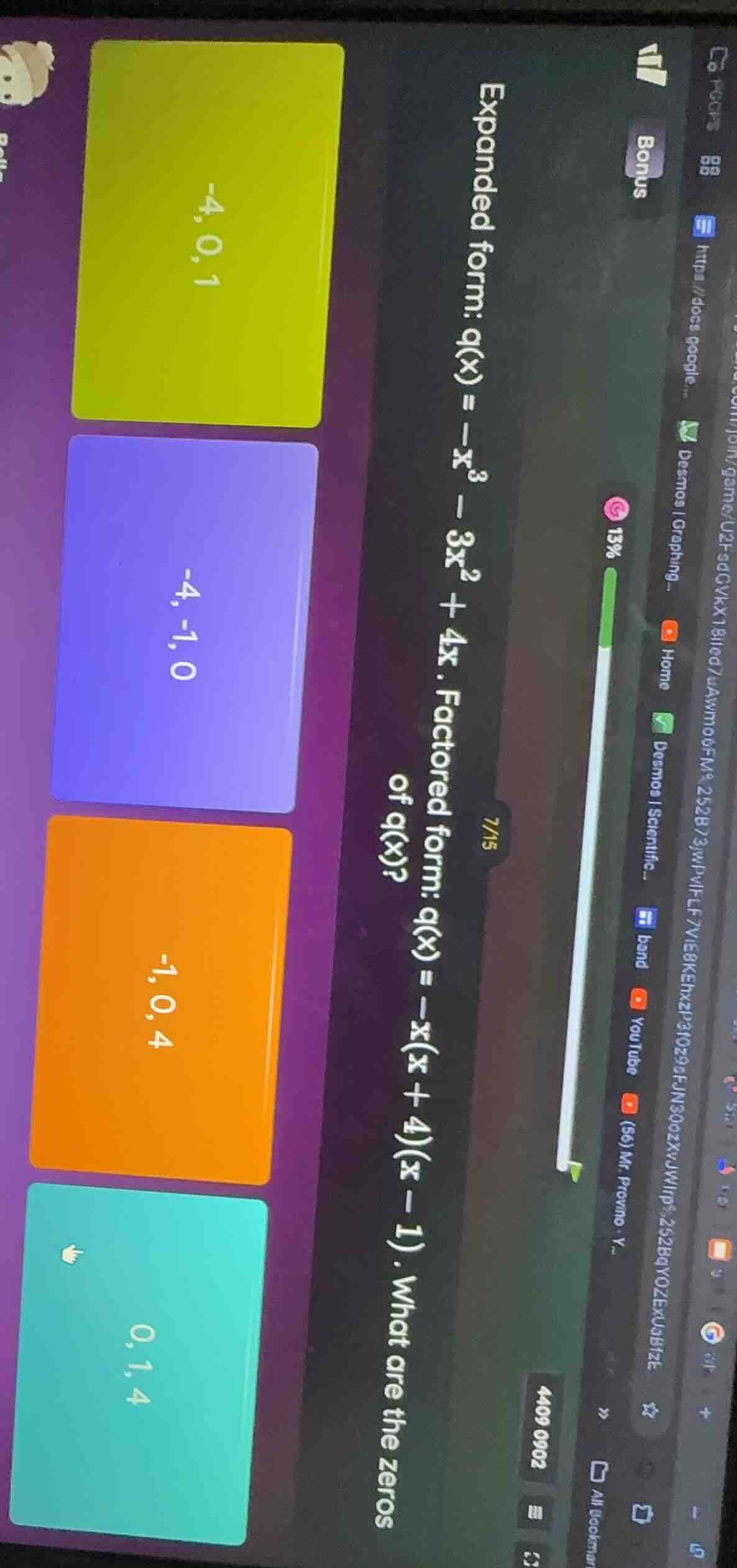
expanded form: $q(x) = -x^3 - 3x^2 + 4x$. factored form: $q(x) = -x(x + 4)(x - 1)$. what are the zeros of $q(x)$?
options:
-4, 0, 1
-4, -1, 0
-1, 0, 4
0, 1, 4
Step1: Recall zero - product property
The zero - product property states that if \(ab = 0\), then either \(a=0\) or \(b = 0\) (or both). For a factored polynomial \(q(x)=-x(x + 4)(x - 1)\), we set \(q(x)=0\). So, \(-x(x + 4)(x - 1)=0\).
Step2: Solve for each factor
- For the factor \(-x\): Set \(-x = 0\), then \(x=0\).
- For the factor \((x + 4)\): Set \(x + 4=0\), then \(x=-4\).
- For the factor \((x - 1)\): Set \(x - 1=0\), then \(x = 1\). Wait, no, wait. Wait, the factored form is \(q(x)=-x(x + 4)(x - 1)\)? Wait, no, let's re - check. Wait, the expanded form is \(q(x)=-x^{3}-3x^{2}+4x\). Let's factor the expanded form. First, factor out \(-x\): \(q(x)=-x(x^{2}+3x - 4)\). Then factor the quadratic \(x^{2}+3x - 4\). We need two numbers that multiply to \(-4\) and add to \(3\). The numbers are \(4\) and \(-1\). So \(x^{2}+3x - 4=(x + 4)(x - 1)\). So the factored form is \(q(x)=-x(x + 4)(x - 1)\). Now, set \(q(x)=0\):
\(-x=0\) gives \(x = 0\); \(x + 4=0\) gives \(x=-4\); \(x - 1=0\) gives \(x = 1\)? Wait, no, wait the options are \(-4,0,1\); \(-4,-1,0\); \(-1,0,4\); \(0,1,4\). Wait, maybe I made a mistake in factoring. Wait, the expanded form is \(q(x)=-x^{3}-3x^{2}+4x\). Let's factor again. \(q(x)=-x(x^{2}+3x - 4)\). Wait, \(x^{2}+3x - 4=(x + 4)(x - 1)\)? Let's multiply \((x + 4)(x - 1)=x^{2}-x+4x - 4=x^{2}+3x - 4\). Yes. So when we set \(q(x)=0\), \(-x(x + 4)(x - 1)=0\). So the solutions are \(x = 0\), \(x=-4\), \(x = 1\). Wait, but let's check the options. The first option is \(-4,0,1\).

Snap & solve any problem in the app
Get step-by-step solutions on Sovi AI
Photo-based solutions with guided steps
Explore more problems and detailed explanations
\(-4,0,1\)