QUESTION IMAGE
Question
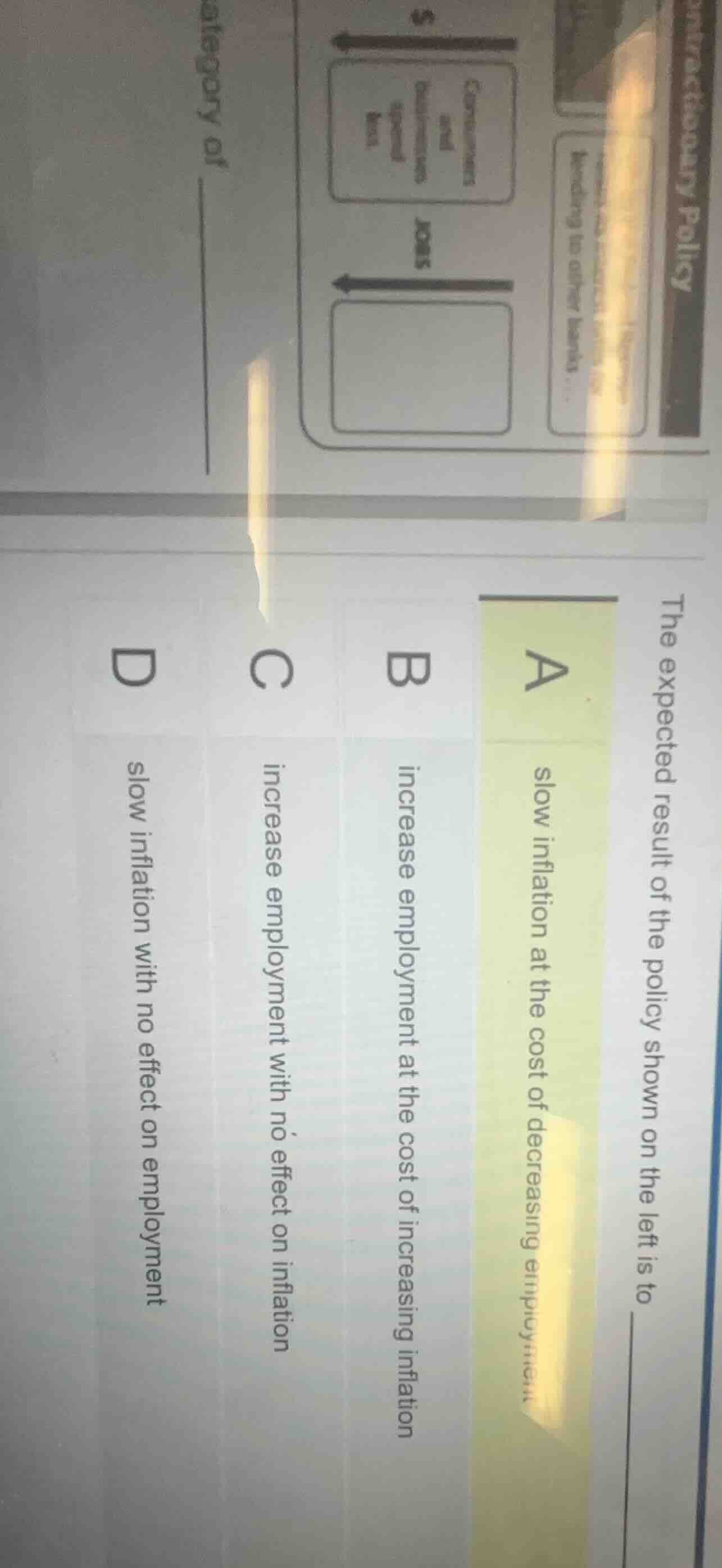
the expected result of the policy shown on the left is to
a slow inflation at the cost of decreasing employment
b increase employment at the cost of increasing inflation
c increase employment with no effect on inflation
d slow inflation with no effect on employment
Brief Explanations
To solve this, we analyze each option:
- Option A: "slow inflation at the cost of decreasing employment" implies a trade - off where inflation slows but employment drops. This is not a typical desired policy outcome in most macroeconomic policy contexts.
- Option B: "increase employment at the cost of increasing inflation" is in line with the Phillips curve relationship in macroeconomics. Expansionary policies (like the one possibly shown in the left - hand policy diagram, e.g., monetary or fiscal expansion) often aim to increase employment, and in the short - run, this can lead to an increase in inflation as a trade - off.
- Option C: "increase employment with no effect on inflation" is not consistent with most macroeconomic models. In the short - run, there is usually a trade - off between inflation and unemployment (employment), and in the long - run, the Phillips curve is vertical, but achieving employment growth without inflation impact is rare in the short - term policy context.
- Option D: "slow inflation with no effect on employment" is also not consistent with standard macroeconomic relationships. Slowing inflation (through contractionary policies) usually has a negative impact on employment.

Snap & solve any problem in the app
Get step-by-step solutions on Sovi AI
Photo-based solutions with guided steps
Explore more problems and detailed explanations
B. increase employment at the cost of increasing inflation