QUESTION IMAGE
Question
experimental and theoretical probability
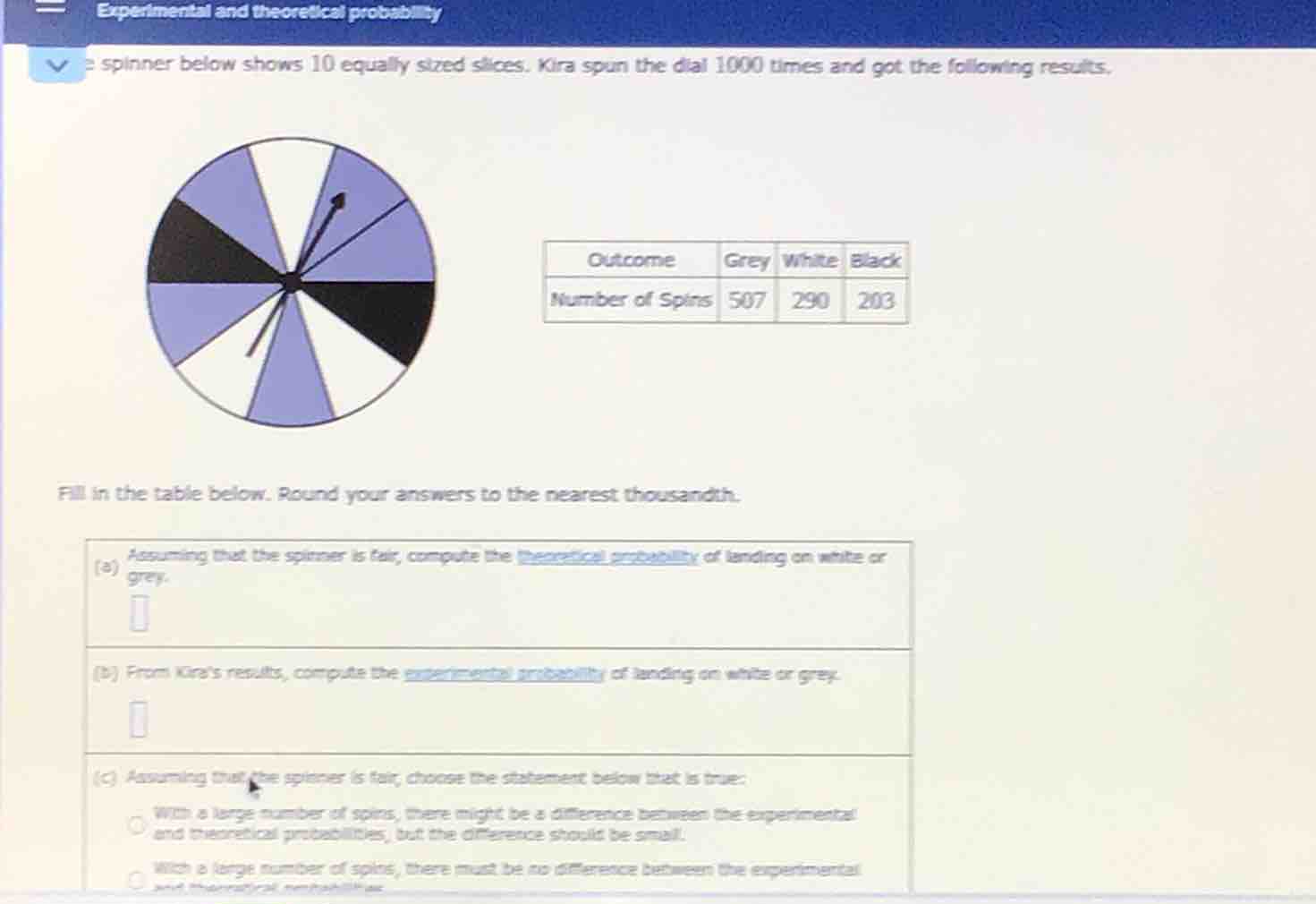
a spinner below shows 10 equally sized slices. kira spun the dial 1000 times and got the following results.
| outcome | grey | white | black |
|---|
fill in the table below. round your answers to the nearest thousandth.
(a) assuming that the spinner is fair, compute the theoretical probability of landing on white or grey.
(b) from kiras results, compute the experimental probability of landing on white or grey.
(c) assuming that the spinner is fair, choose the statement below that is true:
- with a large number of spins, there might be a difference between the experimental and theoretical probabilities, but the difference should be small.
- with a large number of spins, there must be no difference between the experimental and theoretical probabilities.
Step1: Count white/grey slices
Count of white/grey slices: $5 + 3 = 8$
Total slices: $10$
Step2: Calculate theoretical probability
$\text{Theoretical Probability} = \frac{8}{10} = 0.800$
Step3: Sum white/grey experimental spins
Total white/grey spins: $507 + 290 = 797$
Total spins: $1000$
Step4: Calculate experimental probability
$\text{Experimental Probability} = \frac{797}{1000} = 0.797$
Step5: Identify valid probability statement
Law of Large Numbers: large trials mean small, possible difference.

Snap & solve any problem in the app
Get step-by-step solutions on Sovi AI
Photo-based solutions with guided steps
Explore more problems and detailed explanations
(a) $0.800$
(b) $0.797$
(c) With a large number of spins, there might be a difference between the experimental and theoretical probabilities, but the difference should be small.