QUESTION IMAGE
Question
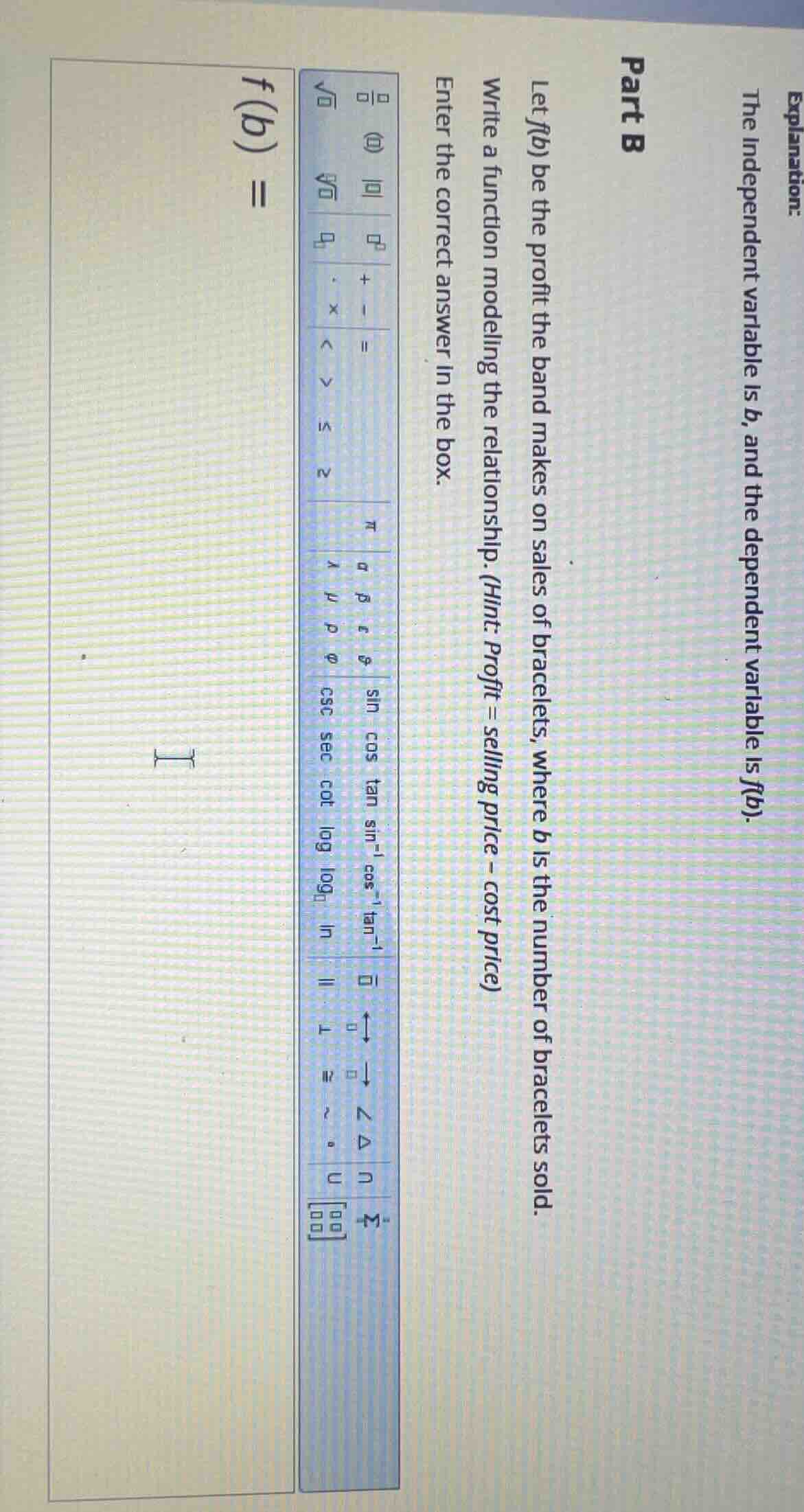
explanation: the independent variable is b, and the dependent variable is f(b). part b let f(b) be the profit the band makes on sales of bracelets, where b is the number of bracelets sold. write a function modeling the relationship. (hint: profit = selling price - cost price) enter the correct answer in the box. f(b) =
Step1: Recall Profit Formula
Profit = selling price - cost price. Let's assume selling price per bracelet is \( s \) and cost price per bracelet is \( c \). But since we need to model profit as a function of \( b \) (number of bracelets sold), if we consider total selling price as \( s \times b \) and total cost price as \( c \times b \), then profit \( f(b) = (s - c)b \). However, if we assume a simpler case where maybe selling price per bracelet is a constant and cost price per bracelet is a constant, but the problem might have implied that maybe it's a linear function. Wait, actually, the hint says Profit = selling price - cost price, but that might be per unit. Wait, no, total profit is total selling price minus total cost price. So if each bracelet is sold at price \( p \) and costs \( q \) to make, then total selling price is \( p \times b \), total cost is \( q \times b \), so profit \( f(b) = (p - q)b \). But since the problem doesn't give specific numbers, maybe we need to represent it generally. Wait, maybe the problem has some missing info? Wait, no, maybe in the original problem (since this is a part B, maybe part A had selling price and cost price). But since the user provided this, maybe we assume that the profit per bracelet is, say, if we consider that maybe the selling price per bracelet is, for example, if it's a linear function. Wait, maybe the problem is expecting a general form. Wait, the hint says Profit = selling price - cost price, but that's per unit? No, total profit is total selling price (number sold times price per) minus total cost price (number sold times cost per). So \( f(b) = ( \text{selling price per bracelet} - \text{cost price per bracelet} ) \times b \). But since the problem is to write the function, maybe we can denote the profit per bracelet as \( m \) (so \( m = \) selling price - cost price), then \( f(b) = m \times b \). But maybe in the problem, the selling price and cost price are constants, so the function is linear in \( b \). For example, if each bracelet gives a profit of \( k \) (so \( k = \) selling price - cost price), then \( f(b) = k \times b \). But since the problem is to write the function, and the user's image shows a box to enter, maybe the answer is a linear function. Wait, maybe the original problem (part A) had selling price and cost price, but since we don't have that, maybe the problem is expecting a general form. Wait, perhaps the problem is simpler: maybe the profit per bracelet is a constant, so \( f(b) = (p - c)b \), where \( p \) is selling price per bracelet and \( c \) is cost price per bracelet. But since the problem is to write the function, and the user is to enter it, maybe the answer is \( f(b) = (s - c)b \), but if we assume that maybe the selling price and cost price are such that, for example, if each bracelet is sold for $x and costs $y, then \( f(b) = (x - y)b \). But since we don't have numbers, maybe the problem is expecting a linear function in \( b \), so the function is \( f(b) = mb \), where \( m \) is the profit per bracelet. But maybe the problem is from a context where, say, the selling price per bracelet is $a and cost per is $b, so \( f(b) = (a - b)b \). But since the user's image is part B, maybe part A had the values. Wait, maybe the problem is actually a standard one where, for example, if each bracelet is sold for $5 and costs $3, then \( f(b) = 2b \), but since we don't have that, maybe the problem is expecting a general form. Wait, no, maybe the problem is to write the function as \( f(b) = ( \text{selling price} - \text{cost price}…

Snap & solve any problem in the app
Get step-by-step solutions on Sovi AI
Photo-based solutions with guided steps
Explore more problems and detailed explanations
\( f(b) = mb \) (where \( m \) is profit per bracelet) or if we assume specific values (but since not given, the general form is \( f(b) = (s - c)b \) where \( s \) is selling price per bracelet and \( c \) is cost price per bracelet). However, if we consider that maybe the problem is simpler, like if each bracelet gives a profit of, say, $x, then \( f(b) = xb \). But since the problem is to enter the function, the answer is a linear function in \( b \), so \( f(b) = kb \) (with \( k \) as profit per bracelet).