QUESTION IMAGE
Question
explanation:
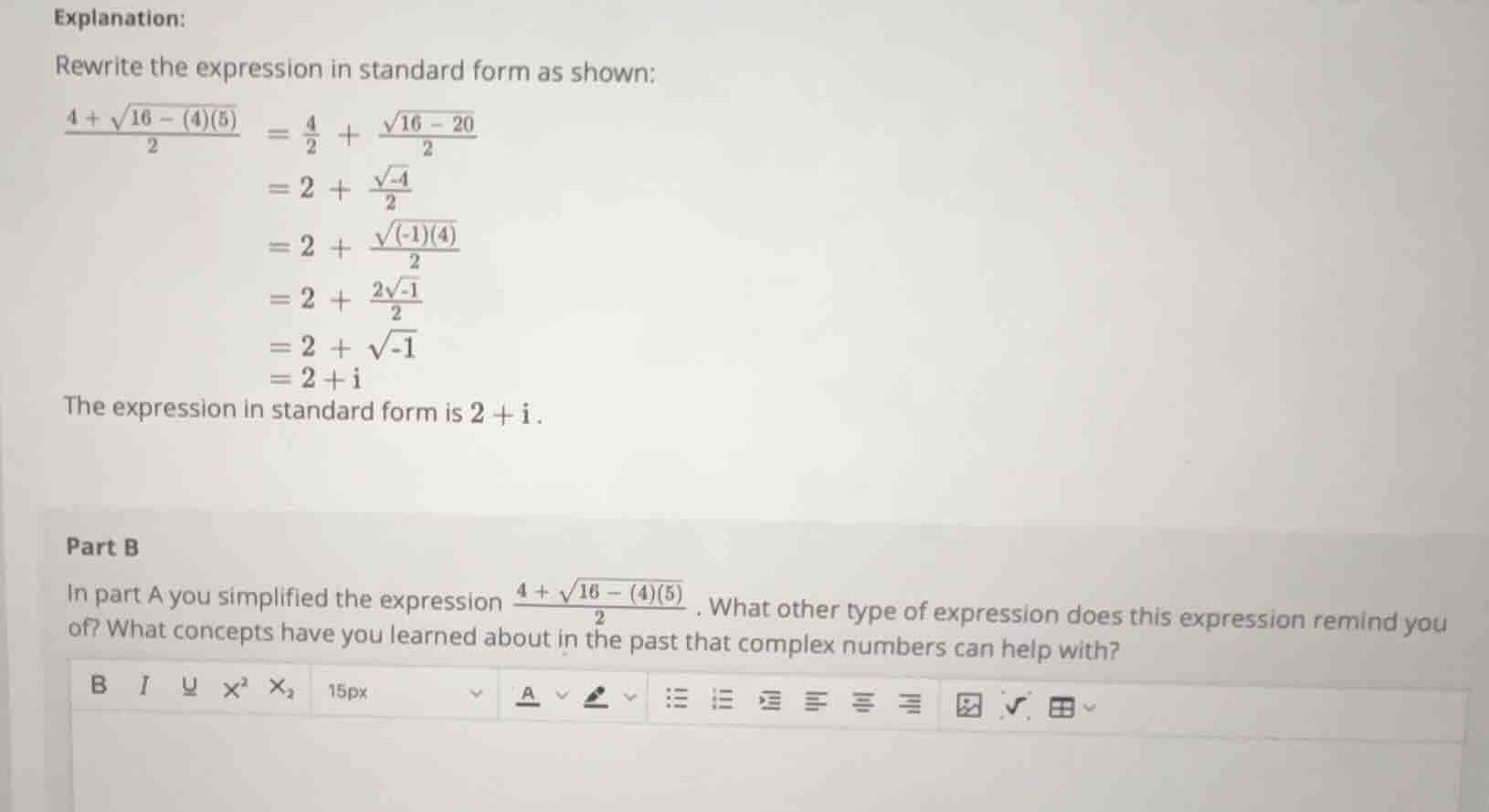
rewrite the expression in standard form as shown:
\\(\frac{4 + \sqrt{16 - (4)(5)}}{2} = \frac{4}{2} + \frac{\sqrt{16 - 20}}{2}\\)
\\(= 2 + \frac{\sqrt{-4}}{2}\\)
\\(= 2 + \frac{\sqrt{(-1)(4)}}{2}\\)
\\(= 2 + \frac{2\sqrt{-1}}{2}\\)
\\(= 2 + \sqrt{-1}\\)
\\(= 2 + \mathrm{i}\\)
the expression in standard form is \\(2 + \mathrm{i}\\).
part b
in part a you simplified the expression \\(\frac{4 + \sqrt{16 - (4)(5)}}{2}\\). what other type of expression does this expression remind you of? what concepts have you learned about in the past that complex numbers can help with?
The expression \(\frac{4 + \sqrt{16 - (4)(5)}}{2}\) resembles the quadratic formula \(x=\frac{-b\pm\sqrt{b^{2}-4ac}}{2a}\) (here, for a quadratic \(ax^{2}+bx + c = 0\), if we consider a quadratic equation like \(x^{2}-4x + 5=0\), \(a = 1\), \(b=-4\), \(c = 5\), the formula gives this form). Complex numbers help with solving quadratic equations where the discriminant (\(b^{2}-4ac\)) is negative (no real roots), as they allow us to find complex roots. Also, they relate to concepts like the fundamental theorem of algebra (every non - constant polynomial has a root in the complex plane), and simplifying expressions with negative square roots.

Snap & solve any problem in the app
Get step-by-step solutions on Sovi AI
Photo-based solutions with guided steps
Explore more problems and detailed explanations
The expression resembles a quadratic formula solution (for a quadratic equation \(ax^{2}+bx + c = 0\), \(x=\frac{-b\pm\sqrt{b^{2}-4ac}}{2a}\)). Complex numbers help with solving quadratic equations with negative discriminants (to find complex roots), understanding the fundamental theorem of algebra, and simplifying expressions with negative square roots.