QUESTION IMAGE
Question
explore: swamps, coal, and more snow
during the carboniferous period (358.9 to 298.9 million years ago) vast tracts of shallow - rooted swamp forests covered
the land. the trees in these carboniferous forests were high in lignin, a fiber largely resistant to the decomposers
present at the time. when trees in the swamp forests died, they were buried without decomposition and the carbon they
contained accumulated at rates faster than it could be recycled back to the atmosphere, becoming preserved as the
coal deposits we see today. at the same time as atmospheric carbon was being removed, atmospheric oxygen rose
to a peak of 35%. around 300 mya, an extinction event called the carboniferous rainforest collapse (crc) saw the
decline and fragmentation of the vast forests as the climate become drier and cooler.
atmospheric co₂, o₂ and temperature
8000
paleozoic
mesozoic
cenozoic
karoo ice age
7000
40
6000
35
5000
co₂
30
4000
25
temperature
20
3000
o₂
22°c (°c)
2000
17°c
15
1000
12°c
temperature
600
500
400
300
200
100
0
year (mya)
trees appear
crc
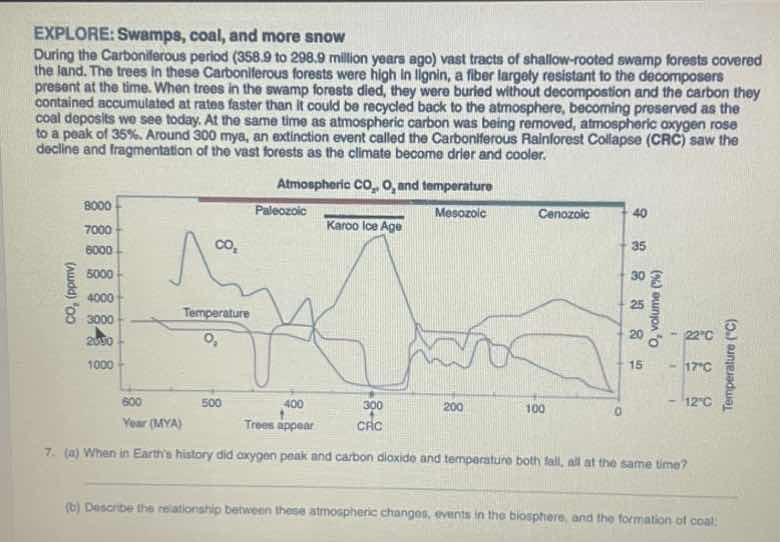
- (a) when in earth’s history did oxygen peak and carbon dioxide and temperature both fall, all at the same time?
(b) describe the relationship between these atmospheric changes, events in the biosphere, and the formation of coal:
Part (a)
To determine when oxygen peaked and carbon dioxide and temperature fell simultaneously, we analyze the graph and the provided text. The Carboniferous Rainforest Collapse (CRC) occurred around 300 million years ago (MYA). The text states that during the Carboniferous period, as trees died and were buried (forming coal), atmospheric carbon was removed (so \( \text{CO}_2 \) fell), atmospheric oxygen rose to a peak of 35%, and the climate became drier and cooler (temperature fell). The graph also aligns with this timing around 300 MYA (when CRC is marked).
- Biosphere - Atmospheric Changes Link: During the Carboniferous, shallow - rooted swamp forests (biosphere) had trees high in lignin, resistant to decomposers. When these trees died, they were buried without decomposition. This burial removed carbon from the biosphere - atmosphere cycle (since carbon in the trees was not released back as \( \text{CO}_2 \) via decomposition). As carbon was removed from the atmosphere (in the form of \( \text{CO}_2 \) being used in photosynthesis and then the carbon being buried), \( \text{CO}_2 \) levels fell. With less \( \text{CO}_2 \) (a greenhouse gas), the greenhouse effect weakened, leading to a fall in temperature (cooler, drier climate). At the same time, the oxygen produced by photosynthesis in these trees accumulated in the atmosphere (since the carbon - oxygen cycle was disrupted by the lack of decomposition, so \( \text{O}_2 \) was not consumed in large - scale decomposition of the buried organic matter), causing \( \text{O}_2 \) to peak.
- Formation of Coal: The burial of the undecomposed (due to lignin resistance) tree matter from the swamp forests over millions of years, under pressure and with geological processes, transformed this organic matter into coal. The decline of the swamp forests (due to the CRC, a biosphere event) as the climate changed also relates to the end of the large - scale coal - forming environment, but the initial accumulation of buried organic matter was the key to coal formation. The atmospheric changes (fall in \( \text{CO}_2 \), peak in \( \text{O}_2 \), fall in temperature) were driven by the biosphere's processes of photosynthesis (producing \( \text{O}_2 \), consuming \( \text{CO}_2 \)) and the non - decomposition of organic matter (trapping carbon, preventing \( \text{CO}_2 \) release, and allowing \( \text{O}_2 \) to accumulate).

Snap & solve any problem in the app
Get step-by-step solutions on Sovi AI
Photo-based solutions with guided steps
Explore more problems and detailed explanations
Around 300 million years ago (during the Carboniferous Rainforest Collapse, CRC) in Earth's history, oxygen peaked and carbon dioxide and temperature both fell at the same time.