QUESTION IMAGE
Question
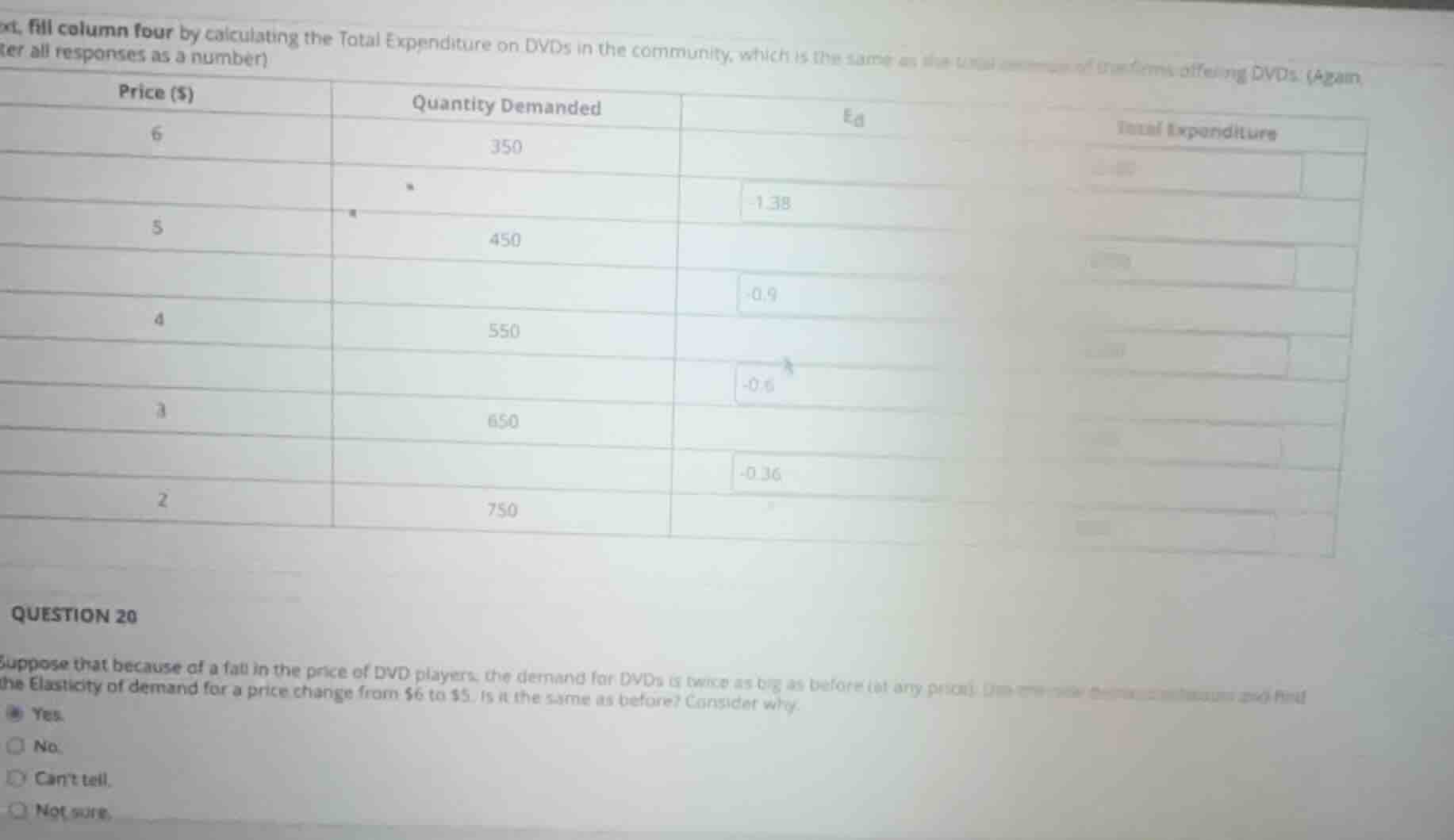
ext, fill column four by calculating the total expenditure on dvds in the community, which is the same as the total revenue of firms offering dvds. (again, enter all responses as a number)| price ($) | quantity demanded | $e_d$ | total expenditure || ---- | ---- | ---- | ---- || 6 | 350 | | || | | 1.38 | || 5 | 450 | | || | | -0.9 | || 4 | 550 | | || | | -0.6 | || 3 | 650 | | || | | -0.36 | || 2 | 750 | | |question 20suppose that because of a fall in the price of dvd players, the demand for dvds is twice as big as before (at any price). is the elasticity of demand for a price change from $6 to $5, is it the same as before? consider why.$odot$ yes.$\bigcirc$ no.$\bigcirc$ cant tell.$\bigcirc$ not sure.
Step1: Calculate total expenditure (P×Q)
$\text{Total Expenditure} = \text{Price} \times \text{Quantity Demanded}$
- For $P=\$6, Q=350$: $6 \times 350 = 2100$
- For $P=\$5, Q=450$: $5 \times 450 = 2250$
- For $P=\$4, Q=550$: $4 \times 550 = 2200$
- For $P=\$3, Q=650$: $3 \times 650 = 1950$
- For $P=\$2, Q=750$: $2 \times 750 = 1500$
Step2: Analyze elasticity (new demand)
New quantity demanded: $Q_1'=700, Q_2'=900$.
Elasticity formula:
$E_d = \frac{\frac{Q_2'-Q_1'}{(Q_2'+Q_1')/2}}{\frac{P_2-P_1}{(P_2+P_1)/2}}$
Substitute values:
$E_d = \frac{\frac{900-700}{(900+700)/2}}{\frac{5-6}{(5+6)/2}} = \frac{\frac{200}{800}}{\frac{-1}{5.5}} = \frac{0.25}{-0.1818} \approx -1.38$
This matches the original elasticity.

Snap & solve any problem in the app
Get step-by-step solutions on Sovi AI
Photo-based solutions with guided steps
Explore more problems and detailed explanations
Total Expenditure Column (from top to bottom):
2100, 2250, 2200, 1950, 1500
Question 20:
Yes.