QUESTION IMAGE
Question
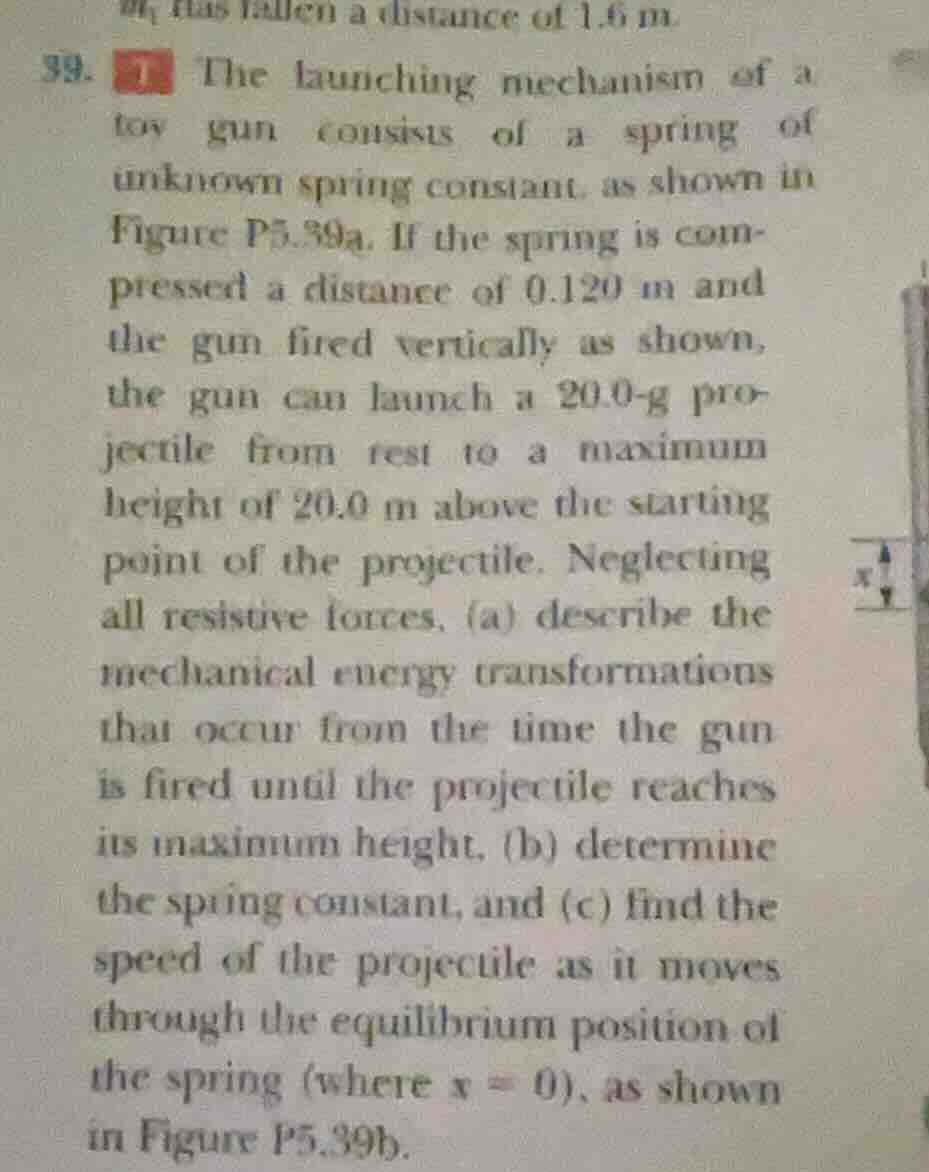
has fallen a distance of 1.6 m. 39. the launching mechanism of a toy gun consists of a spring of unknown spring constant, as shown in figure p5.39a. if the spring is compressed a distance of 0.120 m and the gun fired vertically as shown, the gun can launch a 20.0 - g projectile from rest to a maximum height of 20.0 m above the starting point of the projectile. neglecting all resistive forces, (a) describe the mechanical energy transformations that occur from the time the gun is fired until the projectile reaches its maximum height, (b) determine the spring constant, and (c) find the speed of the projectile as it moves through the equilibrium position of the spring (where x = 0), as shown in figure p5.39b.
Part (a)
When the gun is fired, the compressed spring has elastic potential energy ($U_s=\frac{1}{2}kx^2$). As the spring expands, this elastic potential energy is converted into kinetic energy ($K=\frac{1}{2}mv^2$) of the projectile. As the projectile moves upward, its kinetic energy is gradually converted into gravitational potential energy ($U_g = mgh$) due to the work done by gravity (conservative force, so mechanical energy is conserved in the absence of non - conservative forces like air resistance). At the maximum height, the projectile's velocity is zero, so all the initial elastic potential energy of the spring has been converted into gravitational potential energy of the projectile - Earth system.
Step 1: Identify the conservation of mechanical energy
We use the principle of conservation of mechanical energy. The initial mechanical energy is the elastic potential energy of the spring, $E_{i}=\frac{1}{2}kx^{2}$, where $k$ is the spring constant, $x = 0.120\ m$ is the compression of the spring. The final mechanical energy (at maximum height) is the gravitational potential energy, $E_{f}=mgh$, where $m = 20.0\ g=0.020\ kg$, $g = 9.8\ m/s^{2}$, and $h = 20.0\ m$. Since mechanical energy is conserved ($E_{i}=E_{f}$) (neglecting non - conservative forces), we have $\frac{1}{2}kx^{2}=mgh$.
Step 2: Solve for the spring constant $k$
From $\frac{1}{2}kx^{2}=mgh$, we can re - arrange the formula to solve for $k$:
\[k=\frac{2mgh}{x^{2}}\]
Substitute the values: $m = 0.020\ kg$, $g = 9.8\ m/s^{2}$, $h = 20.0\ m$, and $x = 0.120\ m$ into the formula.
First, calculate the numerator: $2mgh=2\times0.020\ kg\times9.8\ m/s^{2}\times20.0\ m = 2\times0.020\times9.8\times20.0\ kg\cdot m^{2}/s^{2}=7.84\ kg\cdot m^{2}/s^{2}$
Then, calculate the denominator: $x^{2}=(0.120\ m)^{2}=0.0144\ m^{2}$
Now, find $k$: $k=\frac{7.84}{0.0144}\ kg/s^{2}\approx544.44\ N/m$
Step 1: Identify the energy at the equilibrium position
When the projectile moves through the equilibrium position of the spring ($x = 0$), the elastic potential energy of the spring is zero. The mechanical energy at this point is the kinetic energy of the projectile, $E=\frac{1}{2}mv^{2}$, where $v$ is the speed we want to find. The initial mechanical energy is still the elastic potential energy of the spring, $\frac{1}{2}kx^{2}$, and we know from part (b) that $\frac{1}{2}kx^{2}=mgh$. Also, at the equilibrium position, the mechanical energy is $\frac{1}{2}mv^{2}$ (since elastic potential energy is zero here). So we can also use the conservation of energy between the initial state (compressed spring) and the equilibrium position state.
Alternatively, we can use the fact that at the equilibrium position, the kinetic energy of the projectile is equal to the initial elastic potential energy of the spring (because when it reaches the equilibrium position, the spring is no longer compressed, so elastic potential energy is zero, and all the initial elastic potential energy has been converted into kinetic energy). So $\frac{1}{2}mv^{2}=\frac{1}{2}kx^{2}$, and we know from part (b) that $\frac{1}{2}kx^{2}=mgh$, so $\frac{1}{2}mv^{2}=mgh$.
Step 2: Solve for the speed $v$
From $\frac{1}{2}mv^{2}=mgh$, we can cancel out the mass $m$ (since $m
eq0$) and get $\frac{1}{2}v^{2}=gh$. Then, solve for $v$:
\[v=\sqrt{2gh}\]
Substitute $g = 9.8\ m/s^{2}$ and $h = 20.0\ m$ into the formula:
\[v=\sqrt{2\times9.8\ m/s^{2}\times20.0\ m}=\sqrt{392\ m^{2}/s^{2}}\approx19.8\ m/s\]

Snap & solve any problem in the app
Get step-by-step solutions on Sovi AI
Photo-based solutions with guided steps
Explore more problems and detailed explanations
When the gun is fired, the elastic potential energy of the compressed spring is first converted into the kinetic energy of the projectile. As the projectile moves upward, this kinetic energy is then converted into gravitational potential energy of the projectile - Earth system. At maximum height, the projectile has only gravitational potential energy (and zero kinetic energy), with the total mechanical energy (sum of elastic potential energy initially, then kinetic + gravitational potential energy during motion) conserved (since non - conservative forces are neglected).