QUESTION IMAGE
Question
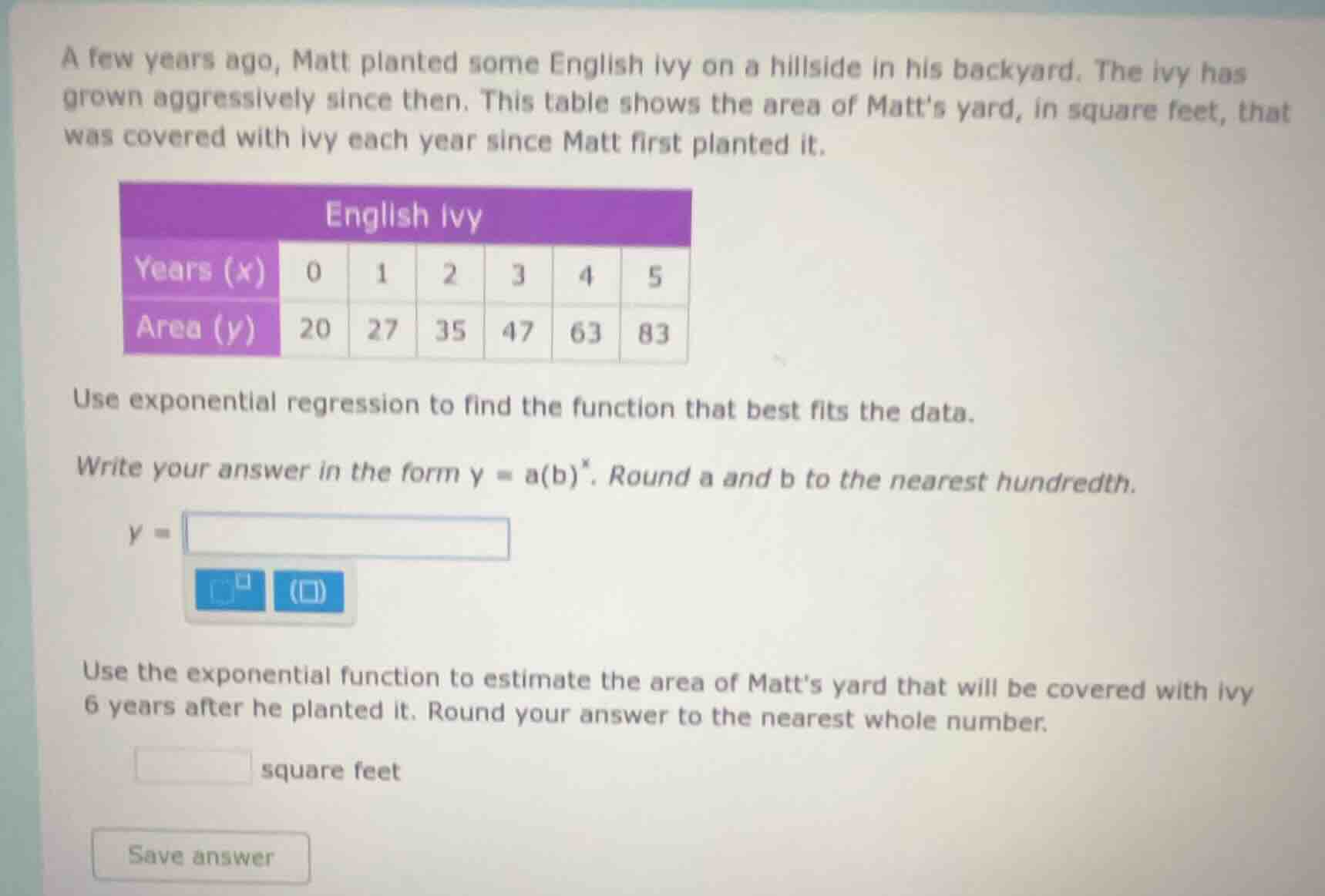
a few years ago, matt planted some english ivy on a hillside in his backyard. the ivy has grown aggressively since then. this table shows the area of matts yard, in square feet, that was covered with ivy each year since matt first planted it.
english ivy
years (x) 0 1 2 3 4 5
area (y) 20 27 35 47 63 83
use exponential regression to find the function that best fits the data.
write your answer in the form $y = a(b)^x$. round $a$ and $b$ to the nearest hundredth.
$y = $
use the exponential function to estimate the area of matts yard that will be covered with ivy 6 years after he planted it. round your answer to the nearest whole number.
square feet
save answer
Step1: Recall exponential regression form
The target form is $y = a(b)^x$, where $a$ is the initial value, $b$ is the growth factor. We use a calculator/statistical tool to compute $a$ and $b$ from the data points: $(0,20), (1,27), (2,35), (3,47), (4,63), (5,83)$.
Step2: Calculate regression parameters
Using exponential regression (converting to linear via $\ln(y) = \ln(a) + x\ln(b)$ and performing linear regression), we find:
$a \approx 20.21$, $b \approx 1.31$
So the function is $y = 20.21(1.31)^x$
Step3: Substitute $x=6$ into the function
$$y = 20.21(1.31)^6$$
First calculate $(1.31)^6 \approx 4.826$
Then compute $20.21 \times 4.826 \approx 97.53$
Step4: Round to nearest whole number
Round $97.53$ to the nearest integer, which is 98.

Snap & solve any problem in the app
Get step-by-step solutions on Sovi AI
Photo-based solutions with guided steps
Explore more problems and detailed explanations
$y = 20.21(1.31)^x$
98 square feet