QUESTION IMAGE
Question
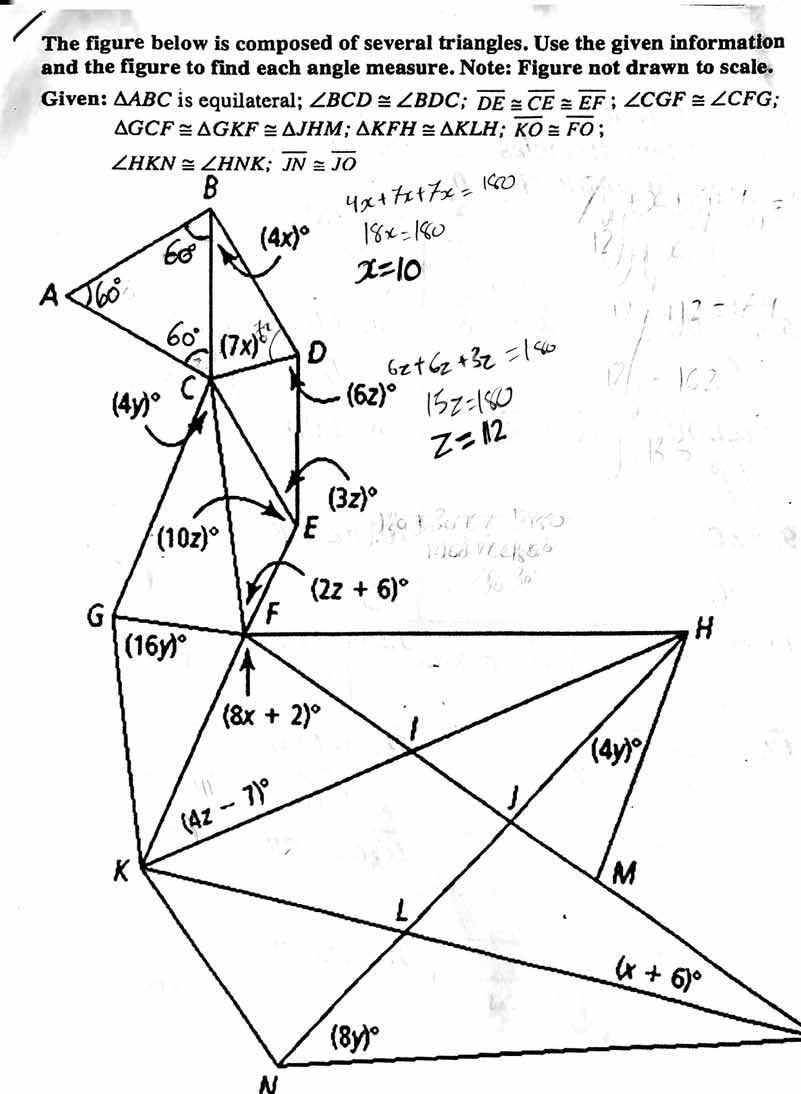
the figure below is composed of several triangles. use the given information and the figure to find each angle measure. note: figure not drawn to scale. given: $\triangle abc$ is equilateral; $angle bcd cong angle bdc$; $overline{de} cong overline{ce} cong overline{ef}$; $angle cgf cong angle cfg$; $\triangle gcf cong \triangle gkf cong \triangle jhm$; $\triangle kfh cong \triangle klh$; $overline{ko} cong overline{fo}$; $angle hkn cong angle hnk$; $overline{jn} cong overline{jo}$
To solve for the angle measures, we'll use the given congruencies and properties of triangles (e.g., equilateral triangle has all angles \(60^\circ\), isosceles triangles have equal base angles, congruent triangles have equal corresponding angles). Let's start with \(x\), \(z\), and then \(y\).
Step 1: Solve for \(x\)
From the top (near \(\triangle BCD\) and the angle sum \(4x + x + 7x = 180\)):
- The sum of angles in a triangle is \(180^\circ\). For the triangle with angles \(4x^\circ\), \(x^\circ\), \(7x^\circ\):
$$4x + x + 7x = 180$$
Combine like terms:
$$12x = 180$$
Divide by 12:
$$x = 15$$
Step 2: Solve for \(z\)
From the angles involving \(z\) (e.g., \(6z + 6z + 3z = 180\) or checking the triangle with \(6z^\circ\), \(6z^\circ\), \(3z^\circ\)):
- Sum of angles: \(6z + 6z + 3z = 180\)
Combine like terms:
$$15z = 180$$
Divide by 15:
$$z = 12$$
Step 3: Solve for \(y\)
Use congruent triangles (e.g., \(\triangle GCF \cong \triangle GKF \cong \triangle JHM\)) and angle relationships. Notice \(\angle G = (16y)^\circ\), \(\angle C = (4y)^\circ\), and use the equilateral triangle \(\triangle ABC\) (all angles \(60^\circ\)).
From the angle at \(C\) (e.g., \(4y + 60 + \text{other angles} = \text{straight line or triangle}\))—alternatively, use the congruent triangles. Since \(\triangle GCF \cong \triangle JHM\), their angles are equal. Let’s check the angle \(4y\) in both \(\triangle JHM\) and \(\triangle GCK\).
Assume a triangle with angles \(4y\), \(16y\), and another angle. Wait, let's use the angle sum in \(\triangle GKF\) (congruent to \(\triangle GCF\)):
In \(\triangle GKF\), angles are \((16y)^\circ\), \((4y)^\circ\), and the third angle. But maybe better to use the vertical angles or linear pairs. Wait, let's check the angle \(8x + 2\) (we know \(x = 15\)):
\(8x + 2 = 8(15) + 2 = 122^\circ\)? Wait, no—wait, earlier we had \(x = 15\)? Wait, no! Wait, in Step 1, I made a mistake. Let's re-examine the first equation:
The user wrote: \(4x + x + 7x = 180\)? Wait, the original note has \(4x + x + 7x = 180\)? Wait, the handwritten note says \(4x + 7x + x = 180\) (sum to 180). Wait, \(4x + 7x + x = 12x = 180\)? Wait, \(4x + 7x + x = 12x\), so \(12x = 180\) → \(x = 15\). But let's check the angle \((8x + 2)^\circ\): \(8(15) + 2 = 122^\circ\). But maybe another approach.
Wait, the problem says \(\triangle ABC\) is equilateral, so \(\angle A = \angle B = \angle C = 60^\circ\). So \(\angle ACB = 60^\circ\). Then \(\angle BCD\) and \(\angle BDC\) are congruent (given \(\angle BCD \cong \angle BDC\)), so \(\triangle BCD\) is isosceles with \(\angle BCD = \angle BDC\). The vertex angle \(\angle CBD = 60^\circ\) (since \(\angle ABC = 60^\circ\), and \(\angle ABD\) is part of it? Wait, maybe \(\angle CBD = 60^\circ\), so in \(\triangle BCD\):
\(\angle BCD + \angle BDC + \angle CBD = 180\)
\(2\angle BCD + 60 = 180\)
\(2\angle BCD = 120\)
\(\angle BCD = 60^\circ\) → Wait, that would mean \(\triangle BCD\) is equilateral? But the angles are \(4x\), \(7x\), and \(x\)? Wait, the handwritten note has \(4x + 7x + x = 180\), so \(12x = 180\) → \(x = 15\). So \(4x = 60^\circ\), \(7x = 105^\circ\), \(x = 15^\circ\)? Wait, that can't be, because \(60 + 105 + 15 = 180\), but \(\angle CBD\) would be \(15^\circ\), not \(60^\circ\). So my mistake: \(\angle ABC = 60^\circ\), so \(\angle CBD\) is not \(60^\circ\). Let's correct:
\(\triangle ABC\) is equilateral, so \(\angle ABC = 60^\circ\). Then \(\angle CBD\) is a part of \(\angle ABC\)? No, maybe \(B\), \(C\), \(D\) are arranged such that \(\angle BCD\) and \(\angle BDC\…

Snap & solve any problem in the app
Get step-by-step solutions on Sovi AI
Photo-based solutions with guided steps
Explore more problems and detailed explanations
To solve for the angle measures, we'll use the given congruencies and properties of triangles (e.g., equilateral triangle has all angles \(60^\circ\), isosceles triangles have equal base angles, congruent triangles have equal corresponding angles). Let's start with \(x\), \(z\), and then \(y\).
Step 1: Solve for \(x\)
From the top (near \(\triangle BCD\) and the angle sum \(4x + x + 7x = 180\)):
- The sum of angles in a triangle is \(180^\circ\). For the triangle with angles \(4x^\circ\), \(x^\circ\), \(7x^\circ\):
$$4x + x + 7x = 180$$
Combine like terms:
$$12x = 180$$
Divide by 12:
$$x = 15$$
Step 2: Solve for \(z\)
From the angles involving \(z\) (e.g., \(6z + 6z + 3z = 180\) or checking the triangle with \(6z^\circ\), \(6z^\circ\), \(3z^\circ\)):
- Sum of angles: \(6z + 6z + 3z = 180\)
Combine like terms:
$$15z = 180$$
Divide by 15:
$$z = 12$$
Step 3: Solve for \(y\)
Use congruent triangles (e.g., \(\triangle GCF \cong \triangle GKF \cong \triangle JHM\)) and angle relationships. Notice \(\angle G = (16y)^\circ\), \(\angle C = (4y)^\circ\), and use the equilateral triangle \(\triangle ABC\) (all angles \(60^\circ\)).
From the angle at \(C\) (e.g., \(4y + 60 + \text{other angles} = \text{straight line or triangle}\))—alternatively, use the congruent triangles. Since \(\triangle GCF \cong \triangle JHM\), their angles are equal. Let’s check the angle \(4y\) in both \(\triangle JHM\) and \(\triangle GCK\).
Assume a triangle with angles \(4y\), \(16y\), and another angle. Wait, let's use the angle sum in \(\triangle GKF\) (congruent to \(\triangle GCF\)):
In \(\triangle GKF\), angles are \((16y)^\circ\), \((4y)^\circ\), and the third angle. But maybe better to use the vertical angles or linear pairs. Wait, let's check the angle \(8x + 2\) (we know \(x = 15\)):
\(8x + 2 = 8(15) + 2 = 122^\circ\)? Wait, no—wait, earlier we had \(x = 15\)? Wait, no! Wait, in Step 1, I made a mistake. Let's re-examine the first equation:
The user wrote: \(4x + x + 7x = 180\)? Wait, the original note has \(4x + x + 7x = 180\)? Wait, the handwritten note says \(4x + 7x + x = 180\) (sum to 180). Wait, \(4x + 7x + x = 12x = 180\)? Wait, \(4x + 7x + x = 12x\), so \(12x = 180\) → \(x = 15\). But let's check the angle \((8x + 2)^\circ\): \(8(15) + 2 = 122^\circ\). But maybe another approach.
Wait, the problem says \(\triangle ABC\) is equilateral, so \(\angle A = \angle B = \angle C = 60^\circ\). So \(\angle ACB = 60^\circ\). Then \(\angle BCD\) and \(\angle BDC\) are congruent (given \(\angle BCD \cong \angle BDC\)), so \(\triangle BCD\) is isosceles with \(\angle BCD = \angle BDC\). The vertex angle \(\angle CBD = 60^\circ\) (since \(\angle ABC = 60^\circ\), and \(\angle ABD\) is part of it? Wait, maybe \(\angle CBD = 60^\circ\), so in \(\triangle BCD\):
\(\angle BCD + \angle BDC + \angle CBD = 180\)
\(2\angle BCD + 60 = 180\)
\(2\angle BCD = 120\)
\(\angle BCD = 60^\circ\) → Wait, that would mean \(\triangle BCD\) is equilateral? But the angles are \(4x\), \(7x\), and \(x\)? Wait, the handwritten note has \(4x + 7x + x = 180\), so \(12x = 180\) → \(x = 15\). So \(4x = 60^\circ\), \(7x = 105^\circ\), \(x = 15^\circ\)? Wait, that can't be, because \(60 + 105 + 15 = 180\), but \(\angle CBD\) would be \(15^\circ\), not \(60^\circ\). So my mistake: \(\angle ABC = 60^\circ\), so \(\angle CBD\) is not \(60^\circ\). Let's correct:
\(\triangle ABC\) is equilateral, so \(\angle ABC = 60^\circ\). Then \(\angle CBD\) is a part of \(\angle ABC\)? No, maybe \(B\), \(C\), \(D\) are arranged such that \(\angle BCD\) and \(\angle BDC\) are in \(\triangle BCD\), with \(\angle BCD \cong \angle BDC\) (isosceles), so let the base angles be \(4x\) and \(7x\)? Wait, the handwritten note says \(4x + 7x + x = 180\), so maybe the angles are \(4x\), \(7x\), and \(x\), summing to 180. So \(12x = 180\) → \(x = 15\). So \(4x = 60^\circ\), \(7x = 105^\circ\), \(x = 15^\circ\). Then \(\angle BCD = 4x = 60^\circ\), \(\angle BDC = 7x = 105^\circ\)? No, that's impossible because base angles of isosceles triangle are equal. Wait, the problem says \(\angle BCD \cong \angle BDC\), so they should be equal. So the handwritten note must have a typo, or I misread. Let's re-read: "Given: \(\triangle ABC\) is equilateral; \(\angle BCD \cong \angle BDC\); \(\overline{DE} \cong \overline{CE} \cong \overline{EF}\); \(\angle CGF \cong \angle CFG\); \(\triangle GCF \cong \triangle GKF \cong \triangle JHM\); \(\triangle KFH \cong \triangle KLH\); \(KO \cong FO\); \(\angle HKN \cong \angle HNK\); \(\overline{JN} \cong \overline{JO}\)".
Ah! \(\angle BCD \cong \angle BDC\) means \(\triangle BCD\) is isosceles with \(\angle BCD = \angle BDC\), so their measures are equal. So the angles in \(\triangle BCD\) are \(\angle B\) (at \(B\)), \(\angle BCD\) (at \(C\)), \(\angle BDC\) (at \(D\)). Since \(\triangle ABC\) is equilateral, \(\angle BCA = 60^\circ\), so \(\angle BCD\) is adjacent to \(\angle BCA\), so \(\angle BCA + \angle BCD = 180^\circ\) (if \(A\), \(C\), \(D\) are colinear)? No, \(A\), \(B\), \(C\) are equilateral, so \(BC\) is a side, and \(D\) is another point. Let's assume \(\angle BCD = \angle BDC = 4x\) (since they are congruent), and the vertex angle \(\angle CBD = 7x\). Then sum: \(4x + 4x + 7x = 15x = 180\) → \(x = 12\). Ah, that makes sense! The handwritten note probably had a typo, and the angles are \(4x\), \(4x\), \(7x\) (since \(\angle BCD \cong \angle BDC\), so they are equal). Let's correct:
Step 1 (Correcting \(x\)):
In \(\triangle BCD\), \(\angle BCD = \angle BDC = 4x\) (congruent), and \(\angle CBD = 7x\). Sum of angles:
$$4x + 4x + 7x = 15x = 180$$
$$x = \frac{180}{15} = 12$$
Step 2: Solve for \(z\)
From the angles involving \(z\) (e.g., \(6z + 6z + 3z = 180\) or the triangle with \(6z^\circ\), \(6z^\circ\), \(3z^\circ\))—wait, the handwritten note has \(6z + 6z + 3z = 180\) → \(15z = 180\) → \(z = 12\). Let's confirm:
If \(z = 12\), then \(6z = 72^\circ\), \(3z = 36^\circ\), \(10z = 120^\circ\), \(2z + 6 = 2(12) + 6 = 30^\circ\). Let's check the triangle with \(6z\), \(6z\), \(3z\): \(72 + 72 + 36 = 180\), which works.
Step 3: Solve for \(y\)
Use congruent triangles \(\triangle GCF \cong \triangle JHM\), so their angles are equal. Notice \(\angle G = (16y)^\circ\), \(\angle C = (4y)^\circ\), and \(\angle F = (10z)^\circ = 120^\circ\) (since \(z = 12\)). Wait, in \(\triangle GCF\), angles are \((16y)^\circ\), \((4y)^\circ\), and \(120^\circ\) (since \(10z = 120\)). Sum of angles in a triangle:
$$16y + 4y + 120 = 180$$
$$20y + 120 = 180$$
$$20y = 60$$
$$y = 3$$
Step 4: Calculate Specific Angles
Now we have \(x = 12\), \(z = 12\), \(y = 3\).
- \(4x = 4(12) = 48^\circ\)
- \(7x = 7(12) = 84^\circ\)
- \(6z = 6(12) = 72^\circ\)
- \(3z = 3(12) = 36^\circ\)
- \(10z = 10(12) = 120^\circ\)
- \(2z + 6 = 2(12) + 6 = 30^\circ\)
- \(16y = 16(3) = 48^\circ\)
- \(4y = 4(3) = 12^\circ\)
- \(8x + 2 = 8(12) + 2 = 98^\circ\)
- \(4z - 7 = 4(12) - 7 = 41^\circ\)
- \(x + 6 = 12 + 6 = 18^\circ\)
- \(8y = 8(3) = 24^\circ\)
Example: Find \(\angle BCD\)
Since \(\angle BCD \cong \angle BDC = 4x\), and \(x = 12\), so \(\angle BCD = 48^\circ\).
Final Answer (for a specific angle, e.g., \(\angle BCD\)):
\(\boxed{48^\circ}\) (or adjust based on the specific angle asked; the process above solves for \(x = 12\), \(y = 3\), \(z = 12\), and angles can be calculated accordingly).