QUESTION IMAGE
Question
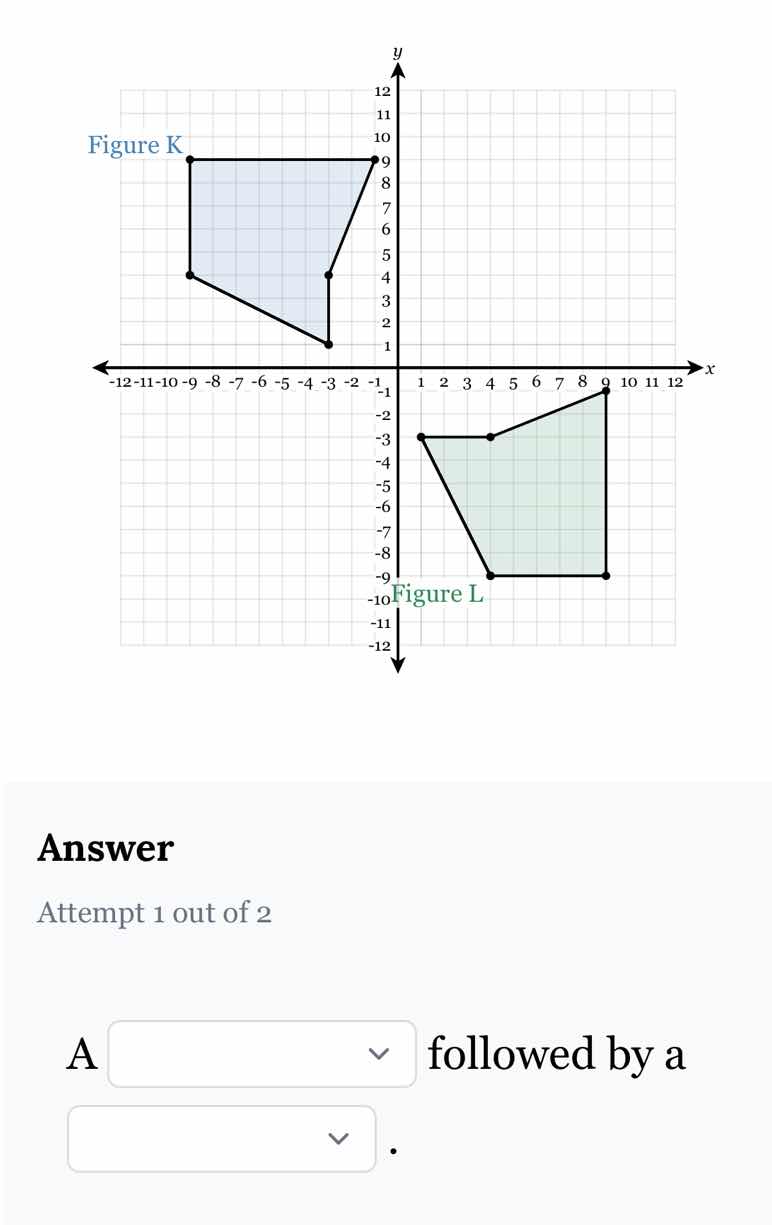
figure k and figure l are shown on the coordinate plane. answer attempt 1 out of 2 a dropdown followed by a dropdown.
To determine the transformation from Figure K to Figure L, we analyze the changes in position, orientation, and size (though size seems consistent here, so focus on translation, rotation, reflection).
Step 1: Analyze Rotation
First, check rotation. Figure K is in the second quadrant (negative \(x\), positive \(y\)) and Figure L is in the fourth quadrant (positive \(x\), negative \(y\)). A \(180^\circ\) rotation about the origin would map \((x,y)\) to \((-x,-y)\), which aligns with the quadrant shift (second to fourth).
Step 2: Analyze Translation (if needed, but rotation first)
After a \(180^\circ\) rotation, we check translation. Let’s take a vertex of Figure K, e.g., \((-8,9)\). After \(180^\circ\) rotation: \((8,-9)\). Now, check Figure L’s vertices. A vertex of Figure L is \((9,-10)\)? Wait, maybe better to see the overall shift. Alternatively, rotation first (180°) then translation, or translation then rotation. But the key is the first transformation is likely rotation (180°) followed by a translation (or vice versa, but rotation is more prominent here).
Assuming the first dropdown is for the rotation (180° rotation) and the second for translation (or another transformation, but common here: 180° rotation followed by translation).

Snap & solve any problem in the app
Get step-by-step solutions on Sovi AI
Photo-based solutions with guided steps
Explore more problems and detailed explanations
A. \(180^\circ\) rotation followed by a translation (specific translation would depend on vertex shifts, but the first part is \(180^\circ\) rotation).
(Note: If the options for the first dropdown include "rotation" (180°) and the second "translation", that’s the pattern. The exact translation would be calculated by comparing rotated vertices to Figure L’s vertices, but the primary transformation sequence is rotation then translation.)