QUESTION IMAGE
Question
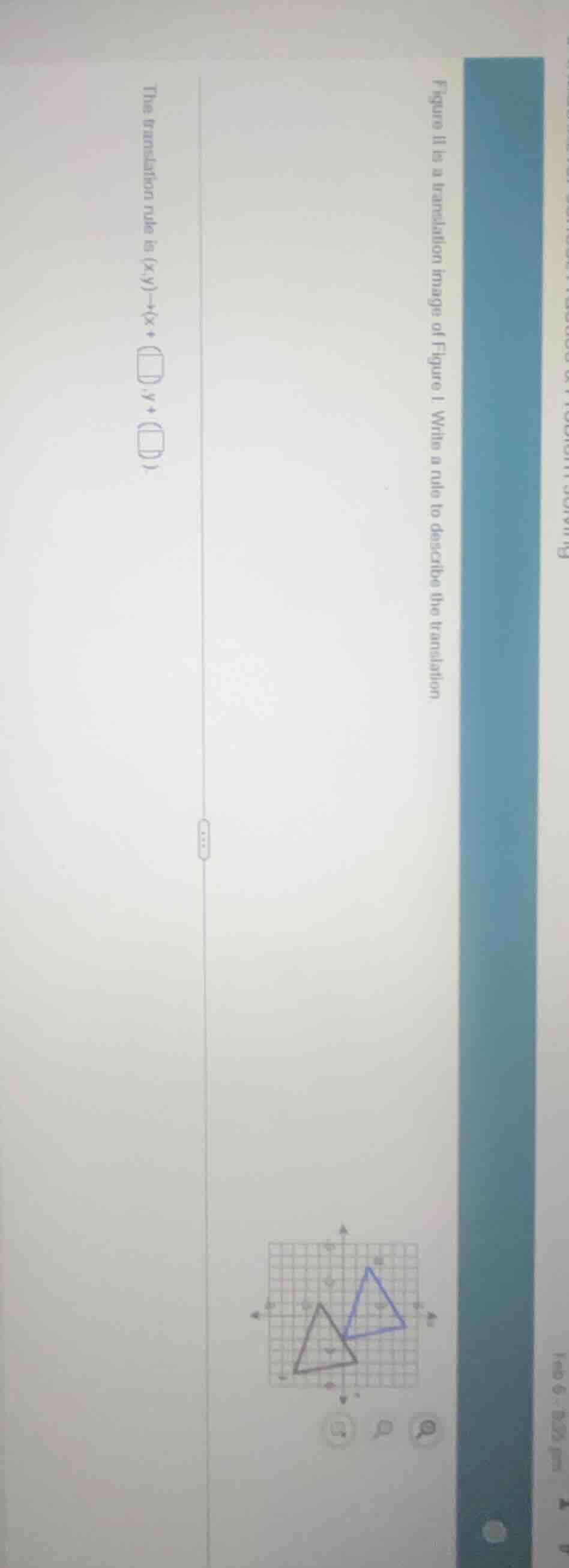
figure ii is a translation image of figure i. write a rule to describe the translation. the translation rule is ((x,y)\to(x+square,y+square))
Step1: Identify corresponding vertices
Let's take a vertex of Figure I (black triangle) and its image in Figure II (blue triangle). Suppose a vertex of Figure I is \((x_1, y_1)\) and the corresponding vertex of Figure II is \((x_2, y_2)\).
Step2: Calculate horizontal translation
From the grid, we can see that the horizontal (x - direction) shift: Let's assume a vertex of Figure I is at \((-1, -2)\) and the corresponding vertex of Figure II is at \((2, 1)\). The change in x - coordinate: \(x_2 - x_1=2-(-1) = 3\). So the horizontal translation is \(+ 3\).
Step3: Calculate vertical translation
The change in y - coordinate: \(y_2 - y_1=1-(-2)=3\). So the vertical translation is \(+ 3\). So the translation rule is \((x,y)\to(x + 3,y + 3)\) (the values may vary slightly depending on the chosen vertices, but generally, by observing the grid, the horizontal and vertical shifts are both 3 units).

Snap & solve any problem in the app
Get step-by-step solutions on Sovi AI
Photo-based solutions with guided steps
Explore more problems and detailed explanations
The translation rule is \((x,y)\to(x + 3,y + 3)\) (the first box is 3 and the second box is 3).