QUESTION IMAGE
Question
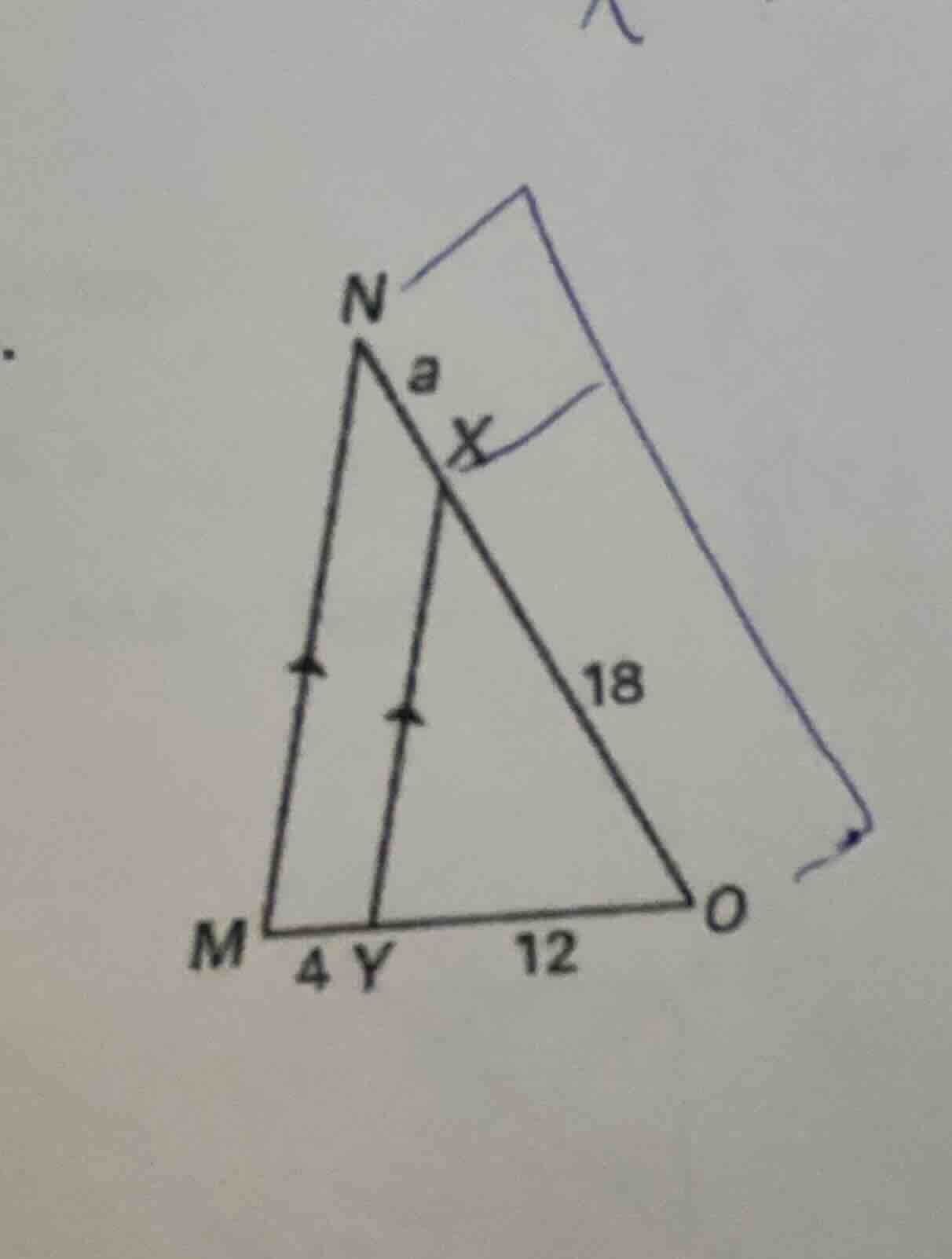
in the figure, there are line segments and triangles. the length of my is 4, yo is 12, and the length of a side related to the triangle is 18. we need to find the value of x (or solve the related problem based on the figure).
Step1: Identify Similar Triangles
The lines \( MN \) and the other parallel line (implied by the arrows) create similar triangles. So, the ratio of corresponding sides should be equal. The ratio of \( MY \) to \( MO \) and \( NY \) - related side to \( NO \) (but here we use the segments on the base and the side with length 18). Wait, actually, the base segments: \( MY = 4 \), \( YO = 12 \), so \( MO = 4 + 12 = 16 \)? Wait, no, the diagram shows \( M \) to \( Y \) is 4, \( Y \) to \( O \) is 12. And the side with length 18 is from the intersection point to \( O \), and \( x \) is from \( N \) to the intersection? Wait, maybe the triangles are similar by the Basic Proportionality Theorem (Thales' theorem). So, the line parallel to \( MN \) (the one with the arrow) divides the sides proportionally. So, the ratio of \( MY \) to \( YO \) should be equal to the ratio of the segments on the other side? Wait, no, maybe the ratio of \( MY \) to \( MO \) (wait, \( MO = MY + YO = 4 + 12 = 16 \)) and the ratio of the segment above to the total length 18? Wait, no, let's re - examine.
Wait, the two triangles: one with base \( MY = 4 \) and the other with base \( MO = 4 + 12 = 16 \)? No, maybe the segments on the base are \( MY = 4 \) and \( YO = 12 \), and on the other side, the segment from the intersection to \( O \) is 18, and \( x \) is from \( N \) to the intersection. So, by the Basic Proportionality Theorem, \( \frac{MY}{YO}=\frac{x}{18} \)? Wait, no, that doesn't seem right. Wait, maybe the ratio of \( MY \) to \( MO \) (where \( MO = MY + YO = 4+12 = 16 \)) and the ratio of \( x \) to \( x + 18 \)? No, that's not correct. Wait, maybe the lines are parallel, so the triangles are similar. So, the ratio of corresponding sides is equal. So, the triangle with base \( MY = 4 \) and the triangle with base \( MO=4 + 12 = 16 \) are similar? No, the base of the smaller triangle is \( MY = 4 \), and the base of the larger triangle (including \( YO \)) is \( MO = 16 \)? Wait, no, the length from \( M \) to \( O \) is \( 4+12 = 16 \), and the length from the intersection point to \( O \) is 18, and \( x \) is from \( N \) to the intersection. So, the ratio of similarity is \( \frac{MY}{MO}=\frac{4}{16}=\frac{1}{4} \)? No, that can't be. Wait, maybe the ratio is \( \frac{MY}{YO}=\frac{4}{12}=\frac{1}{3} \), and then \( \frac{x}{18}=\frac{1}{3} \)? No, that would give \( x = 6 \), but that doesn't seem right. Wait, maybe I got the ratio reversed.
Wait, let's use the correct proportionality. If a line is drawn parallel to one side of a triangle, intersecting the other two sides, then it divides those sides proportionally. So, in triangle \( NMO \), if the line (with the arrow) is parallel to \( NM \), then it divides \( NO \) and \( MO \) proportionally. So, \( \frac{MY}{YO}=\frac{NX}{XO} \), where \( NX=x \) and \( XO = 18 \). Wait, \( MY = 4 \), \( YO = 12 \), so \( \frac{4}{12}=\frac{x}{18} \). Simplify \( \frac{4}{12}=\frac{1}{3} \), so \( \frac{1}{3}=\frac{x}{18} \), then \( x=\frac{18}{3}=6 \)? No, that seems too small. Wait, maybe the ratio is \( \frac{MY}{MO}=\frac{x}{x + 18} \), where \( MO=4 + 12 = 16 \). So, \( \frac{4}{16}=\frac{x}{x + 18} \). Cross - multiply: \( 4(x + 18)=16x \), \( 4x+72 = 16x \), \( 12x = 72 \), \( x = 6 \). Wait, but that's the same as before. But maybe I misidentified the segments.
Wait, another approach: the two triangles are similar. The ratio of the bases: the base of the smaller triangle is \( MY = 4 \), and the base of the larger triangle (from \( M \) to \( O \)) is \( 4+12 = 16 \). The ratio of similarity…

Snap & solve any problem in the app
Get step-by-step solutions on Sovi AI
Photo-based solutions with guided steps
Explore more problems and detailed explanations
\( \boldsymbol{6} \)